
Lieferung heute & morgen

Qualitätsgarantie

Willkommens-Angebote freischalten: KOSTENLOSE Lieferung | Bis zu 80 % RABATT | Kostenlose 30-Tage-JoyPlus-Testphase
App herunterladen
As a Joybuy Product Recommendation Officer, my mission is to provide you with clear, objective information. Especially with products like no-drill pleated blinds, it's crucial to separate fact from marketing hype. Many renters and homeowners are looking for a simple solution for sun and privacy protection, but the market is flooded with products that overpromise and underdeliver. This guide will help you navigate the common pitfalls.
Before you make a decision, you should be aware of the three most common issues that lead to frustration and unnecessary expense:
To avoid these problems, focus on three essential features. These will determine the longevity and functionality of your new privacy screen.
Drill-free installation is the main advantage, but the systems differ.
A good clamp-on pleated blind offers adjustable brackets suitable for a range of frame thicknesses (e.g., 10–23 mm).
The fabric determines how much light enters the room and how much privacy you enjoy.
A custom-made pleated blind is not always necessary if you measure correctly. The most common source of error is determining the wrong order width.
Based on the criteria above, we have identified a few products that represent a considered choice for specific requirement profiles.
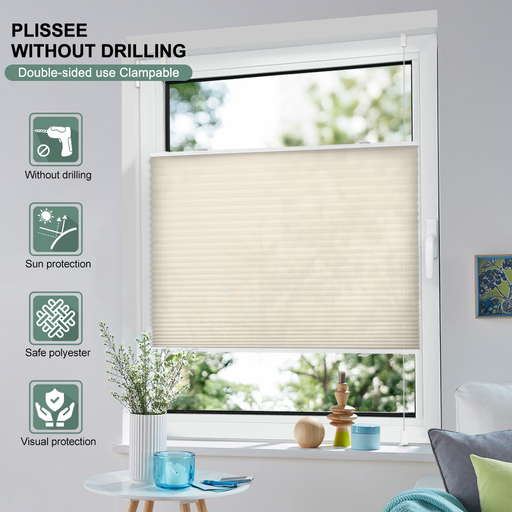
Why it's a good fit: Ideal for standard windows in rental properties. It offers a straightforward and functional solution for privacy and sun protection without drilling into the window frames. The neutral colour complements many interior design styles.
The product uses a proven clamp-fit system designed for common window frame thicknesses, thus addressing the problem of unstable brackets.
Installation is tool-free and can be removed without leaving any residue. The opaque but light-filtering polyester fabric is easy to maintain.
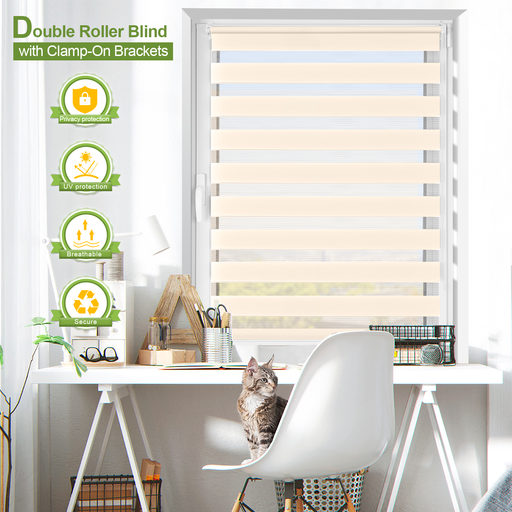
Why it's a good fit: For users who want more than just a simple privacy screen. The double roller blind combines transparent and opaque fabric panels, allowing for infinitely variable light control—from full transparency to complete privacy.
Instead of a single, low-quality fabric, this model offers two layers of high-grade polyester. This ensures dimensional stability and long-lasting functionality.
Flexible light control thanks to two independently adjustable fabric panels. Installation is also drill-free via clamp brackets.
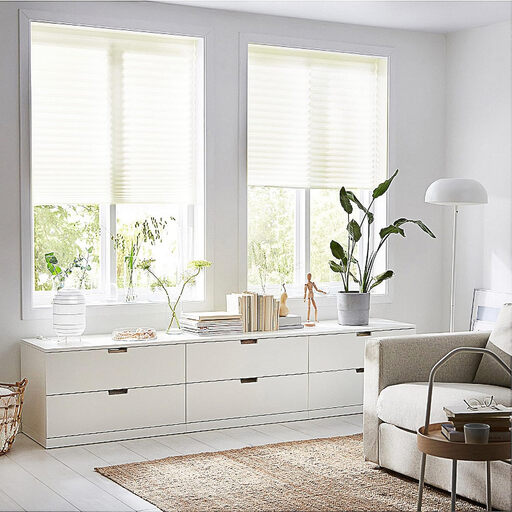
Why it's a good fit: With its dimensions of 80x200 cm, this pleated blind is a great option for floor-to-ceiling windows or a standard balcony door. It provides continuous, seamless coverage for large glass surfaces where smaller models would be impractical.
It solves the problem of ill-fitting sizes by offering a common dimension for doors and large windows. The manufacturer's clear measuring instructions (glass width + 4 cm) help to avoid light gaps.
The blind is tensioned and can be operated from both the top and bottom, allowing for flexible control of light and privacy on large surfaces. It can be installed using either clamp or adhesive brackets.
We have compiled a complete, up-to-date list of products that fully meet these strict selection criteria.
A high-quality clamp-fit pleated blind system is very reliable. Its stability depends on two factors: the quality of the clamp brackets and the correctness of the installation. If the brackets are made of robust material and are suitable for the thickness of your window frame, they provide a firm and durable hold, even with daily use and on tilted windows.
Yes, that is one of the main advantages. Both clamp and adhesive systems are designed to be removed without a trace. Clamp brackets leave no marks as they are simply clipped onto the frame. With adhesive brackets, depending on the adhesive and the surface, it may be necessary to carefully remove any residue with a suitable agent, but they do not cause permanent damage like drill holes.
The main difference lies in the construction. A no-drill roller blind consists of a smooth panel of fabric that is rolled up and down on a tube. A pleated blind (or folding blind), on the other hand, consists of a pre-folded fabric that is compressed and expanded like an accordion. Pleated blinds are often more flexible as they are frequently adjustable from both the top and bottom (tensioned), whereas roller blinds are usually operated only from top to bottom.