
Lieferung heute & morgen

Qualitätsgarantie

Willkommens-Angebote freischalten: KOSTENLOSE Lieferung | Bis zu 80 % RABATT | Kostenlose 30-Tage-JoyPlus-Testphase
App herunterladen
A rollable filing cabinet can free up space in your home office, small office or workshop without being permanently fixed to one spot. However, mobile filing cabinets differ significantly when it comes to storage capacity, load-bearing ability, castors and security features. An attractive finish alone tells you little about whether the cabinet will be practical in daily use.
Three typical buying misconceptions often lead to poor decisions:
Before buying, consider the floor space, desk height and how far the doors or drawers extend. For a home office, a compact mobile filing cabinet around 40 cm wide is often easier to fit under or beside a desk. With taller models, check that open drawers won’t block walkways or other furniture.
A filing cabinet with drawers is ideal for documents, stationery and smaller office supplies. Doors and open shelves, on the other hand, are more practical if you need to store books, equipment, tools or printer accessories. A printer cabinet on castors also needs a sufficiently large and sturdy top surface.
Steel constructions can offer different stability with frequent opening and closing compared to furniture made from wood-based materials. What really matters are the manufacturer’s stated figures for drawer load capacity, total load and material thickness. Don’t confuse these: a load capacity of 15 kg per drawer is not the same as a maximum total load of 50 kg.
For furniture made from MDF or chipboard, coated surfaces are easy to clean and suitable for many office environments. However, you should avoid water, cleaning agents and persistently high humidity unless the manufacturer specifies otherwise. For workshops, also check whether the surface can withstand dust, oil or frequent cleaning.
A mobile roll container should move easily and stand securely where you place it. At least two lockable castors are advisable. With heavy equipment or fully loaded drawers, the weight distribution also needs to be right.
Pay attention to the following points:
The following models cover various use cases: from a compact drawer cabinet for the office to a larger office cabinet for equipment and materials.
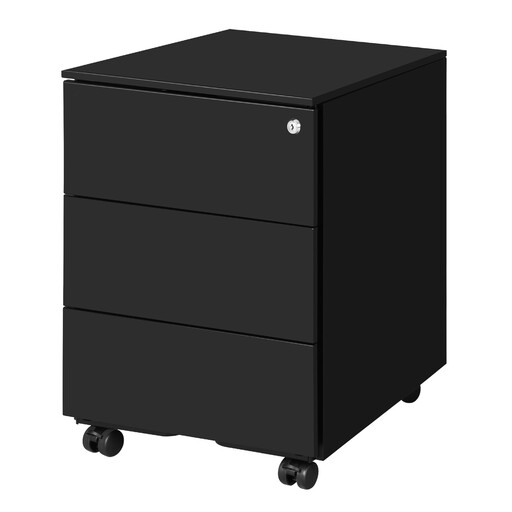
Why this product fits the profile: Three drawers, a steel frame and compact dimensions of roughly 45 × 39 × 55 cm make it suitable for documents and office supplies in a home office or at your desk.
The product specifications state a load capacity of up to 15 kg per drawer, plus four castors, two of which have brakes. The cabinet is delivered pre-assembled; only the castors need to be fitted.
Three drawers, full-extension runners, lock and steel construction; weight according to product specifications: 15.8 kg.
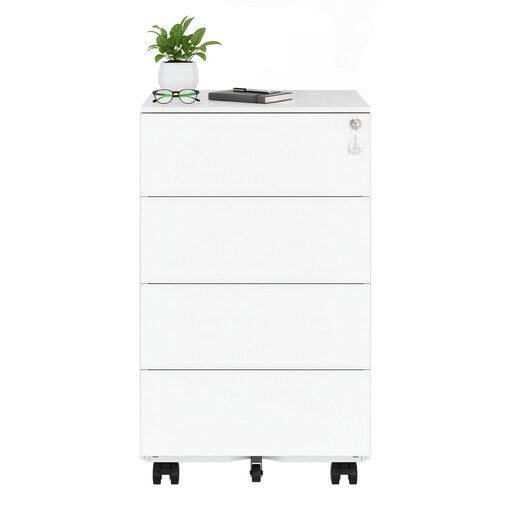
Why this product fits the profile: Four drawers and an additional shelf provide clearer separation between documents and frequently used small items. This model is designed for the office and home office.
The specifications mention full-extension runners, a lock and a steel construction. The pre-assembled furniture also reduces the risk of assembly errors.
Four drawers, castors for mobility and a stated load capacity of up to 15 kg per drawer; dimensions: 45 × 39 × 69.3 cm.
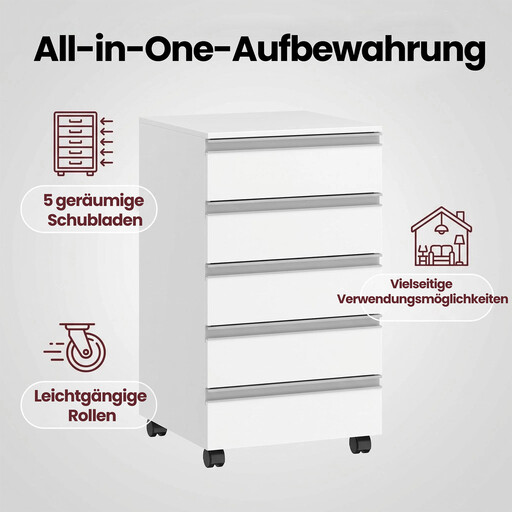
Why this product fits the profile: Five deeper drawers and a sturdy top surface appeal to users in studios, workshops or offices who frequently need to organise drawings, tools, samples and consumables.
The product description states a total load capacity of up to 50 kg, reinforced runners and two lockable front castors. The castors are designed for frequent repositioning.
Five drawers, a top surface for smaller devices and dimensions of 40.5 × 40.5 × 65.5 cm; materials: chipboard and steel.
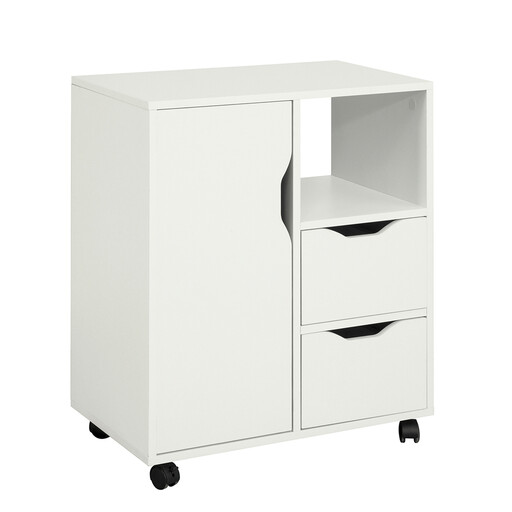
Why this product fits the profile: This printer cabinet on castors combines an open shelf, two drawers and a cupboard compartment. The dimensions of 60 × 35 × 70 cm fit under or beside many desks.
The stated maximum total load of 50 kg and the reinforced panels provide a concrete reference point for printers and office equipment. Use must remain within this manufacturer specification.
Two drawers, one cupboard compartment, two open shelves and castors; materials: PB(E1), MDF and wood-based materials.
We’ve put together a complete, regularly updated list of products that fully meet these strict selection criteria and the safety regulations in force in the EU.
Place it on a level, load-bearing surface and engage the castor brakes. Heavy documents should go in the lower drawers if possible. For tall models, follow the anti-tip and wall-fixing instructions in the assembly manual.
The lifespan depends on the material, load, floor surface and frequency of use. Overloaded drawers, pulling at an angle and blocked castors can wear out fittings more quickly. Even weight distribution, regular cleaning of the castors and following the manufacturer’s instructions will help ensure long-lasting use.
A roll container normally doesn’t need electricity. Running costs may only arise from replacement castors, fittings or cleaning products. For a cabinet for a printer and equipment, you also need to consider the power consumption of the device placed on it. The purchase price is mainly determined by the material, number of drawers, lock, castors and the assembly effort required.