
Lieferung heute & morgen

Qualitätsgarantie

Willkommens-Angebote freischalten: KOSTENLOSE Lieferung | Bis zu 80 % RABATT | Kostenlose 30-Tage-JoyPlus-Testphase
App herunterladen
A good socket set, often called a ratchet set, is the cornerstone for countless repair and maintenance jobs on your car, motorcycle, and around the house. But the market is flooded with sets that promise a lot at first glance, only to quickly reach their limits in practice. The wrong material, mismatched sizes, or a flimsy case can lead to frustration and unnecessary expense.
As a Joybuy Product Recommendation Officer, I see every day which features truly matter. This guide will help you navigate the common pitfalls and find a socket set that reliably gets the job done.
Many buyers focus on the sheer number of pieces or on supposed bargains. This is precisely where the most expensive mistakes are made.
To avoid these mistakes, you should check three core parameters before buying. These determine the longevity and functionality of your tool set.
The material is the heart of any tool. Look for the CR-V Steel (Chrome Vanadium Steel) designation. This alloy offers excellent hardness and toughness, making it resistant to deformation and breakage.
Tools made from simple carbon steel are cheaper, but they wear out much faster and pose a risk with safety-critical fasteners, such as those found in an automotive tool set.
The drive is the square connection point between the ratchet and the socket. Its size is given in inches and determines how much force can be transferred.
A good ratchet set for serious enthusiasts often includes tools with two or even all three drive sizes to ensure maximum flexibility.
Instead of focusing on the highest possible piece count, check if the necessary accessories are included. Indispensable items are:
Here are some recommendations tailored to specific needs that meet the quality criteria mentioned above.
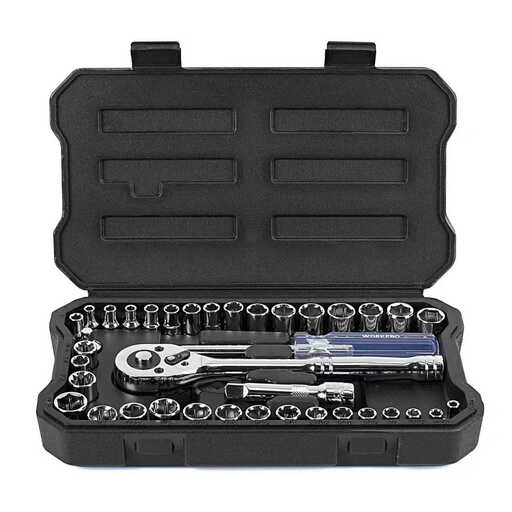
Why This Fits Their Persona: Ideal for individuals who need a compact yet high-quality set for occasional repairs around the house or on a bike. It's easy to store and covers the most common tasks without being overwhelming.
This set bypasses the "quantity over quality" trap. It focuses on 39 useful pieces made of durable CR-V steel and combines the flexible 1/4-inch and 3/8-inch drives.
Combines the two most common drive sizes in one compact case. The ratchet's quick-release function facilitates swift socket changes.
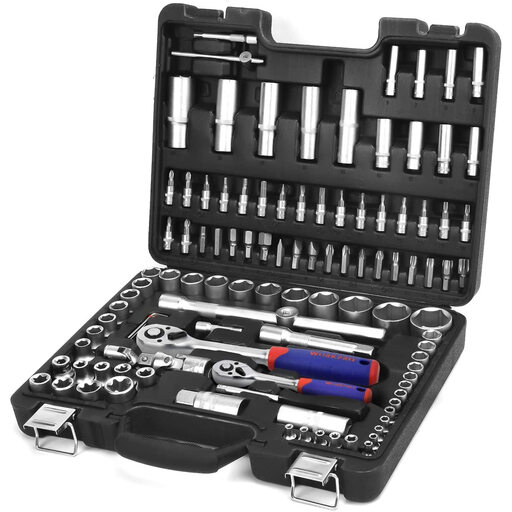
Why This Fits Their Persona: Perfect for anyone who regularly works on their own car or motorcycle. The combination of 1/4" and 1/2" drives covers both fine adjustment work and high-torque applications like changing a wheel.
Solves the "wrong drive size" problem by combining the two most essential sizes for vehicle maintenance. The sturdy case also prevents the loss of parts.
Comprehensive kit including spark plug sockets, extensions, and universal joints. The 72-tooth fine-gear mechanism of the ratchets allows for precise work even in tight spaces.
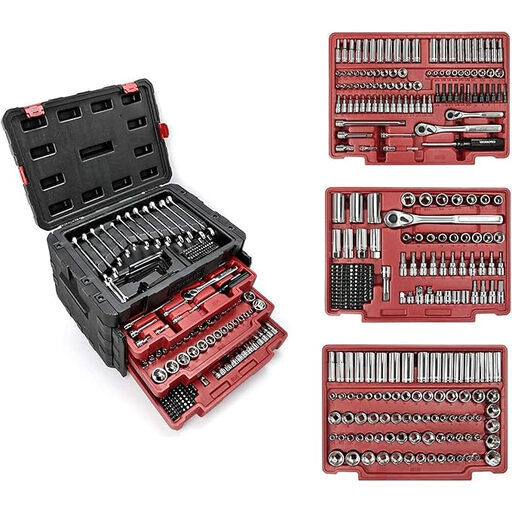
Why This Fits Their Persona: For users looking for a complete workshop setup in a single case. With this set, there's hardly a fastening task it can't handle, from fine mechanics to truck repair.
Although the piece count is huge, there's no compromise on quality here. The tools are made from heat-treated, chrome-plated CR-V steel, and the case is designed for the rigours of daily workshop use.
Includes all three drive sizes (1/4", 3/8", 1/2") plus a vast selection of sockets (metric & SAE), bits, wrenches, and accessories. A one-time purchase for nearly every conceivable application.
We have compiled a complete, real-time list of products that fully satisfy these strict selection criteria and UK safety regulations.
1. Besides the material, how can I identify a high-quality socket set? Pay attention to the craftsmanship of the ratchet. A high-quality ratchet has a fine-toothed mechanism (e.g., 72 teeth or more), which makes it easier to work in tight spaces. The directional switch for forward/reverse should be precise and smooth. Additionally, a clean, matte or polished chrome finish is an indicator of corrosion resistance and good manufacturing quality.
2. What is the difference between 6-point and 12-point sockets? 6-point sockets offer a larger contact area on the bolt head, making them better for transferring high torque and loosening stubborn or damaged bolts, as they reduce the risk of slipping and stripping. 12-point sockets are easier to place onto a bolt head because they offer more engagement points, which can be advantageous in tight spaces. For most applications, especially in the automotive field, a 6-point profile is the more robust choice.
3. How do I properly maintain my ratchet set? Clean the tools with a dry cloth after each use to remove dirt and oil. Store the case in a dry place to prevent rust. The ratchet mechanism can occasionally be lubricated with a drop of fine-mechanism oil to maintain its smooth operation. Inspect the tools for any cracks or damage before each use.