For porridge buyers keeping an eye on salt
If you make your own sweet porridge with plain oats, compare the salt content per 100 g and the ingredients list. A reduced-salt claim on its own doesn’t tell you how much salt the product contains.


You don’t need to look only for a ‘reduced salt’ claim when choosing oats for a sweet breakfast. Compare the ingredients list and salt content per 100 g instead. Published figures for individual plain oats from Kölln, EDEKA and REWE range from 0 g to 0.03 g of salt per 100 g. Separately, whether you choose fine or jumbo oats determines how soft or chewy your breakfast will be.
If you make your own sweet porridge with plain oats, compare the salt content per 100 g and the ingredients list. A reduced-salt claim on its own doesn’t tell you how much salt the product contains.
Fine or extra-fine oats are the obvious choice for a soft porridge. Alnatura describes its extra-fine oats as soft and creamy, even when mixed with cold liquid.
If you want more bite in your sweet breakfast, or also use oats for baking, jumbo or coarse oats are worth considering. Alnatura and Kölln recommend these uses for their respective products.
First compare the salt content and ingredients on the pack. Then choose the type of oats to get the consistency you want in porridge, muesli or baking.
| What to consider | What to check when buying | Who it matters to |
|---|---|---|
| Salt and ingredients | Compare the salt content per 100 g and the ingredients list, especially for porridge mixes. | I want to sweeten my breakfast myself and know what else is in the pack besides oats. Around 42% of consumers put checking salt and ingredients first. |
| Soft texture | Look for ‘fine’ or ‘extra-fine’ oats and check the preparation instructions on the pack. | If I want my porridge soft rather than chewy, the type of oats is the deciding factor for me. Around 33% of consumers prioritise this consistency. |
| Chewy texture | Look for descriptions such as ‘coarse’ or ‘jumbo’ and check the suggested uses. | For muesli or baking, I want oats with a texture that suits the recipe. Around 25% of consumers prioritise this bite and versatility. |
A marketing claim is no substitute for comparing the actual salt content. Figures from Kölln, EDEKA and REWE show that some plain oats already contain between 0 g and 0.03 g of salt per 100 g.
Compare the nutrition information and ingredients lists on the specific packs before choosing the texture you want.
‘Fine’, ‘extra-fine’, ‘coarse’ and ‘jumbo’ help you choose a consistency. They don’t indicate a general salt advantage.
Choose based on the texture you want, then check the salt content separately.
EDEKA notes that published product information may differ from the details on the packaging.
In particular, check the ingredients, nutrition information, allergen advice and may-contain warnings on the pack you’re actually buying.
A gluten-free label doesn’t tell you about the salt content or the porridge consistency you can expect. According to the Verbraucherzentrale, oats labelled gluten-free must be free from contamination with wheat, rye or barley.
If you need oats with this label, check the specific pack. Compare salt and texture separately.
Oats in different varieties for porridge, muesli and baking.
Extra-fine oats for a soft porridge and jumbo oats for a chewier texture.
Fine organic oats from one own-label range, for a softer porridge.
Especially fine or extra-fine oats for a softer consistency.
Here you’ll find fine oats for a soft porridge, a fine variety labelled gluten-free and a porridge mix. Check the salt content and ingredients on each pack. The mix isn’t the same as plain oats.
 No image available
A good option if you’re looking for fine oats for a soft porridge. Check the salt content per 100 g on the pack rather than assuming it from the type of oats.
 No image available
Fine oats are worth considering if you prefer a softer porridge. To compare them with other packs, check the salt content and, if needed, the may-contain warnings.
 No image available
This fine variety is labelled ‘gluten-free’ in the product name. If you need oats with this label, check the current pack. The salt content should be compared separately.
 No image available
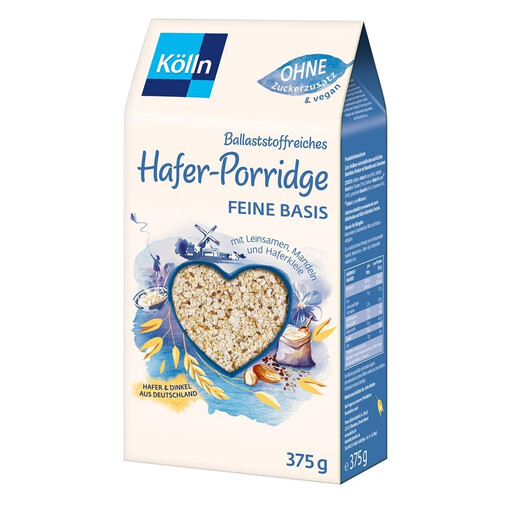
This porridge is an option if you’d prefer a mix rather than plain oats. Check the ingredients and allergen advice on the pack, especially if wheat or almonds are relevant to you.
No, that label isn’t the only way to compare products. Kölln, EDEKA and REWE list 0 g, 0.02 g and 0.03 g of salt per 100 g respectively for some plain oats. Compare the figures and ingredients on the packs you’re choosing between.
In the EU, these claims have to meet certain conditions. The European Commission explains that nutrition claims are permitted only if they appear in the Annex to Regulation (EC) No 1924/2006. When comparing specific oats, also check their nutrition information per 100 g.
Fine or extra-fine oats are the right choice if you want a soft porridge rather than a chewy one. Alnatura describes its extra-fine oats as soft and creamy even when made with cold liquid. Check the instructions on the pack you choose.
If you need oats labelled gluten-free, check the label on the specific pack. According to the Verbraucherzentrale, oats with this label must be free from contamination with wheat, rye or barley. The label doesn’t replace a comparison of salt content or oat texture.
Store them somewhere dry and away from heat. Alnatura gives this advice for its extra-fine and jumbo oats. Also follow the storage instructions on your pack.