
Lieferung heute & morgen

Qualitätsgarantie

Willkommens-Angebote freischalten: KOSTENLOSE Lieferung | Bis zu 80 % RABATT | Kostenlose 30-Tage-JoyPlus-Testphase
App herunterladen
A compact mini polishing machine for cars can be used where larger polishers reach their limits: on door handles, mirror caps, emblems, alloy wheels, headlights or narrow body creases. The BATOCA S6 Mini Cordless Polishing Machine is designed for vehicle detailers, workshops and keen DIYers who need a cordless solution for fine detail work.
Before you buy, however, it’s not just the speed and accessory range that matter. Some typical marketing claims can lead to a purchase you’ll regret.
A high speed can be useful for certain polishing tasks, but it also increases the risk of heat build-up and uneven finishing. For sensitive paint areas, plastic parts or headlights, a finely adjustable control is more important than a single top-end figure.
So look for an adjustable speed range and multiple power levels. According to the product specifications, the BATOCA S6 offers six levels for the RO system from 1,000 to 5,000 rpm. The mini system operates at 4,200 to 21,000 rpm.
A 12 V cordless polishing machine is flexible to use, but you need a realistic plan for run time. Battery life figures are often quoted for idle operation and can differ under load. A built-in battery or a single battery without a spare can interrupt your work across several vehicle areas.
The BATOCA S6 comes with two 12 V lithium-ion batteries, each with 2.0 Ah. The stated run time is up to around 30 minutes per battery in idle mode. This means you can keep the second battery ready while using the first.
A large polishing set may look comprehensive at first glance. What really matters, though, is whether the included backing plates, attachments and pads are suitable for your intended use. Small paint areas need different sizes than larger surfaces. You should also consider the difference between a DA and a rotary polisher.
According to the product description, the BATOCA S6 combines a switchable RO system for rotary movement with a DA system for eccentric movement. The package includes 25 mm, 50 mm and 75 mm attachments, eccentric drives with 3 mm and 12 mm throw, and various pad attachments.
A rotary polisher moves the polishing pad in a fixed circular path. This can allow direct work on small areas, but it requires a controlled technique. A DA or eccentric polisher combines rotation with lateral movement. This is suitable for even finishing and various polishing stages.
For car detailing with a polishing machine, a switchable system is interesting if you plan both precise spot work and finer polishing passes. The changeover should be carried out safely and according to the manufacturer’s instructions.
Large backing plates cover more area, but they are less suitable for tight spaces. A 25 mm attachment can be practical for door shuts, narrow edges, emblems and small scratch areas. 50 mm and 75 mm attachments expand the possibilities on larger detail surfaces.
A compact design is particularly relevant for a car polisher for hard-to-reach areas. It can offer advantages on mirrors, bumpers, A, B and C pillars, as well as motorcycle fairings.
Check before you buy:
With the BATOCA S6, the batteries are also compatible with the S3 and S5 models, according to the product information. Always use the tool with the correct pad, suitable polish and a low starting speed. Work without excessive pressure and keep the attachment moving.
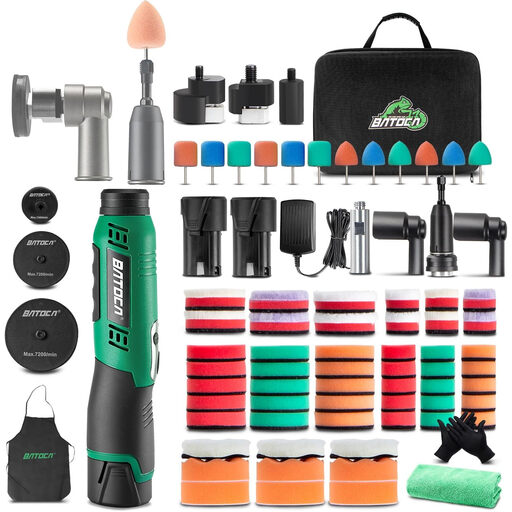
Why this product suits the profile: The set combines two batteries, multiple attachment sizes and a switchable RO/DA system. This gives beginners a compact solution for smaller paint areas, headlights, alloy wheels and motorcycle parts.
The six speed levels and the various backing plate sizes reduce reliance on a single, hard-to-control setting.
Two 12 V batteries, RO/DA switch, 25/50/75 mm attachments and accessories for detail work.
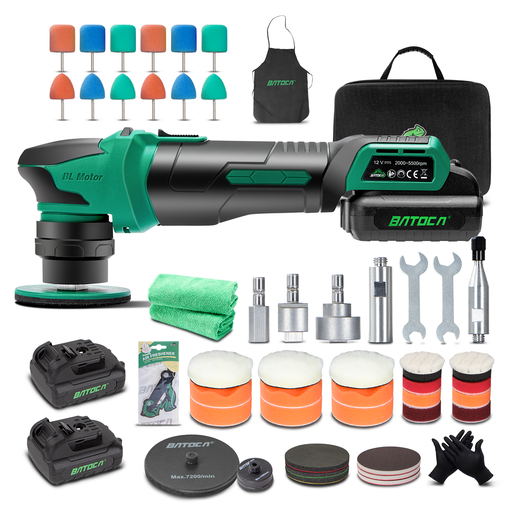
Why this product suits the profile: This model features a brushless motor, two 12 V batteries with 2.5 Ah and a combination of rotary and eccentric drive for regular detail work.
The battery capacity is stated as 2.5 Ah per battery. In addition, four speed levels and a speed memory function are mentioned.
Brushless motor, 25 mm and 75 mm attachments, 3 mm and 12 mm eccentric throw, plus two 2.5 Ah batteries.
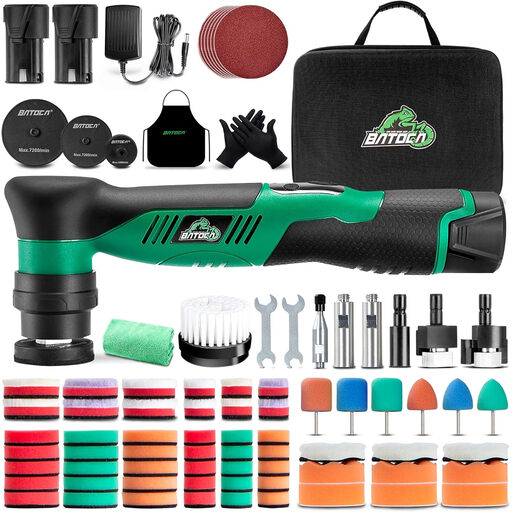
Why this product suits the profile: The S5 is designed for frequent detail work on vehicles and offers three drive modes, six levels and several small attachments for tight areas.
The three switchable functions mean you don’t need a separate tool for rotary and eccentric work.
3 mm and 12 mm eccentric throw, rotary mode, 25/50/75 mm backing plates and two 12 V batteries with 2.0 Ah.
We’ve put together a complete, regularly updated list of products that fully meet these strict selection criteria and the safety regulations in force in the EU.
Before polishing, make sure the paint, pad and work area are clean and free of sand or dust. Small particles can cause scratches as the tool rotates. Test the polish and pad on an inconspicuous area first.
For car paint care, we recommend the following approach:
When polishing headlights and working on plastic surfaces, extra restraint is needed. Not every surface is suitable for the same polish or speed. Always follow the manufacturer’s instructions for the vehicle part and the product you are using. Different pads and cleaning methods are appropriate for glass, alloy wheels and paint.
The design and small attachments are primarily intended for detail work. For large bonnets or complete vehicle sides, a larger polishing machine may be more time-efficient. The S6 is particularly good for edges, shuts, mirrors, door handles, emblems, alloy wheels and other hard-to-reach areas.
According to the product specifications, the run time of a 12 V battery with 2.0 Ah is up to around 30 minutes in idle mode. The actual duration depends on speed, pressure, pad, material and working technique. Two batteries allow you to swap during detail work.
Yes. According to the product description, you can switch between a rotating RO system and an eccentric DA system. The included tool is used for the changeover. Always use the selected operating mode with the correct speed and suitable attachment.