
Lieferung heute & morgen

Qualitätsgarantie

Willkommens-Angebote freischalten: KOSTENLOSE Lieferung | Bis zu 80 % RABATT | Kostenlose 30-Tage-JoyPlus-Testphase
App herunterladen
A well-chosen wall-mounted coat rack brings order to your hallway while adding a stylish accent. But the market is vast, and not every model lives up to its promise. Often, subpar materials or a poorly thought-out design lead to frustration and a cluttered entryway. This guide will help you navigate the common pitfalls and find a functional, durable solution for your home.
Before you make a decision, you should be aware of the most common flaws, which often only become apparent after purchase and installation.
To make an informed decision, you should evaluate three key parameters. These will determine the longevity, functionality, and safety of your new coat rack.
The material is crucial for both stability and aesthetics. A wooden wall-mounted coat rack exudes warmth, with a distinction made between solid wood and engineered woods like MDF.
For a modern coat rack, metals like powder-coated steel or aluminium are excellent choices. They are low-maintenance, rust-resistant, and often have a high load capacity. A black metal hook rail blends seamlessly into minimalist or industrial interior design styles.
The specified maximum load capacity is an important indicator, but it should always be considered in the context of your wall type. A solid brick wall can support more weight than a simple drywall panel. Check whether the included mounting hardware is suitable for your wall or if you need special anchors (e.g., hollow-wall anchors). A good coat hook rail distributes the weight across multiple mounting points.
Consider what you plan to hang. Heavy coats require sturdy, deep hooks. Double or triple hooks offer more storage in a smaller space. A hook spacing of at least 10-12 cm is recommended to ensure there's enough room for bulky garments.
A wall-mounted coat rack with a shelf provides extra storage for hats, gloves, or decorative items. This is especially practical for a coat rack in a small hallway, as it makes optimal use of wall space.
Here are some models tailored to specific needs and living situations.
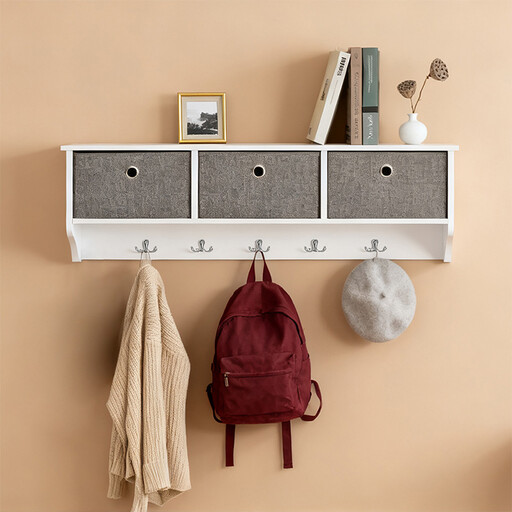
Why This Fits Their Persona: This solution is ideal for family hallways where not just jackets, but also hats, scarves, and shoes need a designated spot. The combination of hooks, a shelf, and foldable boxes creates maximum order in a limited space.
The multifunctional design solves the problem of insufficient storage. With a stated load capacity of up to 50 kg and a solid MDF (E1) construction, it counteracts the pitfall of an unstable rack.
Combines a hook rail, wall shelf, and storage baskets in one product. According to the manufacturer, the wood used is FSC-certified.
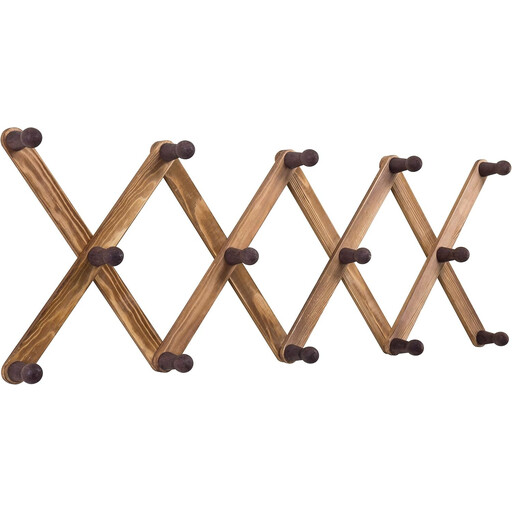
Why This Fits Their Persona: Perfect for those who appreciate rustic charm and need a flexible solution. The accordion design adapts to various wall widths and is ideal for alcoves or narrower walls in a farmhouse or industrial style.
The solid wood construction is significantly sturdier than cheap particleboard. Its variable width bypasses the problem of rigid racks that don't fit perfectly into the intended space.
Flexibly adjustable in width from approx. 40 cm to 81 cm. With 14 hooks, it offers high capacity for clothes and accessories.
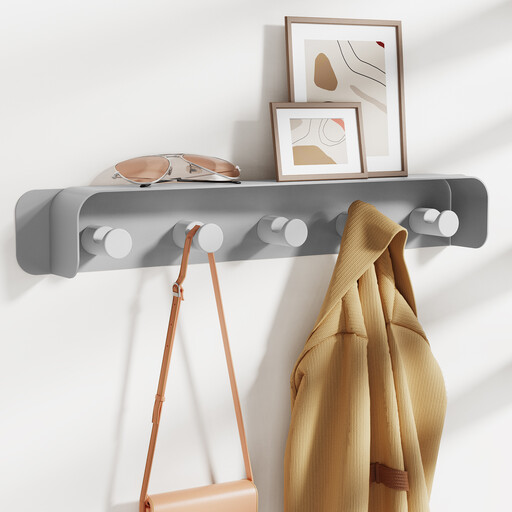
Why This Fits Their Persona: The minimalist aluminium design fits perfectly into modern homes. The combination of hooks and a slim shelf is a space-saving solution for a small hallway without looking cluttered.
According to the manufacturer, the aluminium material is waterproof and rust-resistant, which avoids the problem of swelling engineered wood. The high stated load capacity of up to 25 kg indicates a sturdy construction.
Sleek, modern design with an integrated shelf. The grooved design of the hooks is intended to prevent items from slipping off.
We have compiled a complete, up-to-date list of products that fully meet these strict selection criteria and safety standards.
Safety depends on the wall type and the correct mounting hardware. Before installation, determine if you have a solid brick wall or a hollow wall (drywall). For solid walls, use the included or suitable expansion anchors. For hollow walls, special hollow-wall anchors (e.g., toggle bolts or spring-loaded toggles) are required to ensure sufficient load-bearing capacity. If possible, mount the rack directly into the wall's substructure (studs).
Solid wood is made from natural timber and is generally more durable, robust, and resistant to moisture. If damaged, it can be sanded down and refinished. MDF (Medium-Density Fibreboard) is an engineered wood product made from compressed wood fibres. It is more cost-effective and dimensionally stable, but more susceptible to moisture damage, especially if the protective surface coating is compromised.
For comfortable use, where even thick winter coats can hang side-by-side without getting tangled, a distance of at least 10 to 15 centimetres between the centre of the hooks is recommended. For coat racks intended for children or lighter garments, the spacing can be slightly less.