
Lieferung heute & morgen

Qualitätsgarantie

Willkommens-Angebote freischalten: KOSTENLOSE Lieferung | Bis zu 80 % RABATT | Kostenlose 30-Tage-JoyPlus-Testphase
App herunterladen
Choosing the right ceiling light can completely transform the atmosphere of a room. A dimmable LED ceiling light promises flexibility—from bright task lighting to a cosy evening mood. However, the market is saturated with products that make bold claims but often fail to deliver in practice. Before you make a decision, it's crucial to know the most common pitfalls to avoid a costly mistake.
As your Joybuy Product Recommendation Officer, I'll help you navigate the jungle of information. We'll focus on the facts that truly matter.
The 2 Most Common Annoyances with Dimmable LED Lights:
To bypass these problems, you should focus on verifiable technical specifications. These three parameters are critical to your satisfaction.
Forget wattage as the sole measure of brightness. The crucial factor is luminous flux, measured in lumens (lm). It indicates how much light a lamp actually emits. For a 20 m? living room, for example, around 2500–3000 lumens is a good benchmark for bright ambient lighting.
The colour temperature, measured in Kelvin (K), determines the light's colour and thus the atmosphere:
Models with colour changing capabilities (often referred to as CCT – Correlated Colour Temperature) offer the flexibility to adjust the colour temperature as needed, usually via a remote control or app.
Dimmability can be achieved in several ways:
If you're looking for a light for the bathroom or kitchen, the IP protection rating is an indispensable criterion. The abbreviation IP stands for "Ingress Protection." The first digit describes the protection against foreign objects (like dust), and the second describes protection against water.
For damp rooms like the bathroom, at least IP44 is required. This means the light is protected against splashing water from all directions. A light with a lower protection rating (e.g., IP20) is not safe in such environments and can be quickly damaged by moisture.
Here are some models that represent a considered choice for specific user profiles, based on objective features.
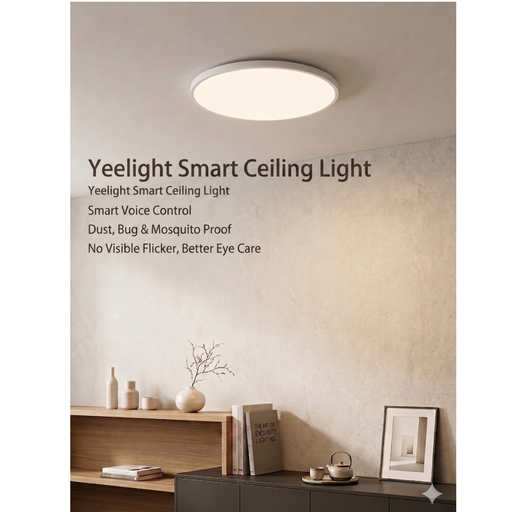
Why This Fits Their Persona: Ideal for users seeking seamless integration into their existing smart home ecosystem. App or voice control via popular platforms provides full command over brightness and colour temperature, as well as scheduling and automation.
Avoids the unreliable "smart" feature trap with certified compatibility for Alexa, Google Home, and SmartThings, ensuring stable and functional integration.
Features an ultra-low brightness moonlight mode for nighttime and a fully sealed design that keeps out dust, insects, and steam.
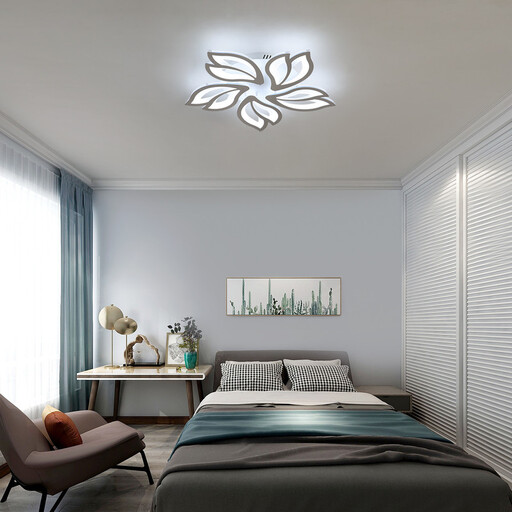
Why This Fits Their Persona: For users who want a modern, decorative light without the complexity of a smart home setup. Brightness and colour temperature (3000K–6500K) are easily controlled via the included remote.
Solves the inconsistent dimming problem with a perfectly matched light and remote control system. The memory function conveniently saves the last used setting.
Combines an artful, petal-inspired design with practical functionality. The flicker-free and glare-free light output is easy on the eyes.
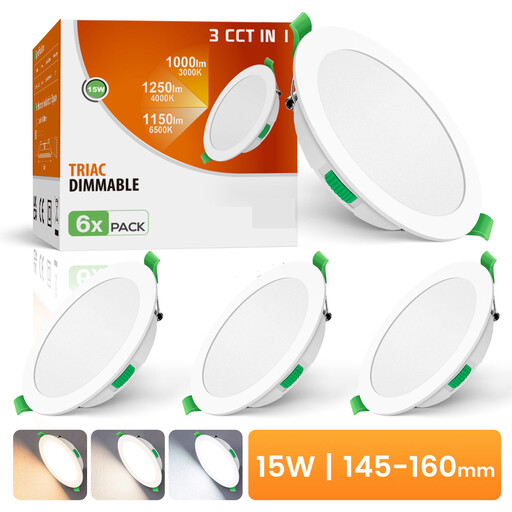
Why This Fits Their Persona: Perfect for renovation projects requiring uniform, flush-mounted lighting. The set of 6 is ideal for outfitting entire rooms like kitchens, hallways, or bathrooms. The IP44 certification allows for safe use in damp areas.
Prevents the purchase of unsuitable lights for damp rooms thanks to its clear IP44 rating. The 3CCT function (colour temperature selection via a switch) offers flexibility before final installation.
Very shallow installation depth (32 mm) for seamless ceiling integration. Direct connection to 230V without a separate transformer simplifies installation.
We've compiled a complete, up-to-date list of products that fully meet these strict selection criteria and safety regulations.
The IP44 protection rating means that the light is protected against splashing water from all sides. This makes it a safe choice for zones in the bathroom that do not come into direct contact with water jets (e.g., above the sink or as general ceiling lighting), as well as for kitchens and covered outdoor areas. For the direct shower area, a higher protection rating (e.g., IP65) would be required.
A general rule of thumb is that living spaces benefit from an ambient brightness of about 100 to 150 lumens per square metre (lm/m?). For a 20 m? living room, this means you should aim for a light or a combination of lights with a total of 2000 to 3000 lumens. Since the light is dimmable, you can always adjust the brightness downwards to create a cosier atmosphere.
No, this is a common mistake. LED lights require specific dimmers. The main types are leading-edge and trailing-edge dimmers. If the light's product description does not specify compatibility with external dimmers, it is likely only controllable via an included remote control, app, or an integrated stepped dimmer. Using an incompatible dimmer can lead to flickering, buzzing, or even damage to the light.