
Lieferung heute & morgen

Qualitätsgarantie

Willkommens-Angebote freischalten: KOSTENLOSE Lieferung | Bis zu 80 % RABATT | Kostenlose 30-Tage-JoyPlus-Testphase
App herunterladen
An LED ceiling light should provide enough light, take up little space and suit the way you use the room. Yet unclear product details and exaggerated claims often lead to the wrong choice. Look out for these three common pitfalls:
Luminous flux is measured in lumens (lm). Depending on the LED technology used, a small 36-watt light can produce a different level of brightness from another model with the same power consumption. When choosing, consider the lumens, room size and beam angle together.
A beam angle of around 120 degrees spreads light widely and evenly. This is useful for a low-profile LED ceiling light in a living room, bedroom or hallway. Larger rooms may need a higher luminous flux, while using several light sources can help avoid dark areas around the edges.
The colour rendering index (CRI or Ra) describes how natural colours look under the light. Values of Ra 80 and above are common for many living spaces and utility rooms. Good colour rendering can be particularly useful in the kitchen, home office or dressing room.
Colour temperature is measured in kelvins:
A dimmable ceiling light with adjustable colour temperature gives you more ways to tailor the lighting. Check whether it dims continuously, in set steps or only via remote control. If you’re choosing a ceiling light with a remote, check the product details for its range, battery type and memory function too.
If your ceilings are low, a flat model around 3 to 5 centimetres high can save space. A round ceiling light often distributes light evenly and suits many room layouts. By contrast, a rectangular LED panel ceiling light can direct light across long rooms or larger areas.
For bathrooms, kitchens and basements, the IP44 rating is an important consideration. The first digit describes protection against solid objects, while the second indicates protection against water splashes. IP44 therefore means limited protection against solid objects and splashing water from different directions. The light must still be installed in accordance with the electrical installation zones in your area. If you’re unsure, have a qualified professional carry out the electrical connection.
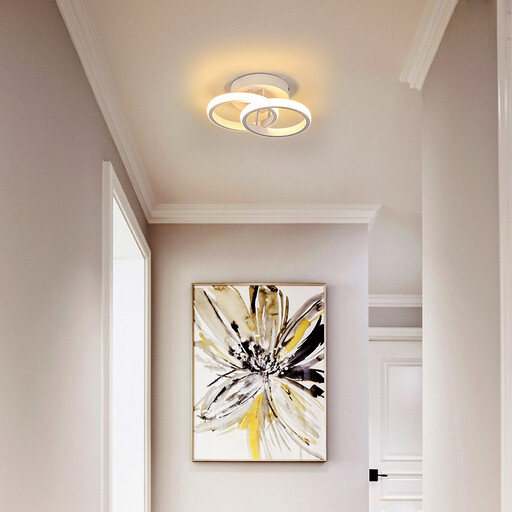
Why it suits this profile: This 22-watt light, with a colour temperature of 3,000 kelvins, is designed for bedrooms, living areas, hallways and entranceways. Its low-profile double-ring design is ideal for rooms with limited ceiling height.
The product details clearly state the wattage and colour temperature, rather than relying on vague claims about brightness.
Integrated LED technology, warm white light at 3,000 K and a space-saving design.
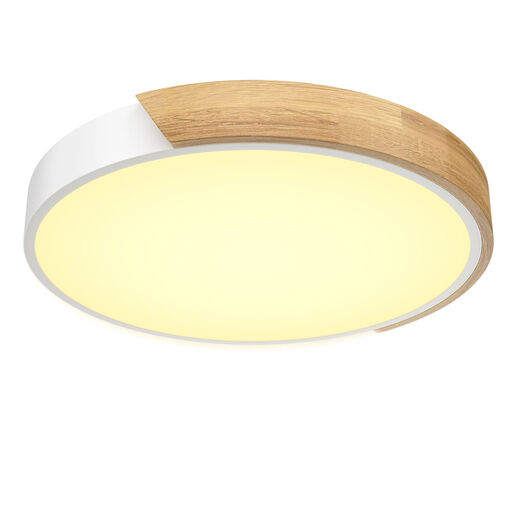
Why it suits this profile: The lacquered oak frame, acrylic diffuser and approximately 5 cm profile combine a welcoming look with a low-profile fit.
The specified height is clear and easy to check. Different sizes and wattages are available to suit your room.
120-degree beam angle, acrylic diffuser and a choice of sizes and wattages.
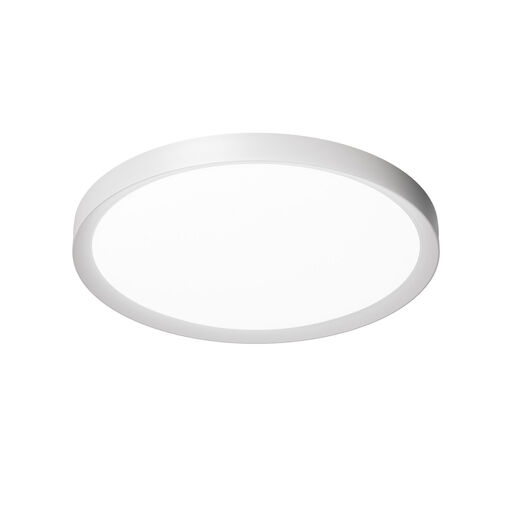
Why it suits this profile: This round ceiling light has an IP44 rating, a 3 cm profile and cool white light. It’s designed for indoor areas where it may be exposed to splashing water.
The product details specify the IP44 rating and dimensions, making it easier to check whether the light is suitable before you buy.
IP44 rating, 120-degree beam angle, 48 watts and a compact profile of around 3 cm.
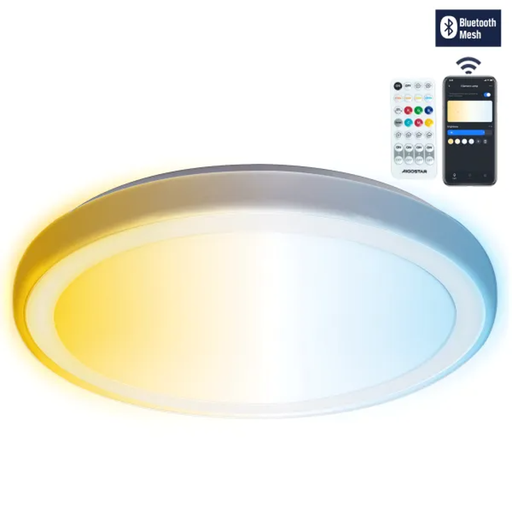
Why it suits this profile: According to the product details, this light supports Bluetooth Mesh and offers an adjustable colour temperature for living rooms, offices and other dry indoor spaces.
The product details specify the network standard, colour temperature range, luminous flux and IP20 rating. This makes it easier to assess its suitability for dry indoor spaces.
36 watts, 3,960 lumens, 120-degree beam angle and Bluetooth Mesh control.
We’ve put together a complete, regularly updated list of products that meet these strict selection criteria and fully comply with the safety regulations in force in the EU.
It depends on the size of the room, how you use it and how bright you want the light to be. Don’t compare wattage alone: pay particular attention to the stated luminous flux in lumens. A higher light output may be useful in large or practical spaces, while bedrooms and hallways often need less brightness.
Many integrated LED lights have a stated lifespan of, for example, 50,000 hours. This is a manufacturer or product specification, and the actual lifespan can depend on factors such as how long the light is used, heat dissipation, mains power quality and ambient temperature. If a built-in LED fails, the whole module or light will need to be replaced.
Running costs depend on the wattage, how many hours the light is used each day and your electricity tariff. Here’s a simple calculation: wattage ÷ 1,000 × operating hours × electricity price per kilowatt-hour. An energy-efficient LED bulb may use less electricity than many older light sources when used in the same way. However, the actual consumption of the model you choose is what matters.