
Lieferung heute & morgen

Qualitätsgarantie

Willkommens-Angebote freischalten: KOSTENLOSE Lieferung | Bis zu 80 % RABATT | Kostenlose 30-Tage-JoyPlus-Testphase
App herunterladen
A no-drill clamp-fix double roller blind can provide privacy and sun protection in rental apartments, houses, and offices without creating drill holes. The combination of transparent and opaque fabric panels is particularly practical: depending on how the layers overlap, the room remains bright, gains privacy, or becomes more strongly shaded.
However, to ensure reliable installation and everyday use over the long term, buyers should look beyond colour and price. The key factors are the correct window dimensions, compatibility with the window frame, and the fabric’s actual light-filtering performance.
With many double roller blinds, the fabric is narrower than the overall blind, including its brackets. With the WOLTU model, the difference between the fabric width and the total width is approximately 4 to 5 cm. Anyone who simply uses the visible glass width risks side gaps that let in light and incomplete privacy protection.
A day and night double roller blind regulates incoming light through alternating transparent and opaque stripes. This can significantly darken a room, but it does not necessarily replace a fully blackout blind. Light gaps may still occur at the sides and between the fabric and the window.
For bedrooms where strong room darkening is important, check whether the specific model is described as opaque or merely as offering light regulation.
Clamp brackets are attached directly to the opening window sash. The WOLTU double roller blind is designed for a frame thickness of 13 to 23 mm. Seals, the window handle, and the opening movement must also be taken into account. Depending on the model, wooden windows, roof windows, sliding windows, or permanently glazed windows may not be suitable.
Before purchasing, carefully review both the product specifications and the construction of your window.
For a clamp-fix window blind, start by measuring the width of the visible window pane. The WOLTU models mentioned here follow these guidelines:
Example: If the glass pane is 56 cm wide, an order width of around 60 cm may be suitable. For a balcony door, also check whether the chain and brackets interfere with the door handle or the door’s opening area.
The sizes 60 x 150 cm roller blind and 60 x 220 cm roller blind are suitable for different installation situations. The 150 cm version is more suitable for many standard windows, while the 220 cm version may be appropriate for taller windows or doors.
A light-filtering roller blind is suitable for living rooms, kitchens, or offices where natural daylight should be retained. A more opaque double roller blind is often more practical for bedrooms and children’s rooms. For bathrooms and kitchens, the fabric should also be easy to clean.
The WOLTU roller blinds mentioned consist of 100% polyester. According to the product description, the material can be cleaned with a damp cloth or a soft brush and is suitable for humid rooms. “Suitable” does not mean that the blind should be exposed to constant moisture or direct splashing water.
A no-drill clamp-fix roller blind is particularly attractive for rental properties because the window frame generally remains free from drill holes. The WOLTU models also include screws and installation instructions. Depending on the installation situation, this allows for permanent mounting as well.
Pay attention to:

Why it suits this profile: The compact size is suitable for many standard windows. This white double roller blind can be installed without drilling using clamp brackets and provides flexible light control for living or working spaces.
The product specifications state the required frame thickness of 13 to 23 mm as well as the recommended addition to the glass width.
100% polyester, clamp or screw installation, chain operation that can be mounted on either side, and cleaning with a cloth or brush.
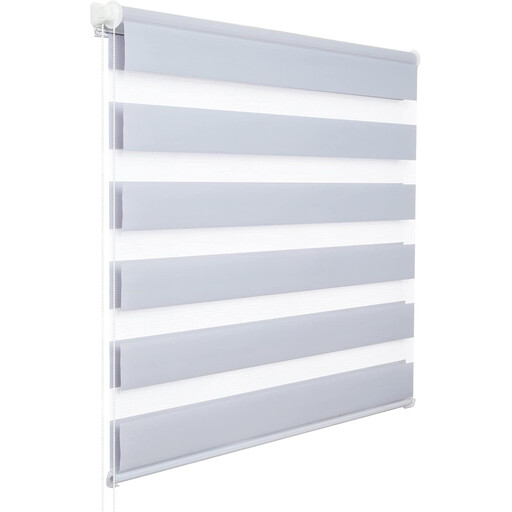
Why it suits this profile: The taller version may be suitable for large windows or balcony doors, provided the dimensions, handle area, and window frame are compatible.
The specifications exclude roof windows and wooden windows and point out the narrower fabric width as well as the handle area.
Two fabric layers for light control, 100% polyester, a surface that can be wiped clean with a damp cloth, and clamp installation for frame thicknesses of 13 to 23 mm.
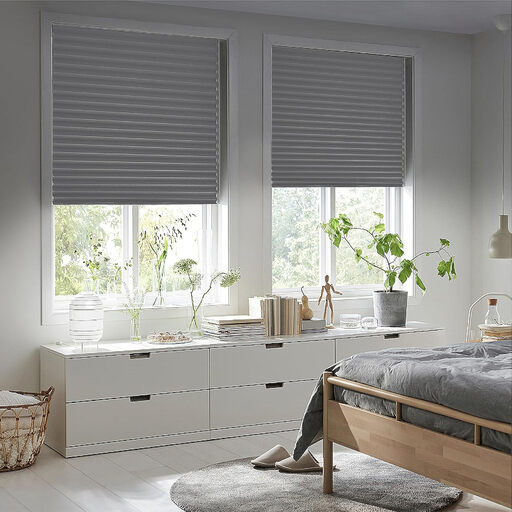
Why it suits this profile: For smaller windows, offices, kitchens, or children’s rooms, this pleated blind offers an alternative handle-operated design with an adjustable position.
It is explicitly described as light-filtering rather than fully blackout. This makes expectations regarding its light performance clearer.
Polyester fabric, no-drill clamp-fix installation, adjustable positioning, and colour options including white, beige, light grey, and anthracite.
The complete selection includes a range of solutions for windows, doors, and decorative privacy protection. Before ordering, always check the dimensions, installation method, and light transmission.
Clean the window frame before installation and make sure the clamp brackets are seated correctly. The blind should move freely without rubbing against the handle, seal, or frame. With chain-operated blinds, ensure that the chain is securely fixed and kept at a sufficient distance from children.
A polyester roller blind is usually cleaned with a damp cloth or a soft brush. Harsh cleaning agents, vigorous rubbing, and prolonged exposure to water can damage the surface and affect the print. Always follow the specific care instructions for the individual product.
Durability depends on the frame thickness, installation quality, and how the blind is used. A correctly sized, properly installed clamp bracket can remain securely in place. Check the brackets regularly and avoid pulling abruptly on the chain or fabric.
It can flexibly reduce both incoming light and visibility from outside. However, complete blackout is not guaranteed with every model. For especially dark bedrooms, carefully check the fabric description, side gaps, and installation position.
Under normal conditions, there are no electricity costs because the blind is operated manually. Potential follow-up costs may include replacement parts, replacing the blind after choosing the wrong size, or purchasing additional blinds for other windows. Taking accurate measurements helps prevent these expenses.