
Lieferung heute & morgen

Qualitätsgarantie

Willkommens-Angebote freischalten: KOSTENLOSE Lieferung | Bis zu 80 % RABATT | Kostenlose 30-Tage-JoyPlus-Testphase
App herunterladen
Emsa food storage containers are among the most frequently searched-for food storage boxes for the kitchen, fridge, freezer and travel. However, having a wide choice does not automatically mean finding the right solution. What matters is not just the brand name or set size, but the specific purpose: do you want to store dry food, freeze cooked meals or transport food without leaks?
A container with a capacity of 1 litre is not automatically suitable for every portion. For muesli, rice or pasta, the shape also matters: tall, narrow food storage containers with lids use kitchen cupboards differently from shallow boxes for leftovers and meal prep. Before buying, compare the internal dimensions, external dimensions and available cupboard height.
A tightly closing lid can protect dry food from moisture. For soups, sauces and liquids, however, models specifically described as leakproof are the better choice. With plastic boxes, you should also check whether the container is suitable for the microwave, freezer and hot food.
Seals, clips and inserts come into direct contact with food. If they are difficult to remove or create hard-to-reach gaps, everyday cleaning becomes more time-consuming. Dishwasher-safe food storage containers can reduce the cleaning effort. Even so, the seal should be checked regularly and fitted correctly.
For individual ingredients or small snacks, 0,18 to 0,55 litres is usually sufficient. One-litre containers are suitable, for example, for cereals, side dishes or larger snack portions. For families and larger quantities of food, capacities of 1,6 to 4,4 litres can be useful. The right size depends on the food and the amount normally used.
For stackable food storage containers, coordinated base dimensions are particularly practical. According to the product details, models in the Emsa Optima range are available in various sizes and designed to fit standard kitchen cupboard dimensions. Non-slip stacking edges can improve stability. Nevertheless, you should compare the external dimensions with your own cupboard before buying.
Plastic is lightweight and often suitable for transporting food, lunch boxes and everyday use. Glass is heavier, but according to the manufacturer’s information, selected Emsa Clip-&-Close glass containers can be used in the oven, microwave, fridge and freezer. The relevant restrictions must be observed: plastic lids must not be put in the oven, and glass containers should not be exposed to sudden, significant changes in temperature.
With microwave-safe food storage containers, the lid often must not be fully closed. For Emsa Clip & Go models, for example, the product details specify a loose cover and limited heating at 600 watts. The instructions on the relevant product page and packaging are always decisive.
With some Emsa Optima containers, an audible click indicates that the lid has been closed. According to the manufacturer’s information, food storage containers in the Clip & Close and Clip & Go ranges feature a leakproof design. This is particularly important for bags, rucksacks and the commute to work. Before transporting the container, make sure the lid is fully closed all the way around; overfilling can impair the seal.
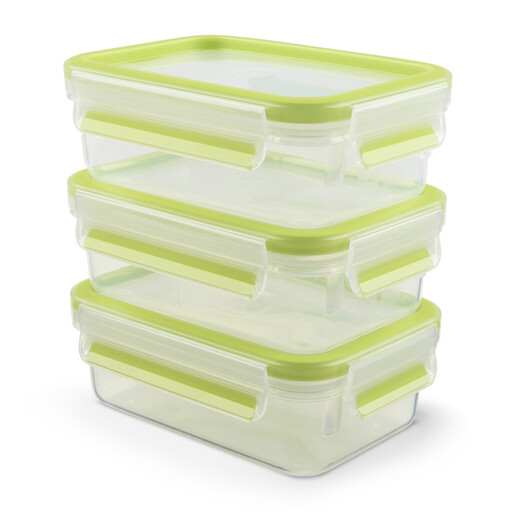
Why this product suits this profile: The set contains three containers, each with a capacity of 0,55 litres, making it suitable for smaller households, snacks, side dishes or prepared portions.
According to the manufacturer’s information, the box and lid have an integrated seal. The specifications also state that the containers are dishwasher-safe, freezer-safe and microwave-safe from -40 to +110 °C.
Three identical sizes make portioning easier, while PP plastic keeps the set comparatively lightweight.
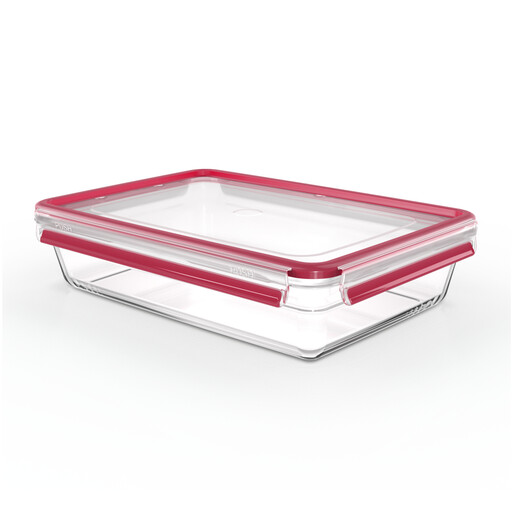
Why this product suits this profile: This glass box is ideal for users who want to prepare and store food, and, according to the manufacturer, also heat it in the oven or microwave.
The product information clearly distinguishes between the glass container and the plastic lid: the container can be placed in the oven without the lid, up to the specified temperature; the lid cannot.
3-litre capacity, stackable rim and, according to the manufacturer, suitability for the freezer, dishwasher and microwave.
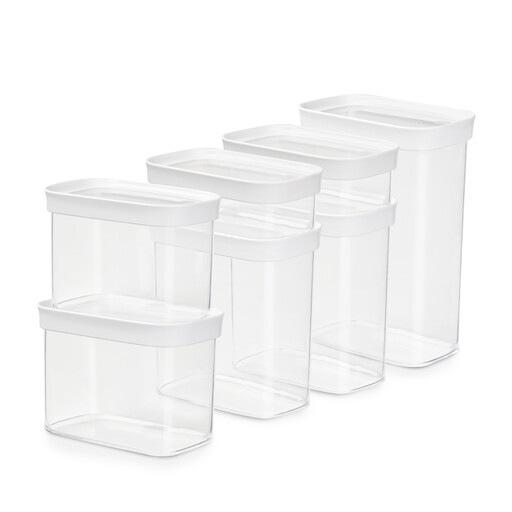
Why this product suits this profile: The set combines 0,45-, 1-, 1,6- and 2,2-litre containers, making it suitable for families and users who regularly store larger quantities of food.
The coordinated sizes and non-slip edges cater for different quantities and help solve the problem of untidy storage in cupboards.
Transparent plastic containers make it easier to check the contents; according to the product information, the containers are dishwasher-safe.
We have compiled a complete, regularly updated list of products that fully meet these strict selection criteria and the safety regulations applicable in the EU.
For dry foods such as flour, rice, porridge oats or pulses, transparent airtight food storage containers in a suitable size and stackable shape are usually more practical than large, cumbersome containers. For the commute to work or university, however, an Emsa lunch box, separate compartments and proven leak protection are more important than maximum cupboard capacity.
According to the manufacturer’s or product information, several of the models mentioned are described as dishwasher-safe. For lids with seals, follow the care instructions for the relevant model. All parts must be completely dry after washing.
Emsa Optima containers with capacities from 0,45 to 4,4 litres are designed for pasta, rice, cereals and similar dry foods. Their transparent design makes it easier to check the contents, while the coordinated sizes support stacking. The ideal size depends on the quantity of food and the cupboard compartment.
This depends on the model and material. According to the product information, Emsa Clip-&-Close glass containers can be used in the microwave without the lid. Clip-&-Go plastic boxes have specific requirements regarding power, heating time and lid position. Always check the model-specific safety instructions before heating food.