People with coeliac disease
Look for a clear gluten-free label and make sure gluten-containing crumbs can’t come into contact with your crackers. The German Coeliac Society highlights the risk of this kind of contact.


If you have coeliac disease, start by choosing a cracker explicitly labelled gluten-free. Check the current ingredients list too, and avoid contact with gluten-containing crumbs when serving. Then think about how you’ll use it: small salted crackers work well for snacking or as a savoury contrast, while larger crackers are better as a base for toppings. If you choose oat crackers, you’ll also need to consider your individual tolerance of gluten-free oats.
Look for a clear gluten-free label and make sure gluten-containing crumbs can’t come into contact with your crackers. The German Coeliac Society highlights the risk of this kind of contact.
You’re looking for a gluten-free snack that can be served plain, with toppings or as a savoury contrast to sweet treats. If your guests have other allergies, check the ingredients of the specific variety too.
As well as checking the gluten-free label, you may want to compare ingredients such as seeds, buckwheat, chickpeas or oats. If a product contains gluten-free oats, individual tolerance is another factor to consider.
First, check the gluten-free label and any other ingredients you need to avoid. Then choose the size and seasoning to suit how you plan to serve the crackers: for snacking or with toppings.
| What to consider | What to check when buying | Who it matters to |
|---|---|---|
| Gluten-free labelling | The current pack must be explicitly labelled gluten-free. When serving, use separate plates and utensils for gluten-free products. | If I have coeliac disease, I want to choose a clearly labelled cracker and serve it without contact with gluten-containing crumbs. This is the top priority for around 50% of consumers. |
| Shape and flavour | Match the size and seasoning to how you plan to serve the crackers: plain as a snack or as a base for sweet or savoury toppings. | If I’m serving crackers with toppings alongside coffee, I need a different shape from the one I’d choose for a small savoury snack. Around 30% of consumers put this first. |
| Other ingredients | Read the ingredients and allergen information for the specific variety. If you want a vegan option or one containing gluten-free oats, check the relevant product details. | As well as choosing gluten-free products, I want to take my ingredient requirements and preference for vegan recipes into account. For around 20% of consumers, this is the most important additional factor. |
The shape and brand name don’t tell you whether a specific variety is gluten-free. For example, TUC lists wheat flour and barley malt extract in MINI ORIGINAL.
If you have coeliac disease, choose the variety in its current packaging based on its explicit gluten-free label, rather than assuming a similar product is suitable.
A gluten-free label doesn’t tell you whether a product contains soya, egg or other ingredients. Schär lists soya flour and possible traces of egg for Saltí.
As well as checking the gluten-free label, read the ingredients list and allergen information on the pack.
Gluten-containing crumbs can get onto gluten-free foods. The German Coeliac Society recommends storing products separately to prevent falling crumbs from reaching gluten-free foods.
When serving coffee, provide separate plates and clean serving utensils. If you’re offering spreads for everyone to share, use separate knives too.
For its Simply Seeds Parmesan-Pepper cracker, Hammermühle notes that people with coeliac disease can vary in how well they tolerate gluten-free oats.
When choosing an oat variety, take your individually assessed tolerance into account. If you’d rather avoid oats, look specifically for a gluten-free option that doesn’t contain them.
Schär offers crackers in different shapes that are labelled gluten-free. For your coffee table, larger crackers could work as a base for toppings, while smaller Saltí make a savoury snack.
The Simply Seeds Parmesan-Pepper variety is a savoury option if you’re serving cheese or other savoury foods with coffee.
Alnavit offers gluten-free mini crackers for coffee get-togethers where you want a small snack rather than a base for larger toppings.
This selection includes a salted cracker for snacking and two crispbreads that make a crunchy base for toppings. Crispbread is an alternative to crackers, not the same type of product. If you have coeliac disease, the gluten-free label on the current pack remains essential for every variety.
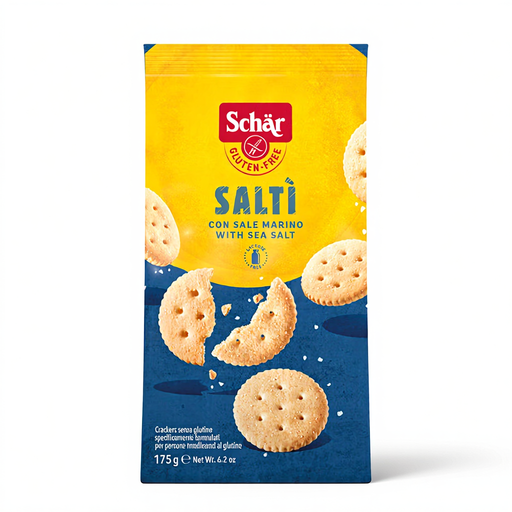 No image available
A savoury snack to enjoy with coffee, or a contrast to something sweet. Schär also suggests pairing Saltí with sweet foods. If you have other allergies, check the details on the current pack.
 No image available
This crispbread is an alternative if you’re looking for a crunchy base for sweet or savoury toppings to enjoy with coffee, rather than serving plain crackers. Check the current pack for any ingredients you need to avoid.
 No image available
This crispbread is a good choice for a coffee table with spreads or other toppings; it isn’t a classic cracker. If you have coeliac disease, check the gluten-free label on the current pack.
In the EU, the “gluten-free” label is subject to a limit of no more than 20 mg of gluten per kg of food under Implementing Regulation No 828/2014. Look for this explicit wording on the current pack when choosing a product. When serving it, you’ll also need to avoid contact with gluten-containing crumbs.
No. “Wheat-free” is not a substitute for a “gluten-free” label. Check the specific pack for a gluten-free statement and read the ingredients list rather than assuming a product is suitable just because it excludes one type of grain.
TUC MINI ORIGINAL aren’t a gluten-free alternative: TUC lists wheat flour and barley malt extract in this variety. Don’t assume the same ingredients apply to other varieties; check the pack for each one.
Serve gluten-free crackers separately from cake and baked goods containing gluten, and use clean, separate serving utensils. The German Coeliac Society specifically highlights the need to prevent contact with falling gluten-containing crumbs.
Not necessarily. For its Simply Seeds Parmesan-Pepper cracker, Hammermühle notes that people with coeliac disease can vary in how well they tolerate gluten-free oats. Bear this in mind when choosing an oat variety.