
Lieferung heute & morgen

Qualitätsgarantie

Willkommens-Angebote freischalten: KOSTENLOSE Lieferung | Bis zu 80 % RABATT | Kostenlose 30-Tage-JoyPlus-Testphase
App herunterladen
Published July 28, 2026 by Joybuy Product Recommendation Officer
If your smartphone gets hot and the frame rate drops while gaming, you're not alone. This issue, known as thermal throttling, occurs when internal components get too hot, causing the system to reduce performance to prevent damage. An external phone cooler is often the most direct solution. However, the market is flooded with products whose marketing promises don't always match reality. Before making a purchase, it's crucial to understand the common pitfalls and key technical features.
Many users invest in accessories that fail to solve their problem. Watch out for these three common shortcomings to avoid a bad investment.
To ensure your phone cooler delivers the performance you need, focus on these three core technical aspects.
The type of cooling is the most important factor. A simple smartphone fan merely improves air circulation. For demanding applications, like with a gaming phone cooler, active cooling is required. This is where the Peltier element (thermoelectric cooling) technology is essential. This component uses the Peltier effect to actively transfer heat from one side to the other. The "cold" side rests against the smartphone, drawing heat away from it, while the "hot" side is cooled by a fan. This allows for temperatures that can even drop below the ambient temperature—a prerequisite for effective phone cooling for gaming.
The attachment must be secure and practical.
Modern coolers offer more than just cooling.
Here are some recommendations tailored to specific use cases.
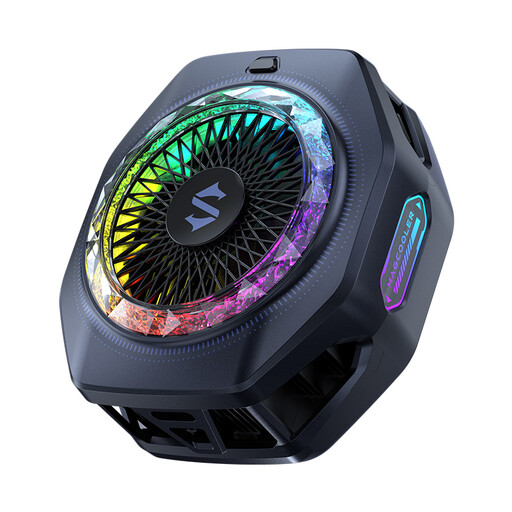
Why it's a match: For competitive players where every frame counts, maximum cooling performance is non-negotiable. This model is designed to eliminate thermal throttling even in the most demanding games, ensuring consistently high performance.
This device uses a powerful Peltier element with up to 35W, not just a simple fan. It actively cools to effectively prevent performance loss where passive coolers fail.
According to the manufacturer, it achieves a temperature reduction of up to 45°C, ensuring stable performance without frame drops.
Why it's a match: For long streaming sessions, not only cooling but also quiet operation and flexible mounting options are crucial. This model addresses these needs with thoughtful design features.
The airflow design directs warm exhaust air away from your hands. It's also optimised for quiet operation to avoid interfering with microphone recordings. Its broad compatibility (magnetic/clamp) prevents fitment issues.
Features a 1/4-inch nut interface, allowing for easy mounting on tripods and rigs for live broadcasting.
Why it's a match: For users who value not only function but also form and smart features. This model combines high cooling performance with customisable aesthetics and intelligent control via an app.
Instead of a simple on/off switch, the Shark Arsenal app provides intelligent temperature control that protects the device from overheating or over-cooling and prevents condensation.
Features 18 addressable RGB LEDs whose colour and effects can be individually customised via the app to create a personalised setup.
We've compiled a complete, up-to-date list of products that fully meet these strict selection criteria and safety regulations.
Does a phone cooler need its own power source? Yes, most active coolers, especially those with a Peltier element, require an external power supply. This is usually done via a USB-C cable connected to a power adapter or a power bank. High-performance models often require a power adapter with a specific minimum output (e.g., 40W) to reach their full cooling capacity.
Can a magnetic phone cooler be used with any phone case? Not directly. A MagSafe cooler adheres best to MagSafe-series iPhones or special MagSafe-compatible cases. For other smartphones or non-magnetic cases, many coolers include a thin metal ring plate. This can be attached to the back of the case to create a secure magnetic connection.
What's the difference between a phone cooler and a simple fan? A simple external phone fan only improves air circulation around the casing, which slightly aids heat dissipation. An advanced phone cooler with a Peltier element is an active cooling system. It specifically draws heat away from the smartphone and can significantly lower the temperature of the back, often even below ambient temperature. This is much more effective when a phone overheats during gaming.