
Lieferung heute & morgen

Qualitätsgarantie

Willkommens-Angebote freischalten: KOSTENLOSE Lieferung | Bis zu 80 % RABATT | Kostenlose 30-Tage-JoyPlus-Testphase
App herunterladen
Plastic storage boxes can help you organise food, craft materials, screws and seasonal items. However, unsuitable dimensions, unstable lids or unclear material details can quickly lead to disappointing purchases. Before buying, it is therefore worth taking a close look at the intended use, dimensions and care instructions.
A plastic box with a lid can protect dry contents, but it is not automatically suitable for liquids, microwave use or the freezer. The specific manufacturer’s information is what matters. Some food storage containers are designed for dry foods, while other models are explicitly intended for liquids or transporting food.
A transparent storage box makes it easier to check the contents at a glance. However, if it is too tall for the fridge compartment or too wide for the shelf, available storage space goes unused. So measure the following beforehand:
Not every box can be stacked safely. According to the product information, the Samba model with a capacity of 1.5 litres is not stackable. The 5five Smart Fridge Storage Bins Set with three containers is also designed to be placed side by side, not stacked. A stackable storage box should therefore be explicitly labelled as such and have a stable base and a suitable lid.
Polypropylene (PP) is often used for household and food storage containers. The transparent container in the Samba model is made from PP; it is intended for dry foods, but not for liquids. For food contact, consumers should always check the product description and packaging.
PET is used, for example, in fridge organisers. The 5five Smart Fridge Storage Bins Set is made from PET, is specified as BPA-free and, according to the product description, can be cleaned in the dishwasher or with a damp sponge.
Polystyrene (PS) is used for the 5five Flixo Storage Box. The box has a silicone seal and is intended for dry foods and other household uses. According to the product information, it is not dishwasher-safe.
For hot food, microwave use or freezing, the relevant approvals must be stated explicitly. Statements such as “food-safe” should not automatically be understood as approval for every temperature or application.
A lid with side flaps keeps small items inside the box and reduces the risk of the contents falling out during transport. For food containers, the sealing ring, type of closure and information about storing liquids are also important.
According to the product description, the Lock&Lock PP Classics Container with 180 ml capacity has a four-sided safety locking system and a silicone seal. It is specified as airtight and watertight, as well as stackable and suitable for the dishwasher, freezer and microwave. For microwave use, the lid must be removed completely or left open; it is not intended for use in the oven or on the hob.
A storage box with compartments is suitable for screws, nails, beads, spices or craft accessories. The 1.5-litre Samba model is specified as having four internal compartments, dimensions of 22.5 × 15.5 × 7 cm and a maximum load of 1 kg. The 5-litre version has five compartments, measures 30.5 × 21.5 × 11.5 cm and can hold up to 4 kg.
For clothes, toys or household items, larger boxes with handles are a practical choice. According to the product information, the set of four transparent PP boxes measuring 51 × 39 × 35 cm has a 2.5 mm-thick body, clip-on lids, integrated handles and a non-slip base. Check the specific load limits before stacking them.
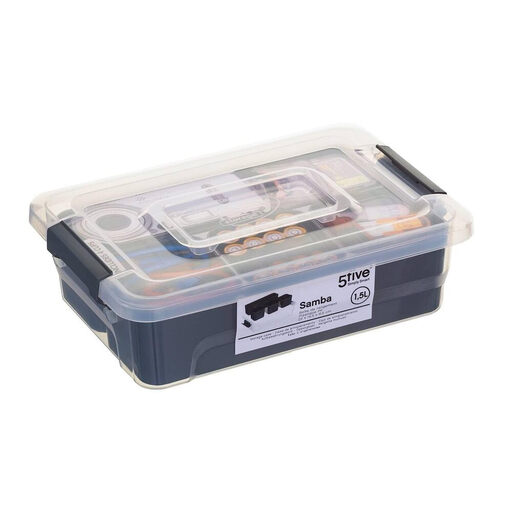
Why this product suits this profile: With a 1.5-litre capacity and four compartments, this compact box keeps small quantities of screws, beads, spices or craft materials organised without taking up much space.
The four fixed compartments prevent small items from becoming mixed up and disorganised. The stated 1 kg load limit helps you plan realistically.
Transparent PP body, secure-closing lid and compact dimensions of 22.5 × 15.5 × 7 cm.
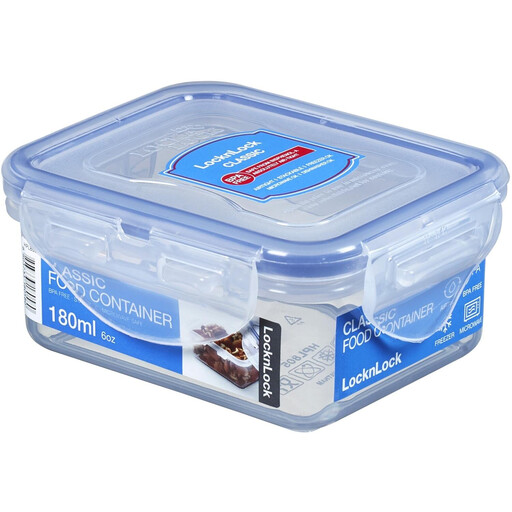
Why this product suits this profile: This small food container is designed for portioned provisions, snacks, cheese or leftovers, with clearly defined information on the closure, cleaning and temperature limits.
The information clearly distinguishes between microwave and oven use. The lid must not remain closed while heating, making the usage instructions easy to understand.
180 ml capacity, four-sided locking system, silicone seal and stated suitability for the dishwasher, freezer and microwave.
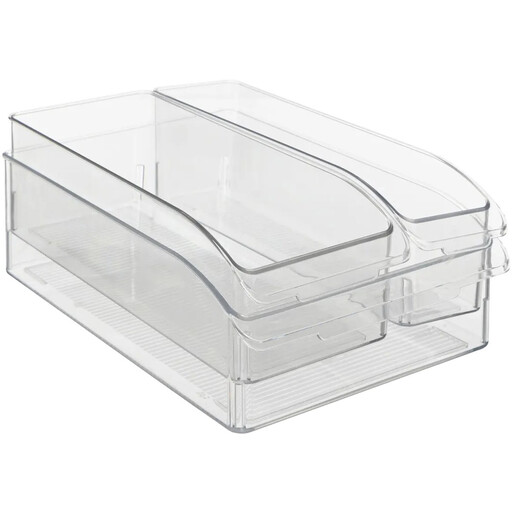
Why this product suits this profile: Three transparent containers with handles make it easier to organise the fridge and are ideal for grouping snacks, fruit, vegetables or bottles.
The product information explicitly states that the containers are not stackable. This allows you to plan around placing them side by side in the compartment.
PET material, three containers in the set, integrated handles, transparent design and stated dishwasher suitability.
We have put together a complete, regularly updated list of products that fully meet these strict selection criteria and the safety regulations applicable in the EU.
For kitchen organisation, it is best to separate items by food type and frequency of use. Dry provisions belong in suitable food storage containers, while leftovers and portioned meals should go in food containers with clearly stated leak resistance. Fridge organisers should be matched to the compartment dimensions and easy to pull out.
In the workshop, models with compartments and a clear view of the contents are practical. Heavy items should only be stored in boxes with an appropriate stated load capacity. With large stackable boxes, the shape of the lid, handles and non-slip base are particularly important.
Clean plastic boxes according to the manufacturer’s instructions. Do not use a box if its body, lid or seal shows cracks or deformation. Heat, naked flames and prolonged exposure to direct sunlight can damage plastic; follow any relevant warnings.
Only models whose product information confirms that they are suitable for food should be used. The temperature approvals, type of closure and cleaning instructions must also match the intended application. A box for dry foods is not automatically suitable for liquids or hot food.
Containers should be completely emptied, gently cleaned and dried after use. Care instructions are particularly important when storing strongly staining or greasy foods. Damaged seals may be less effective at containing odours and liquids.
Their service life depends on the material, load, temperature, cleaning and exposure to sunlight. Overfilling, sharp objects and high temperatures can cause cracks or deformation. Check the box and lid regularly, and replace any damaged parts.