
Lieferung heute & morgen

Qualitätsgarantie

Willkommens-Angebote freischalten: KOSTENLOSE Lieferung | Bis zu 80 % RABATT | Kostenlose 30-Tage-JoyPlus-Testphase
App herunterladen
A shoe bench with a seat and storage combines three functions: it gives you somewhere to sit while putting on or taking off your shoes, keeps footwear organised and provides extra space for small items. In smaller homes or narrow hallways, this piece of furniture can be a practical alternative to a separate bench and shoe cabinet.
However, models vary considerably in their dimensions, ventilation, weight capacity and internal layout. If you focus only on the design or the number of compartments, it’s easy to overlook important details.
A hallway shoe bench needs to fit the entranceway in both width and depth. Take doors, radiators, skirting boards and the space in front of the bench into account. A slim shoe bench that’s 30 cm deep can be easier to fit in many hallways than a deeper shoe cabinet with a bench.
So make sure you measure:
A shoe rack with a seat may hold plenty of pairs, but high heels, boots and slippers all need different amounts of space. Fixed compartments are less adaptable when you need to store a mix of shoe sizes and styles. Adjustable shelves are therefore worth considering if you need to accommodate several people or different types of footwear.
Check the actual height and width of the compartments in the product details, too. The number of compartments alone tells you little about how much usable space there is.
A shoe bench with a lift-up compartment is handy for keys, shoe brushes, shoe-care products and other small items. However, shoes shouldn’t be stored while damp in an enclosed space without air circulation. Open shelves make footwear easy to reach and help air circulate. For everyday use, a combination of open shelves and an enclosed compartment may be more practical than a completely closed shoe cabinet.
Dimensions are key when choosing a shoe bench for your entranceway. A seat height of around 40 to 50 cm can make it easier to put on and take off your shoes, though whether it’s right for you depends on your height and how you sit. Also check that there’s enough storage beneath the seat for what you have in mind.
For example, the SoBuy bench measures 60 × 30 × 43 cm. It’s designed for narrow spaces, but naturally offers less storage space than a wider model with more compartments.
Always treat the stated weight capacity as the manufacturer’s figure for a static load. It doesn’t automatically cover sudden impacts from sitting down, tipping or uneven use. The bench should stand on a flat, stable surface, and you should follow all the assembly instructions.
Check:
Coated chipboard can usually be cleaned with a slightly damp cloth. Bamboo surfaces can also be easy to care for, but need to be placed on a dry, level surface. Removable cushion covers are handy because you can clean them separately. Before buying, check whether the cover really is removable and what the care instructions say.
The models below vary in width, material, storage space and compartment layout. Each recommendation is based on the product details provided.
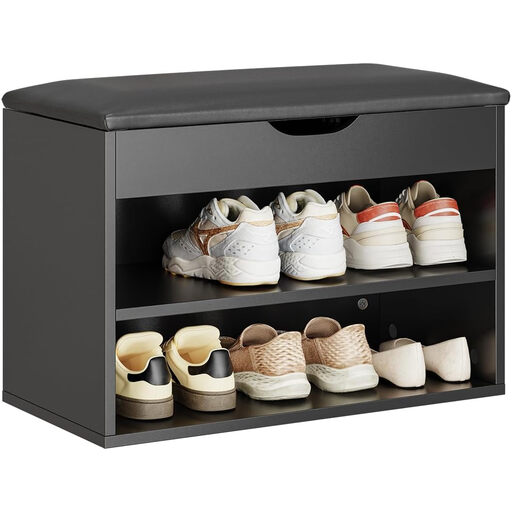
Why it suits this need: Measuring 60 × 30 × 43 cm, this compact shoe bench is designed for narrow hallways, smaller homes and limited entranceway space. It combines a seat, open shoe storage and a concealed compartment.
The clearly stated external dimensions make it easier to check whether the bench will fit. Open compartments give you quick access and help air circulate, while the lift-up compartment provides space for small items.
Compact dimensions, a PU-padded seat, one enclosed compartment and a stated static load capacity of up to 113 kg.
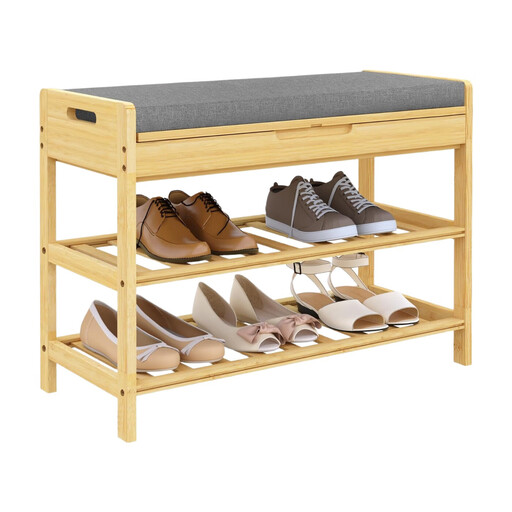
Why it suits this need: This model combines a bamboo construction with two open shoe shelves and an enclosed compartment. It’s suitable for a hallway, living room or bedroom if you value the look of natural materials and a well-organised layout.
The mix of open shelves and enclosed storage means your shoes don’t have to be kept in a completely closed cabinet. The stated dimensions of 68 × 50 × 30 cm make it easier to plan where it will go.
Bamboo frame, two open shelves, one compartment beneath the seat and a stated maximum weight capacity of 150 kg.
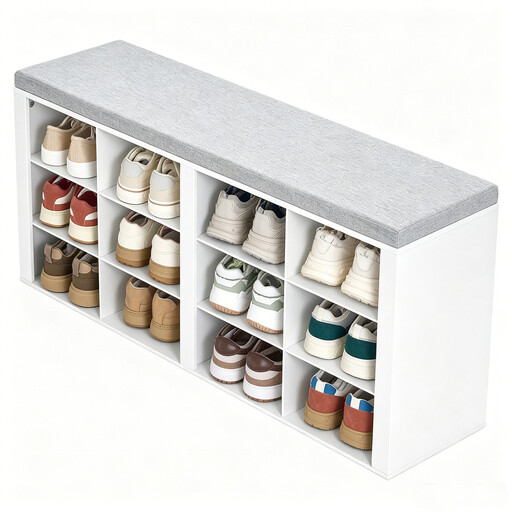
Why it suits this need: At 104.5 cm wide, this shoe bench offers plenty of space for families or households with several types of footwear. The height-adjustable shelves can be adapted to trainers, heels and taller shoes.
The adjustable shelves help solve the problem of fixed compartment heights. Removable seat covers make separate cleaning easier, and the product details state a weight capacity of 150 kg.
Twelve compartments, height-adjustable shelves, removable seat covers and dimensions of 104.5 × 30.5 × 49.5 cm.
We’ve put together a complete, regularly updated list of products that meet these strict selection criteria and fully comply with the safety regulations in force in the EU.
Models around 30 cm deep are often easier to fit into narrow entranceways. The important thing is to make sure doors can open fully and the walkway remains clear. Measure the available space, including skirting boards, and allow for the depth of the seat cushion.
It depends on the width and height of the compartments, as well as the shape of your shoes. Trainers and flat shoes need less height than boots or heels. A bench with a shoe rack and adjustable shelves may be more flexible for a mix of footwear than a model with fixed compartments.
Yes, as long as the construction, seat and weight capacity are suitable for how you plan to use it. Make sure it’s assembled securely, placed on a level surface and used within its stated maximum load. Open shelves make everyday access easier, while an enclosed compartment is better suited to small items and accessories.