
Lieferung heute & morgen

Qualitätsgarantie

Willkommens-Angebote freischalten: KOSTENLOSE Lieferung | Bis zu 80 % RABATT | Kostenlose 30-Tage-JoyPlus-Testphase
App herunterladen
Shoes in the hallway, trainers under the bed and odd pairs in the wardrobe: limited storage space can quickly lead to clutter. Stackable shoe storage boxes can help, as long as their dimensions, load capacity and accessibility suit the space you have. However, not every box is right for every style of shoe or storage situation.
Retailers often list the external dimensions. Walls, doors and frames reduce the usable space inside. This can be especially important for larger trainers, walking boots or shoes with a high ankle. Before buying, measure the longest and tallest points of your shoe and compare them with the usable internal dimensions.
Stackable boxes need to stand on a level, sturdy surface. Tall stacks can become unstable if the floor is uneven, the boxes carry different loads or the components aren’t properly secured. Check whether the boxes have a secure connection, a sturdy frame or simply a flat surface to rest on.
Transparent shoe boxes make it easier to see what’s inside, but they don’t replace regular care. Ventilation holes help air circulate, but don’t automatically prevent damp or odours. Shoes should be clean and dry before being stored. In a damp room, a sealed plastic container without sufficient airflow may not be suitable.
Measure the space you plan to use in the wardrobe, hallway or entrance. Bear in mind:
A set with multiple boxes can be expanded to suit your needs. If space is limited, it may be worth storing the pairs you wear most often first, rather than buying lots of boxes that may end up unused.
Plastic shoe boxes are often made from polypropylene, or PP for short. It’s lightweight and holds its shape, provided the walls and frame are sturdy enough. Plastic or polystyrene doors can make access easier, but they should close securely and open without needing too much force.
Look for clear information about the material, set size and dimensions. With foldable or slot-together models, it’s also important to check that the connections lock securely. A 10-compartment shoe organiser made from fabric or cardboard takes less effort to assemble, but won’t necessarily be as sturdy as a rigid box system.
Shoe boxes with a flap or front door work well on shelves and in stacks, as you can reach individual pairs from the front. That’s more convenient than having to move several boxes to get to the one at the bottom. For a wardrobe, a hanging shoe organiser may be a good option: it makes use of vertical space and doesn’t need any floor space.
When choosing shoe storage for a wardrobe or hallway, also consider how the door opens, the clearance from the floor and how easy it is to clean. Keep cardboard models away from moisture and direct sunlight. Plastic boxes can generally be cleaned with a soft, dry or slightly damp cloth; always follow the product instructions.
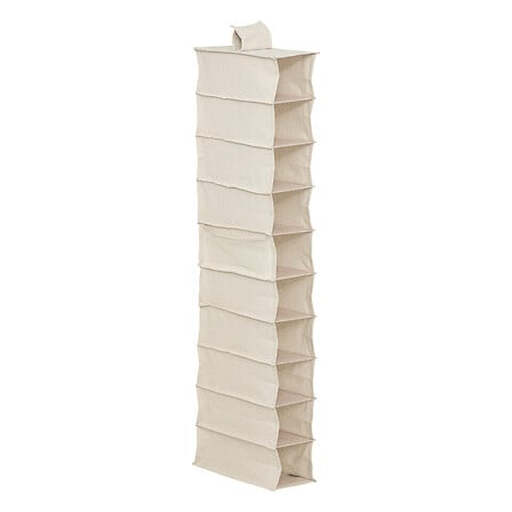
Why this product suits this need: This hanging shoe organiser makes use of the height in your wardrobe or on a suitable rail, without taking up extra floor space. Ten individual compartments and a side pocket keep your storage neatly organised.
The compartments prevent shoes from being left in loose piles on the floor. With external dimensions of 15,5 × 29,5 × 128 cm, check the available space before installing it.
Ten compartments, one large side pocket, a low product weight of 0,613 kg and a hook included. Keep the cardboard material dry and avoid overloading it.
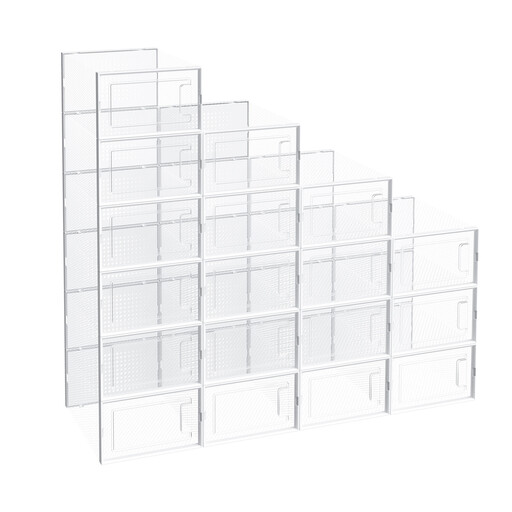
Why this product suits this need: This 18-piece set is designed for households with several pairs of shoes and anyone looking for a coordinated, stackable storage solution for the wardrobe or hallway. Front doors and transparent panels make it easier to identify what’s inside.
The front opening means you don’t have to move several boxes to reach your shoes. Before buying, check that each box’s dimensions of 35 × 25,2 × 19 cm fit the available width, depth and height.
18 PP boxes with transparent fronts, front doors and ventilation holes. The product details state that they’re designed for trainers up to UK size 11, but it’s still worth checking the shape of your shoes.
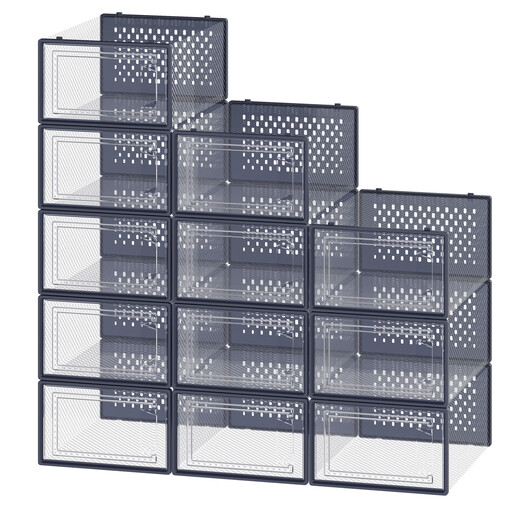
Why this product suits this need: These 12 individual boxes are a good choice if you store trainers and need to access them often. Transparent panels and front openings make it easy to see what’s inside, while the stackable design makes use of vertical space.
At 33,3 × 23,2 × 14,3 cm per box, it’s worth checking the fit before buying. The ventilation holes allow air to circulate, but don’t replace dry storage.
12 PP boxes with transparent bodies, blue fronts and ventilation holes. They’re designed for different types of shoe, but shoe height is still the key thing to check.
We’ve put together a complete, regularly updated list of products that meet these strict selection criteria and fully comply with the safety regulations in force in the EU.
Keep the shoes you wear most often on the front or middle shelves. You can store seasonal pairs higher up or further back. With stackable boxes, place the heaviest one at the bottom wherever possible. Avoid sharp objects, overfilled compartments and damp shoes.
For a tidy storage solution that lasts, it’s also worth sorting your shoes consistently, for example by how often you wear them, by type or by season. Labels can be useful for non-transparent boxes. Before assembling the boxes, check all the connections and doors.
It depends on the construction, the surface and the manufacturer’s instructions. Only follow a stated maximum stacking height if the manufacturer has explicitly provided one. For tall stacks, placing them near a wall or piece of furniture can help, as long as this doesn’t block any doors.
Not necessarily. The key measurements are the internal length, width and height. Even if the product description mentions a particular shoe size, the shape of the sole, padding and a high ankle can all affect how much space is needed. Measure the specific pair before buying.
Store shoes when they’re clean and dry, and don’t put them away straight after wearing them. Shoe boxes with ventilation can help air circulate. Check your shoes regularly and clean the boxes according to the product instructions. Keep cardboard or fabric organisers away from moisture and direct sunlight.