
Same-day & Next-day Delivery

Quality Guaranteed

Unlock Your Welcome Offers: FREE Delivery | Up to 80% OFF | Free 30-day JoyPlus trial
Download the APP
By a Joybuy Product Recommendation Officer, August 28, 2026
A good stainless steel salad bowl is more than just a container; it's a cornerstone of the modern kitchen. But when choosing one, many buyers face a dilemma: Why does a bowl advertised as "stainless" start to rust after just a few months? Or why does vigorously whisking a dressing turn into a slippery ordeal on the countertop?
These problems are often due to subtle defects or exaggerated marketing claims. Before you make a decision, it's helpful to know the most common pitfalls that can lead to a purchase you'll regret.
To avoid these pitfalls, you should focus on a few crucial features. These define the durability and functionality of your future kitchen bowl.
The quality of the stainless steel is the most important criterion. Look for designations like 18/8 stainless steel or 304. These alloys contain a higher percentage of chromium and nickel, making them more resistant to rust, corrosion, and acids. Such a bowl is an investment in durability and food safety. In addition to the material, wall thickness is also crucial. A thicker-walled bowl is more stable, resists dents better, and has a more premium feel.
For anyone who uses their bowl for active prep work and not just serving, a stable base is essential. Making a kitchen bowl non-slip is a simple but effective design choice. Models with a permanently integrated silicone base or a TPR (Thermoplastic Rubber) coating adhere securely to the work surface. This allows for one-handed operation and prevents slipping even during vigorous mixing—ideal for a stainless steel mixing bowl that is also used for baking.
The ideal bowl adapts to your needs. A stainless steel bowl set offers clear advantages here: different sizes cover various tasks—from a small bowl for dressings to a large one for dough or family-sized salads. Moreover, sets can usually be nested to save space.
Design also plays a role. While a polished surface is classic and easy to clean, a hammered-finish stainless steel serving bowl can add an elegant accent to the dining table. It combines functionality in the kitchen with appealing aesthetics for serving.
Instead of making a one-size-fits-all recommendation, we have identified products that meet specific user profiles.
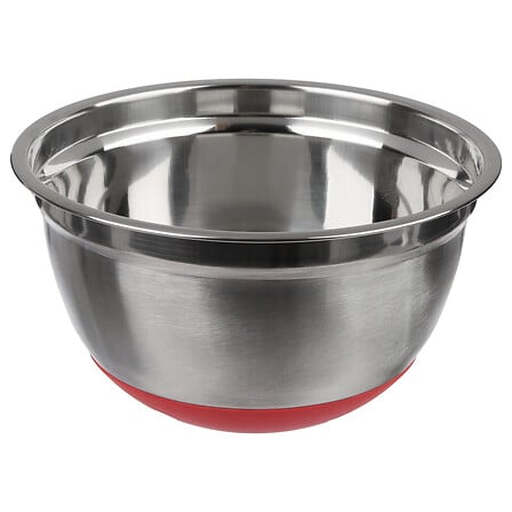
Why This Fits Their Persona: Ideal for daily use where functionality and stability are top priorities. This bowl is a reliable assistant for preparing salads, mixing baking ingredients, or handling other everyday kitchen tasks.
The innovative non-slip base specifically prevents the bowl from sliding on the countertop—a direct solution to the common pitfall of poor stability.
Practical 2.5-liter capacity for common household sizes; lightweight for easy handling.
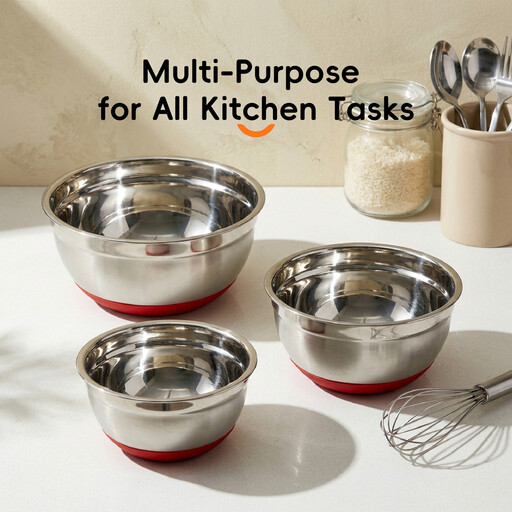
Why This Fits Their Persona: Perfect for cooks who need different sizes for various tasks—from baking to marinating—but also value space-saving storage.
This set solves the problem of impractical storage, as the three bowls can be nested inside one another. Additionally, each bowl features a silicone base, ensuring stability across all sizes.
Three versatile sizes (18/20/24 cm); space-saving, nestable design; non-slip silicone base on every bowl.
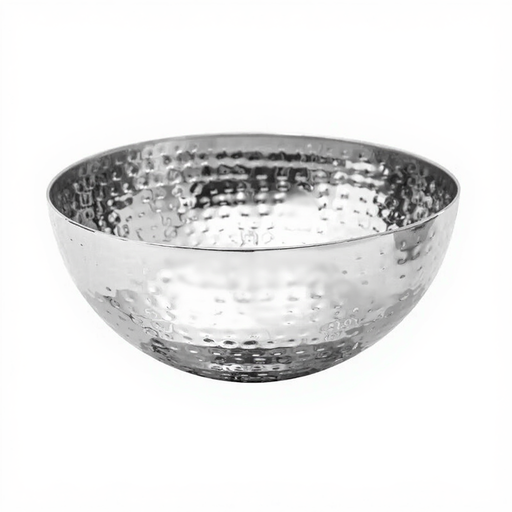
Why This Fits Their Persona: For anyone looking for a bowl that looks as good on the dining table as a stylish serving piece as it does in the kitchen. The hammered finish is a visual highlight.
This bowl avoids the trap of purely functional but unattractive kitchenware. Its robust stainless steel construction resists dents and scratches, while the design qualifies it for serving at special occasions.
Elegant, hammered finish; generous 24 cm diameter, ideal for serving salads or side dishes for multiple people.
We've compiled a complete, up-to-date list of products that fully meet these strict selection criteria and safety standards.
Most basic stainless steel bowls are dishwasher-safe. However, for models with a glued-on or coated silicone base or a TPR base, you should check the manufacturer's instructions. Hand washing is sometimes recommended to ensure the longevity of the non-slip coating.
A good indicator is the material specification. Look for labels like 18/8 stainless steel or 304 stainless steel in the product description. These grades are designed for food contact and offer high resistance to rust and acids. A heavier weight and thicker wall are also often signs of more robust quality.
Yes, a stainless steel mixing bowl is excellent for preparing baked goods. It's ideal for mixing dough, whipping egg whites, or preparing creams. Stainless steel is hygienic, doesn't absorb odors, and is easy to clean. However, note that most stainless steel bowls are not suitable for use in the oven unless explicitly stated by the manufacturer.