
Lieferung heute & morgen

Qualitätsgarantie

Willkommens-Angebote freischalten: KOSTENLOSE Lieferung | Bis zu 80 % RABATT | Kostenlose 30-Tage-JoyPlus-Testphase
App herunterladen
A storage shelving unit should create extra storage without becoming a space problem or a safety risk. In practice, disappointing purchases are often caused not by the design, but by unclear load capacity details, unsuitable dimensions or an assembly method that doesn’t work where you plan to put it.
A figure such as “600 kg load capacity” doesn’t automatically apply to each individual shelf. It’s important to check whether the figure applies to the whole unit, each shelf or specific conditions. It usually refers to a static load: the weight is evenly distributed and isn’t increased by impacts or moving loads.
Before buying, check:
A shelving unit can have the right external dimensions and still prove unsuitable for everyday use. In a garage, you’ll need room to open doors and take out boxes. In a hallway, the depth shouldn’t obstruct the way through. You should also factor in skirting boards, sockets and radiators.
So don’t just measure the available wall width. Also check:
A tool-free shelving unit is often assembled using a slot-in or grooved system. This can make assembly easier, but you still need to check the connections. Wall fixings are often a good idea for tall or heavily loaded units, and may be required according to the product information.
Make sure the floor is level, all the connections are fully engaged and you follow the instructions provided. If you’re choosing a metal shelving unit with MDF shelves, you should also keep it away from moisture unless the manufacturer says it’s suitable for damp conditions.
A living-room shelving unit with a moderate load capacity is usually sufficient for books, ornaments and lightweight storage boxes. A heavy-duty shelving unit for the garage, workshop or cellar, on the other hand, needs to meet specific weight requirements. Allow some extra capacity rather than putting the unit under its stated limit all the time.
For paint tins, tool cases or spare parts, a storage rack with a high load capacity and adjustable shelves is a practical choice. Store heavier items as low down as possible and avoid concentrating the load on small areas.
A kitchen shelving unit should have easy-to-reach shelves for spices and pantry essentials. A bathroom shelving unit, by contrast, needs a design suited to a humid environment. In the hallway, a shoe cabinet with a mirror can combine several functions, while a space-saving shelving unit for a small flat makes the most of vertical space.
Adjustable shelves make it easier to store items of different heights. Check how far apart the shelves can be positioned and whether the unit remains stable when the load isn’t evenly distributed.
For a tall freestanding shelving unit, anti-tip protection is particularly important. A hanging wardrobe organiser, on the other hand, frees up floor space but has a much lower load capacity than a steel shelving unit. A foldable model can be handy for items you only use occasionally, but it won’t necessarily be suitable for storing heavy items permanently.
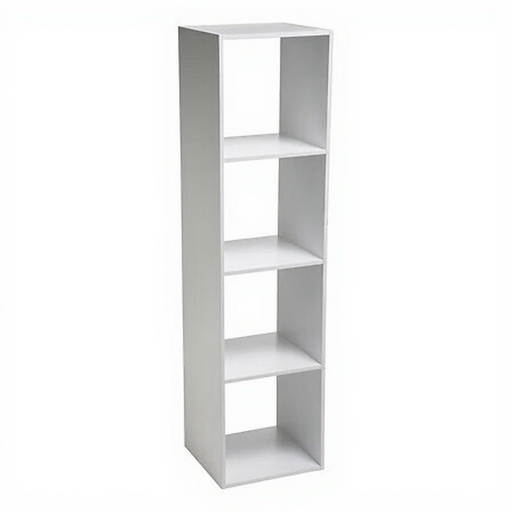
Why this product suits your needs: This freestanding shelving unit has four open compartments, making it suitable for books, ornaments, boxes or everyday essentials in the living room, bedroom or home office.
Its external dimensions of 134 x 34.5 x 32 cm make it easier to plan where it will go. The open design avoids deep compartments that are difficult to reach.
Four open shelves, a white finish and assembly with the instructions provided.
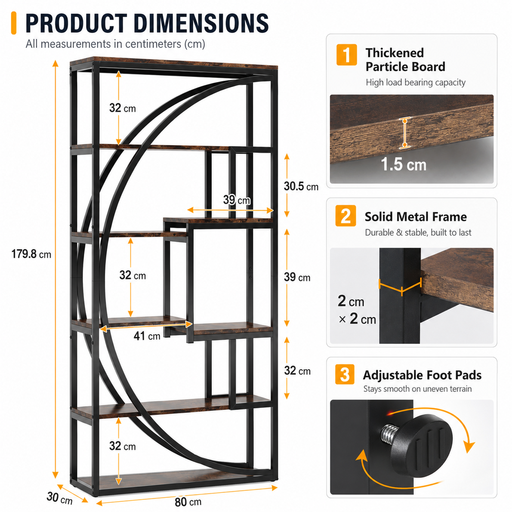
Why this product suits your needs: The combination of a black metal frame and a vintage brown wood-effect finish makes it a good fit for the living room, study or bedroom, while making use of vertical space.
The dimensions of 80 x 30 x 179.8 cm make it easy to see how much floor space you’ll need. Eight open compartments help you organise items of different sizes.
Five shelves, eight open compartments and a design combining a metal frame with chipboard.
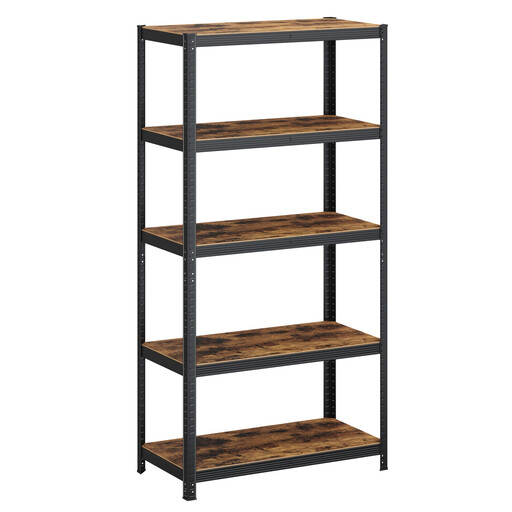
Why this product suits your needs: For a garage, shed, cellar, workshop or small business, this metal shelving unit offers five shelves and a high stated load capacity.
The product details state a load capacity of 120 kg per shelf and 600 kg in total. The shelves are also adjustable in 5 cm increments, and anti-tip protection is included.
Tool-free slot-in assembly, a divisible design and a galvanised steel frame with MDF shelves.
We’ve put together a complete, regularly updated list of products that meet these strict selection criteria and fully comply with the safety regulations in force in the EU.
Place the shelving unit on a level, sturdy surface. Tall models should be secured to the wall using the anti-tip kit provided, particularly in homes with children. Keep heavier items on the lower shelves. After assembly, check all slot-in connections and screws.
For many living-room shelving units, a soft, slightly damp cloth is all you need. MDF and chipboard surfaces shouldn’t be left in contact with water for extended periods. In a cellar or garage, you should also watch out for condensation and make sure there’s adequate ventilation.
It depends on what you’re storing. Books and ornaments need less load capacity than tools or crates of drinks. What matters is the stated capacity per shelf and distributing the weight evenly. It’s a good idea to leave a safety margin.
First, make sure it’s level, then fit the anti-tip protection as instructed. Use wall plugs and screws that are suitable for your wall. The type of wall – such as concrete, brick or plasterboard – determines which fixings you’ll need.
Not every metal shelving unit is designed for bathrooms, cellars or unheated garages. Check the surface treatment, material details and the manufacturer’s guidance. MDF shelves can swell in high humidity, even if the frame is made of metal.