
Lieferung heute & morgen

Qualitätsgarantie

Willkommens-Angebote freischalten: KOSTENLOSE Lieferung | Bis zu 80 % RABATT | Kostenlose 30-Tage-JoyPlus-Testphase
App herunterladen
Clutter often happens not because there’s too little storage space, but because items are kept without a proper system. Storage boxes can neatly group clothing, toys, household items or craft supplies and help you make better use of existing wardrobes, shelves, cellar and garage space.
However, a few typical marketing promises can lead to poor choices when buying. A box looks spacious in product photos but later doesn’t fit your shelf. A supposedly sturdy model warps under excessive load. And a transparent box isn’t automatically airtight or suitable for every storage location.
The dimensions stated usually refer to the external measurements. Lids, reinforcements, handles and material thickness reduce the usable internal space. Before buying, you should therefore measure the compartment, shelf or wardrobe precisely and allow a little play for inserting the box.
With cube organisers, for example, 30 × 30 × 30 cm doesn’t fit every cube shelf. A compartment with an internal width of 30 cm can be too tight because of the frame or back panel. So check the furniture’s measurements, not just the product name.
Stackable boxes need a sturdy lid, a non-slip base and a shape that limits sideways movement. Look for a stated maximum load and whether it applies per box or to the whole stack.
A plastic storage box with a lid is better suited to vertical stacking space than a soft fabric box. The latter is handy on a shelf but shouldn’t be loaded with heavy items or used as a surface to place things on.
Transparent storage boxes make it easier to find what you need but don’t automatically protect contents from moisture. A flip lid can reduce dust, whereas a truly sealed design requires additional gaskets or an appropriate locking mechanism.
For textiles in the cellar, check the storage location, place clothing inside completely dry and avoid putting the box directly on a damp floor. For longer-term storage, a vacuum storage bag can also be useful. Keep sharp objects and pointed edges away, as they can damage the material.
Choose the box according to the item and where it will be stored:
For items you need frequently, handles or front access are practical. Boxes with lids offer better protection but need to be fully accessible to remove the contents.
PP plastic is easy to wipe clean and keeps its shape, provided the stated load limit is respected. With transparent models, the contents are easy to recognise. Fabric boxes made from non-woven material are light and foldable, but need a stable insert and shouldn’t be washed if the manufacturer specifies cleaning only with a damp cloth.
With textile boxes, it’s worth checking the base board, seams and handles. A construction of cardboard and non-woven fabric is suitable for clothing, books or light household items. For heavy tools or damp environments, plastic boxes are usually more appropriate.
Look for details such as the maximum static load, type of closure and permitted environment. A snap-on lid is suitable for dust protection and transport. For food, only use products whose material and usage information expressly allow that application. Many organiser boxes are not intended for storing liquids.
Direct heat, open flames and prolonged intense sunshine can deform or discolour plastic. In the home, boxes should also be positioned so that children can’t climb on them.
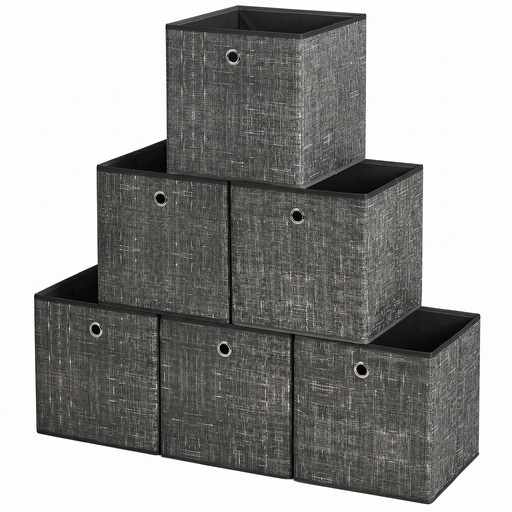
Why this product fits the profile: The 6-piece set is designed for shelf compartments with matching cube dimensions and offers a simple way to organise clothing, books or smaller household items by category.
The spec lists dimensions of 30 × 30 × 30 cm, a cardboard and non-woven fabric construction, and a maximum static load of 5 kg per box. That makes it easier to check suitability against your shelf before buying.
Foldable design, carrying handles and six boxes per set. The base plates are inserted for use and removed again for storage.

Why this product fits the profile: This model is aimed at households that want to store seasonal clothing, baby items or household goods visibly and in a stackable way.
The spec mentions PP plastic, a 2.5 mm body thickness, snap-on lids, integrated handles and a non-slip base. Even so, you should observe the load limit before stacking.
Transparent design for quick contents checks and a lid for protected storage. Suitable for wardrobe, utility room, balcony or car boot.
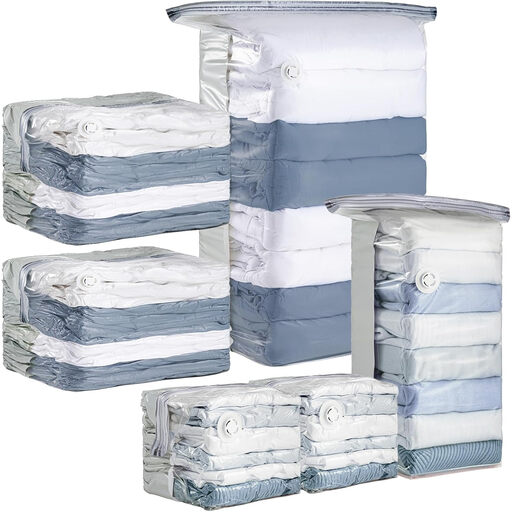
Why this product fits the profile: For duvets, blankets, pillows or seasonal clothing, the cube-shaped design can be a space-saving addition to your wardrobe and storage cupboard.
The set uses a double zip with slider clip and a valve for conventional vacuum cleaners. Textiles must be dry and the closure fully sealed before vacuuming.
PA and PE materials, water-repellent construction, plus three large and three medium bags in the set. Keep away from sharp objects and open flames.
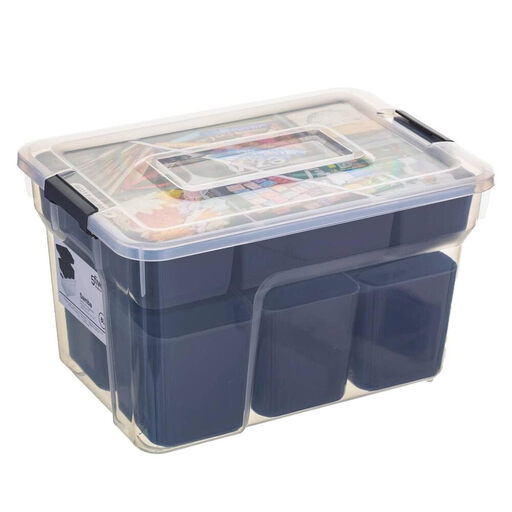
Why this product fits the profile: Ten internal compartments are suitable for beads, buttons, screws, electronic accessories or other small parts in a hobby room, kitchen and garage.
The compartments prevent small parts from getting mixed together in a large box. The transparent lid makes the contents visible; the stated maximum load is 7 kg.
Polypropylene construction, 10 separate compartments and side latches. According to the product details, the box is not stackable and not intended for liquids.
We’ve compiled a complete, continuously updated list of products that fully meet these strict selection criteria and the safety regulations applicable in the EU.
For clothing, foldable fabric boxes, wardrobe organisers with handles or vacuum storage bags are suitable. Fabric boxes are practical for regular access. Vacuum bags save space for bedding and seasonal clothing, but should be filled only with dry, clean items and kept free from sharp objects.
Store only completely dry items and choose a dry, well-ventilated location. Plastic boxes with lids reduce dust but are no substitute for controlled room humidity. In the cellar, boxes should be raised and not placed directly against exterior walls or on the floor.
A storage box set can make sense if you want to organise several categories at once. However, compare the usable storage space, material thickness and load capacity per box. A larger set isn’t automatically more economical if individual boxes are too big or too small for your storage space.