
Lieferung heute & morgen

Qualitätsgarantie

Willkommens-Angebote freischalten: KOSTENLOSE Lieferung | Bis zu 80 % RABATT | Kostenlose 30-Tage-JoyPlus-Testphase
App herunterladen
A dead car battery or a flat tyre always happens at the worst possible time. A jump starter with a compressor promises to solve both problems with a single device, making it an indispensable part of any car emergency kit. However, the market is flooded with products making lofty promises. Many drivers invest in a multi-function device, only to find it unreliable or impractical in a critical moment. Before you make a purchase, it's crucial to understand the common pitfalls.
Common Pitfalls When Buying:
To make an informed decision, you should focus on the technical specifications that are relevant in practice. A good car jump starter power bank is characterised by a balanced combination of power, durability, and functionality.
The peak current (measured in Amps, A) is a starting point, but pay close attention to the engine compatibility ratings (e.g., "for petrol engines up to 8.0L and diesel engines up to 6.0L"). This specification provides a more practical assessment of the car battery booster's performance. A device for a small car with a petrol engine requires significantly less power than a jump starter for a large SUV with a diesel engine. Check if the manufacturer specifies a continuous starting current, as this value is more meaningful.
Capacity is specified in milliampere-hours (mAh) and determines how many times you can jump-start a car or charge your smartphone. However, the underlying battery technology is more important:
A good electric tyre inflator should do more than just pump air. Look for the following features:
Based on these criteria, we have identified a few models that are particularly well-suited for different user profiles.
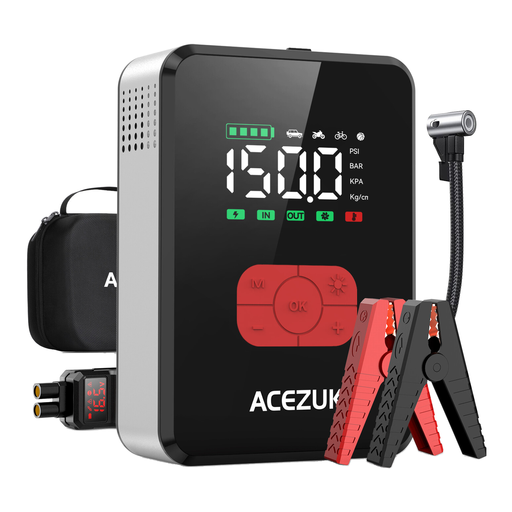
Why This Fits Their Persona: This device is an all-in-one solution for everyday use. The combination of high jump-starting power and a smart compressor with a large display and preset modes makes it especially user-friendly for those seeking a straightforward and reliable solution for roadside emergencies.
The smart compressor with auto-shutoff and the display on the jumper clamp prevent user error, avoiding the trap of impractical extra features.
Powerful enough for large petrol and diesel engines (up to 12L, according to the manufacturer); smart compressor with a 3.3-inch display and 4 presets.
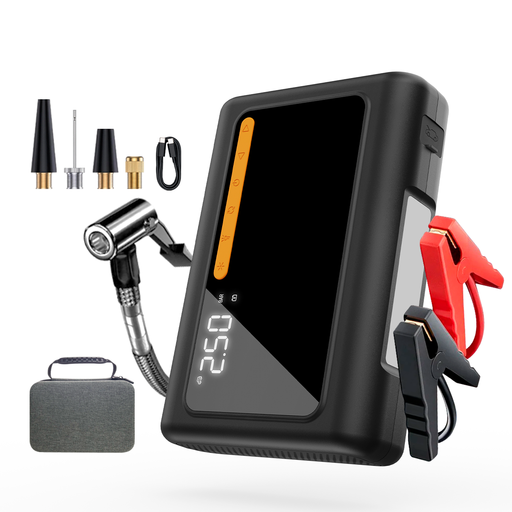
Why This Fits Their Persona: Ideal for users who prioritise maximum reliability, safety, and longevity. If you want to store the device in your car for years without worrying about recharging or extreme temperatures, this is the right solution. Suitable for owners of multiple vehicles or for use in harsh conditions.
The sodium-ion technology directly addresses the weaknesses of standard lithium batteries: low self-discharge (up to 5 years of standby, per the manufacturer), high cycle life (≥ 6,000), and a wide, safe operating temperature range.
Extreme durability and maintenance-free operation; high safety in both heat and cold (-40°C to 80°C); integrated 150 PSI compressor and PD60W fast-charging function.
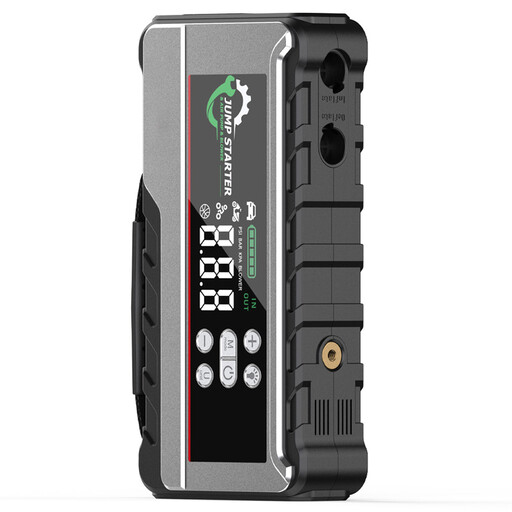
Why This Fits Their Persona: For drivers looking for a multi-functional solution that offers great value for money. It provides not only jump-starting and a compressor but also a fast PD65W charging function that can even power laptops on the go. A practical choice for budget-conscious users who don't want to compromise on functionality.
This device avoids the trap of useless extra features by offering a genuinely fast and versatile PD65W charging function for modern electronics like laptops and tablets.
Very fast charging (PD65W) for external devices; integrated 150 PSI compressor and an additional blower function for items like air mattresses.
We have compiled a complete, up-to-date list of products that fully meet these strict selection criteria and all relevant safety standards.
1. How often do I need to charge a jump starter power bank? This largely depends on the battery technology. Conventional lithium-ion devices should be recharged every 2 to 3 months to ensure they are ready for use. Models with sodium-ion batteries have a significantly lower self-discharge rate and, according to manufacturers, often only need to be charged every few years or after use. Always check the manufacturer's recommendation.
2. Is a higher peak current always better? Not necessarily. An extremely high peak current is not required for most standard passenger cars (petrol or diesel). It is more important that the device's power matches your vehicle's engine. A specification like "suitable for 8.0L petrol / 6.0L diesel" is often a more reliable indicator than a pure peak amp value. An oversized device offers no additional benefit for a smaller vehicle.
3. Can I jump-start a diesel engine with one of these devices? Yes, but it is crucial to choose a model designed for it. Diesel engines have a higher compression ratio and require a significantly higher and more sustained current to start, especially in cold weather, compared to petrol engines. Pay close attention to the manufacturer's specifications regarding suitability for diesel engines and the maximum engine displacement. Devices designed only for small petrol engines will fail on a diesel engine.