Parents looking to limit sugar
You want to check the sugar content and portion size of a waffle for snack time, rather than relying only on a claim on the front of the pack.


For a toddler’s snack, neither child-friendly packaging nor a “reduced sugar” claim tells the whole story. Compare the sugar per 100 g, the ingredients and the portion you plan to serve. Baking waffles at home gives you control over the ingredients and size, but takes time. With packaged waffles, it’s particularly important to check the specific product’s nutrition table.
You want to check the sugar content and portion size of a waffle for snack time, rather than relying only on a claim on the front of the pack.
You check for wheat and other ingredients before buying, or need an option that is clearly labelled gluten-free.
You’re weighing up a ready-to-eat packaged waffle against baking your own, where you can choose the recipe and size yourself.
For toddler snack time, the main difference between homemade and packaged waffles is how much control you have over the ingredients and portion. A regular sweet waffle can be planned as a defined treat, but a “reduced sugar” claim doesn’t replace checking the nutrition information on any ready-made product.
A good choice if: You want to choose the ingredients and size yourself, and have time and a waffle maker. REWE’s quark waffle recipe uses a ripe banana instead of added table sugar.
Bear in mind: The banana still adds sugar to the recipe. REWE’s version includes ingredients such as wheat flour, egg and dairy products. Preparation and cleaning also take time.
A good choice if: You need a ready-made option and want to compare a product carrying this claim with other waffles.
Bear in mind: “Reduced sugar” is a comparative claim, not proof that the product has a low sugar content per 100 g. Lebensmittelklarheit makes a clear distinction between these claims.
A good choice if: You’re deliberately planning one as a small treat.
Bear in mind: Sugar content varies by product. Verbraucherzentrale suggests using a child-sized handful as a guide to a portion of sweets and snacks.
| Criterion | What to check when buying | Who it matters most to |
|---|---|---|
| Sugar content | Compare sugar per 100 g in the nutrition information; don’t assume that a sugar-reduction claim means the absolute amount is low. | If I want to limit sugar, I need a figure I can compare across packs. For around 36% of consumers, sugar content is the most important factor when choosing. |
| Ingredients and gluten | Check the ingredients list for wheat and other declared allergens. If a gluten-free diet is required, look for an explicit gluten-free label. | If I need to avoid gluten or certain ingredients, the labelling determines which waffles are suitable. For around 29% of consumers, this check takes priority. |
| Portion | Check the weight of each waffle and the pack size, and decide on a portion before serving. | An open pack makes it harder for me to keep a snack-time treat to a set portion. Around 21% of consumers put portion planning first. |
| Making your own | When choosing a recipe, consider its ingredients, the size of each waffle and the preparation time needed. Don’t assume “sweetened with fruit” means sugar-free. | If I bake at home, I can choose the recipe, but I need to set aside time. For around 14% of consumers, this control is the main reason for choosing to bake. |
A reduction compared with a similar food doesn’t tell you how much sugar the waffle actually contains. Lebensmittelklarheit distinguishes between the two claims.
Start by comparing the sugar per 100 g, then use the reduction claim as additional information.
Ingredients can contain naturally occurring sugars even when no sugar has been added. So the front of the pack doesn’t tell you the total sugar content on its own.
Check the ingredients list and the “of which sugars” entry in the nutrition information.
Waffle sizes vary. Size alone doesn’t tell you the sugar content per 100 g or the amount of sugar in the portion you plan to serve.
Compare packs using the same reference amount, then decide how many waffles to serve at snack time.
The label answers a question about ingredients, not about sugar content or whether the product is suitable as an everyday snack.
If gluten needs to be avoided, check for the relevant label. For comparing sweetness, the ingredients list and nutrition information still matter.
The examples below cover different recipes and types of baked goods. Information about one product doesn’t apply to a brand or retailer’s entire range.
REWE publishes a recipe for quark waffles made with ripe banana instead of added table sugar.
Lidl Kochen publishes a recipe for homemade low-fat waffles.
The product information for BISCOTTO Vanilla Wafers is an example of packaged sweet waffles.
EDEKA24 has a category for baked goods, biscuits and waffles, including waffle mixes.
The Lotus Biscoff product described by EDEKA24 is caramelised biscuit, not a waffle.
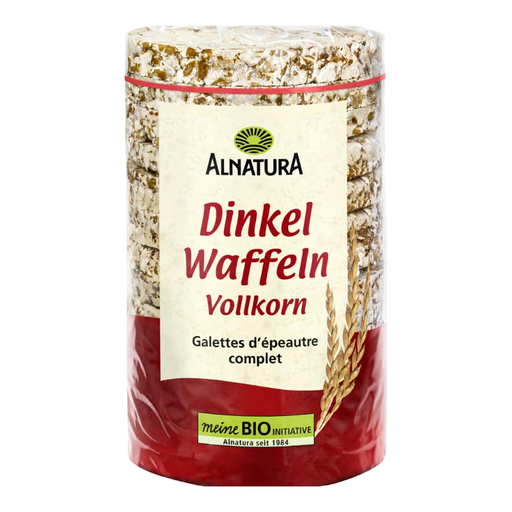
This packaged spelt waffle is an option if you want to compare ingredients, sugar information and portion size for toddler snack time using the details on the specific pack.
 No image available
These packaged spelt waffles are an option if you want to decide on the portion yourself. Check the sugar per 100 g and the ingredients on the pack. If a gluten-free diet is required, spelt is an important ingredient to check.
No. Lebensmittelklarheit explains that a sugar-reduction claim compares a product with a similar food. The nutrition information per 100 g tells you how much sugar the specific waffle contains.
No. Ingredients can contain naturally occurring sugars even when no sugar has been added. So, as well as checking the claim on the front of the pack, look at the sugar per 100 g and the ingredients list.
There isn’t one set number of waffles that works for every product, as sizes vary. Verbraucherzentrale recommends no more than one portion of sweets and snacks a day, and suggests using a child-sized handful as a guide. Take other sweet snacks eaten that day into account, too.
Check the ingredients list, particularly for gluten-containing cereals such as wheat or spelt. If a gluten-free diet is required, also look for a clear “gluten-free” label on the specific product.