Parents looking for an everyday breakfast
You want to combine chocolate flavour with wholegrain ingredients without basing your decision on a wholegrain claim alone. It’s also worth checking the sugar per 100 g.


When choosing a breakfast cereal to serve regularly to a toddler, wholegrain alone isn’t enough to go on. Compare the sugar per 100 g, ingredients and allergens in chocolate cereals too. If chocolate flavour matters, products that state their wholegrain ingredients may be worth considering, but a higher wholegrain content doesn’t automatically mean less sugar. If your child has an allergy or intolerance, always prioritise the current information on the pack over these comparisons.
You want to combine chocolate flavour with wholegrain ingredients without basing your decision on a wholegrain claim alone. It’s also worth checking the sugar per 100 g.
Your child likes chocolate cereal, but not every shape or texture. Compare cereal balls and crunchy muesli as different products, and check both the wholegrain content and sugar level of any variety your child will eat.
If you need to avoid certain ingredients, check the current ingredients list, highlighted allergens and any may-contain warnings before every purchase. Wholegrain products can contain gluten-containing cereals, and recipes may change.
For chocolate cereal served at a toddler’s breakfast, sugar content, wholegrain ingredients and suitability are separate considerations. Start by comparing the information on the specific products. If you need to avoid allergens, check the ingredients before letting other features influence your choice.
| What matters to you | What to check | Who it matters most to |
|---|---|---|
| Sugar in an everyday breakfast | Compare ‘of which sugars’ per 100 g for the products as sold. Also check the ingredients list for sugar and other sweetening ingredients. | If chocolate cereal is served regularly at breakfast, I don’t want to choose based on the wholegrain claim alone. Around 42% of consumers would put a lower sugar content first. |
| Wholegrain content and type of cereal | Look for a stated wholegrain percentage and the type of cereal named. Consider these alongside the sugar content. | I want to know which wholegrain cereal is actually in the product, rather than judging it by its chocolate-themed packaging. Around 33% of consumers would prioritise this. |
| Ingredients and allergens | Check the current ingredients list, highlighted allergens and may-contain warnings. Don’t rely on product names or previous packaging. | If someone in my household needs to avoid certain ingredients, I’ll make my decision based first on the information on the specific product. For around 25% of consumers, this would be their main priority when buying. |
Wholegrain content and sugar levels tell you different things. Nestlé states that NESQUIK Knusper-Frühstück contains 52.7% wholemeal wheat flour and 22.1 g of sugar per 100 g. So a stated wholegrain content doesn’t answer the question of how much sugar is in it.
Compare the nutrition information per 100 g, then check which wholegrain cereal the product contains.
‘Chocolate’ or ‘wholegrain’ won’t tell you all the cereals and other ingredients used. The EU Food Information Regulation lists gluten-containing cereals, including wheat and oats, in Annex II.
If your child has an allergy or intolerance, read the information on every current pack, including any may-contain warnings.
In its 2019 product monitoring, the Robert Koch Institute reported a median of 24 g of sugar per 100 g for breakfast cereals with child-oriented packaging. This figure describes the products studied, not every individual variety or its current recipe.
Don’t use characters or packaging design as a shortcut. The nutrition information and ingredients on the pack you choose are what matter.
‘Less sweet’ is no substitute for nutrition information. EDEKA24 states that Dr. Oetker Vitalis Knusper Schoko Müsli weniger süß contains 14 g of sugar per 100 g.
Check the actual sugar content and ingredients list instead of comparing different serving sizes or relying on the product description alone.
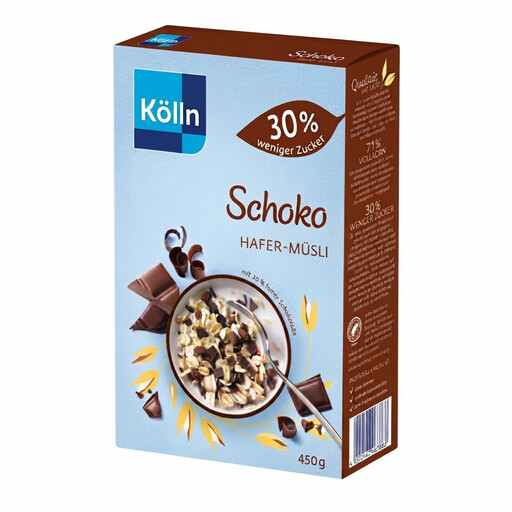
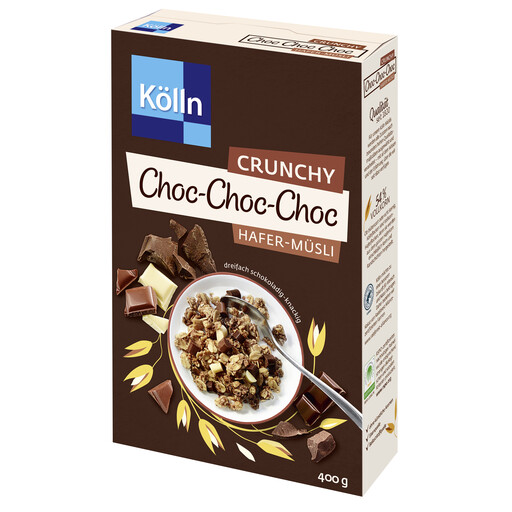
Kölln is included here for its chocolate oat cereal, Zauberfleks Schoko.
NESQUIK Knusper-Frühstück is a chocolate cereal that lists wholemeal wheat flour.
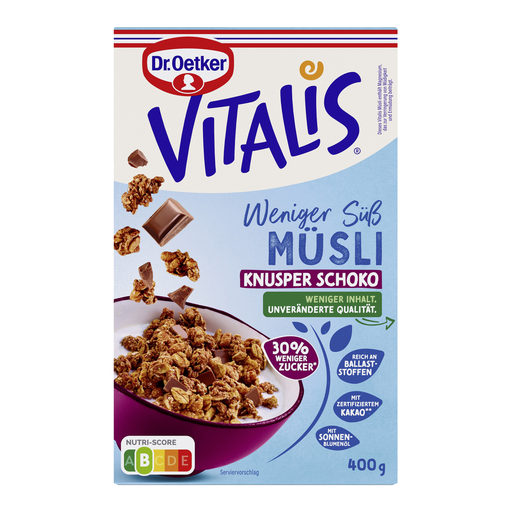
Vitalis Knusper Schoko Müsli weniger süß is worth comparing if you’re looking for chocolate crunchy muesli rather than cereal balls.
REWE stocks several chocolate-flavoured Kellogg's cereals, including Choco Krispies Chocos and Trésor.
This selection features chocolate oat and chocolate crunchy mueslis for comparing ingredients and nutrition information. It doesn’t include cereal balls. Before serving any of these products for a toddler’s breakfast, take a close look at the current pack, particularly if the product contains sweeteners or has a higher sugar content.
 No image available
A way to compare chocolate flavour and oat ingredients at breakfast. Check the sugar per 100 g and wholegrain content on the current pack. If you need to avoid allergens, also check the ingredients and may-contain information.
 No image available
For households looking to compare chocolate crunchy muesli with a stated wholegrain content. EDEKA24 states that the 400 g pack of Vitalis Knusper Schoko Müsli weniger süß contains 56% wholegrain oats and 14 g of sugar per 100 g. Always refer to the current pack for ingredients and allergens.
 No image available
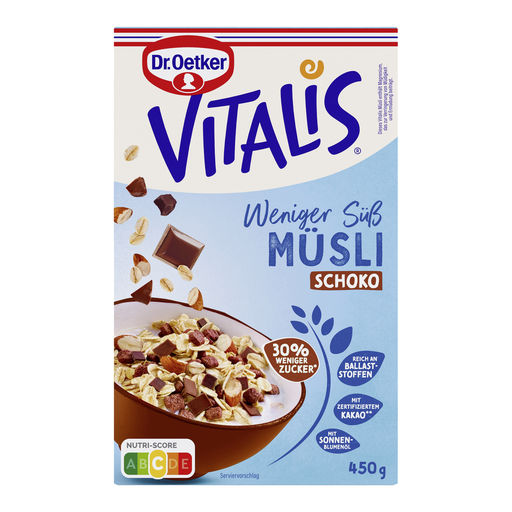
A 450 g option to compare with other chocolate crunchy mueslis. Check the wholegrain content, sugar per 100 g, ingredients and allergens directly on its current pack. Don’t assume the information for the 400 g variety also applies to this one.
 No image available
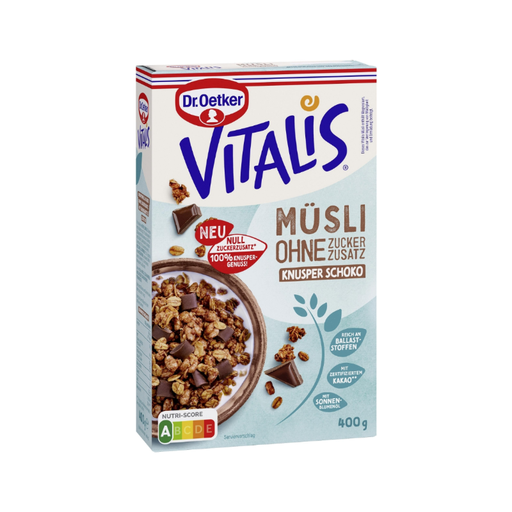
For this chocolate crunchy muesli, the ingredients list is especially important alongside the sugar content. It lists maltitol and warns that excessive consumption may have a laxative effect. Before serving it to a toddler, check the current pack to make sure the ingredients and intended portion are suitable.
 No image available
For comparing with other chocolate oat mueslis when chocolate flavour is an important part of your choice. Before serving it regularly for a toddler’s breakfast, check the sugar per 100 g, wholegrain ingredients and allergens on the current pack.
No. Wholegrain content and sugar levels need to be considered together. The German Nutrition Society describes differences between wholegrain and white-flour products, but this doesn’t tell you how much sugar is in a particular chocolate cereal. Check the ingredients list too.
Packaging design isn’t a reliable way to judge an individual variety. In its 2019 product monitoring, the Robert Koch Institute found a median of 24 g of sugar per 100 g in breakfast cereals with child-oriented packaging. For your decision, check the information on the current pack.
Check the ingredients list and highlighted allergen information on the current pack. Annex II of the EU Food Information Regulation lists gluten-containing cereals, including wheat, rye, barley and oats. If your child has a diagnosed allergy or intolerance, don’t base your choice solely on a search filter or an earlier recipe.
No. The reference intakes shown for NESQUIK are based on an average adult and don’t set a portion size for toddlers. So don’t use these percentages to work out a toddler’s serving.
The criterion is for DGE certification of nursery breakfasts and snacks, not every family breakfast. The German Nutrition Society’s 2022 guide specifies muesli with no added sugar or sweeteners for this purpose.