
Lieferung heute & morgen

Qualitätsgarantie

Willkommens-Angebote freischalten: KOSTENLOSE Lieferung | Bis zu 80 % RABATT | Kostenlose 30-Tage-JoyPlus-Testphase
App herunterladen
A wooden wall-mounted coat rack can create plenty of storage in a small hallway, bedroom, bathroom or office without taking up floor space. Whether you choose a coat rack rail, wall-mounted hook rail, or a combination of shelf and hooks, appearance is not the only factor that matters. The fixing method, load capacity, hook spacing and materials all need to be suitable for everyday use.
As a Joybuy Product Recommendation Officer, I have filtered the most important buying criteria and highlighted which solutions suit different households. This can help you avoid common poor purchases where a decorative coat rack quickly becomes impractical.
Having lots of hooks does not automatically mean more usable storage. Spacing, hook depth and arrangement are what really matter. If the wall hooks are too close together, thick winter coats, bags and scarves can overlap. Families should therefore check not only the number of hooks, but also the space available for each item of clothing.
Figures such as 11 lb or 5 kg may refer to a single hook or to the complete product. Before buying, make sure you know which one applies. The actual load capacity also depends on the wall and the fixing materials used. Even a coat rack rail with a high product capacity may not hold securely on an unsuitable plasterboard wall.
A wooden coat rack may be made from solid wood, Rubberwood, MDF or a combination of different materials. MDF is a wood-based material and may be suitable for indoor use, but its structure differs from that of pine or Rubberwood. Paint or stain can also affect the care requirements. For use in the bathroom, look for a suitable surface treatment and choose a dry area for installation.
For products featuring an FSC statement, check which component it applies to. In the product details below, FSC-certified Rubberwood is specifically mentioned. This is a precise material specification, not a general promise of quality.
Measure the available wall width before ordering. A narrow hallway coat rack should not obstruct doors, light switches or walking routes. Larger spacing is more useful for coats than for keys or lightweight accessories. A vertical arrangement can save space in narrow entrance areas, while a horizontal wall hook rail provides an organised solution for several family members.
The screws and wall plugs supplied are not automatically suitable for every wall. For:
Before hanging heavy coats, check the connection and do not exceed the stated maximum load. A wall-mounted coat rack is not designed to be used as a grab handle or climbing aid.
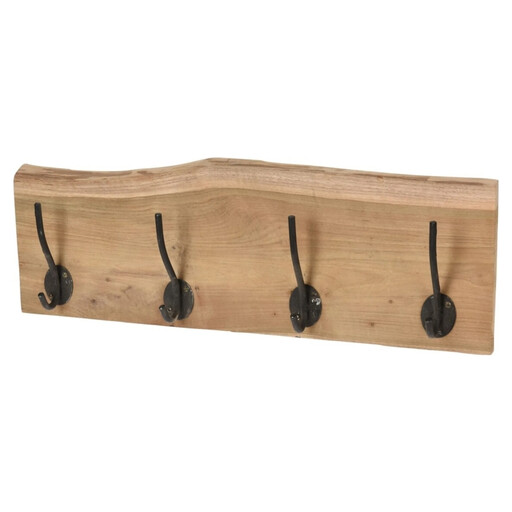
Why it’s suitable: Measuring 50 cm in length and fitted with four hooks, this compact coat rack rail is ideal for smaller hallways, bathrooms or areas behind doors.
The number of hooks and the overall dimensions are clearly stated. The design remains uncluttered rather than grouping lots of closely spaced hooks on a narrow surface.
According to the product details, the panel is made of wood and the hooks are made of metal. The surface can be cleaned with a damp cloth.

Why it’s suitable: This model combines five hooks with a shelf and retaining edge. It works well in hallways, bedrooms, bathrooms or offices when you also need somewhere to place small items.
The product information states a maximum load of 44 lb or approximately 20 kg. Wall anchors suitable for the substrate are required for installation.
According to the product description, the wooden parts are made from FSC-certified Rubberwood with clear lacquer, while the metal parts are made from powder-coated steel.

Why it’s suitable: The combination of a wooden panel and six metal hooks is designed for jackets, bags, towels or rucksacks, making it suitable for busy entrance areas.
The product description states a maximum total load of 30 kg. However, the wall type, wall plugs and even distribution of weight must still be taken into account.
According to the product information, the wood is made from FSC-certified Rubberwood with a lacquered finish; the hooks are made from aluminium alloy and feature rounded edges.
A wooden coat rack stays looking its best for longer when dust is removed regularly with a dry or slightly damp cloth. Harsh cleaners and abrasive products can damage lacquer, paint or powder coating. In the bathroom, avoid leaving standing water on the surface. Check the screws after installation and at regular intervals thereafter, particularly if heavy bags or coats are frequently hung from the wall hook rail.
Hooks without clips are often more suitable for hats and caps, as they place less concentrated pressure on the fabric. A vertical solution such as the MyGift model with ten hooks may be suitable for several headwear items; according to the product details, the maximum load is 15.9 kg. Beforehand, check that the exact product size and mounting area fit the available space.
We have put together a current selection of products that take these important buying criteria and the applicable German safety requirements into account.
As a general guide, allow at least one or two hooks for each person who uses the hallway regularly. Extra capacity is useful for children, school bags, sports bags and seasonal clothing. Hook spacing remains crucial to prevent clothes from hanging on top of one another.
That depends on the wall substrate and the weight involved. Suitable wall plugs are used for concrete and brick, while plasterboard requires special cavity wall anchors or fixing points secured into the supporting framework. The installation instructions for the product should be checked against the type of wall. For heavy loads, a secure screw fixing is more important than an especially high stated product capacity.
Yes, some models can be used there if the manufacturer’s specifications allow it. Several of the products mentioned specifically describe Rubberwood with clear lacquer and coated metal parts as suitable for more humid rooms. However, the wall-mounted coat rack should not be exposed to splashing water on a permanent basis. Good ventilation and wiping away moisture will help extend its service life.