
Lieferung heute & morgen

Qualitätsgarantie

Willkommens-Angebote freischalten: KOSTENLOSE Lieferung | Bis zu 80 % RABATT | Kostenlose 30-Tage-JoyPlus-Testphase
App herunterladen
A car battery charger needs to match your battery, your vehicle and how you intend to use it. Many poor purchases happen not because of a lack of power, but because of unclear specifications: a device with a high peak current isn't automatically a suitable charger, and a jump starter won't replace a proper battery charge.
With a jump starter power bank or a car jump starter, the maximum starting current is often promoted. This figure describes the short-term assistance when starting the engine. It doesn't tell you how quickly or gently the device charges a car battery.
A classic car battery charger, on the other hand, works over a longer period with a defined charging current. For regular maintenance, charging after long periods of inactivity, or trickle charging, this type of device is usually more suitable.
Not every 12V car battery charger is suitable for every battery. AGM, EFB, GEL, flooded and lithium batteries sometimes require different charging programmes. An AGM battery charger or GEL battery charger should explicitly support the relevant battery mode.
For LiFePO4 batteries, a suitable LiFePO4 charger is required. A 12V device is also not automatically suitable for 24V systems. You should check the battery voltage and battery type before buying by looking at the battery label or your vehicle documents.
A battery monitor, a display or a so-called repair function can be useful if the way they work is clearly described. A battery repair device function can, for example, be implemented as a pulse or desulphation programme. However, it does not guarantee that a damaged or deeply discharged battery can be made usable again.
For portable devices, the operating limits are also important: a tyre compressor draws power for longer periods and can heat up. Information about the maximum operating time and the required cooling breaks should therefore be part of your buying decision.
The charging current is given in amps. A 6A device is suitable for many smaller to medium 12V batteries, for example in cars or motorcycles. For larger batteries in motorhomes, boats or commercial vehicles, a higher charging current can make sense.
What matters is the capacity range in Ah specified by the manufacturer. A device should neither be undersized for a significantly larger battery nor use unnecessarily high charging currents for a small motorcycle battery.
An intelligent battery charger recognises the state of charge depending on the model and switches between several charging phases. Typical functions are diagnosis, bulk charge, absorption and float charge. An automatic charging process with shut-off or monitoring can reduce the risk of overcharging.
Look for specific information on:
A jump starter is intended for emergencies. It can help start the engine with a discharged 12V battery, but it does not fully charge the vehicle battery like a stationary charger. For longer periods of inactivity, a trickle charger is the more suitable solution.
If you're often on the road, you could choose a power bank with an LED light or a tyre compressor. Before buying, you should check the maximum engine size according to the manufacturer's specification against your vehicle. 24V lorry systems and high-voltage batteries from electric vehicles are not automatically compatible with the devices mentioned.
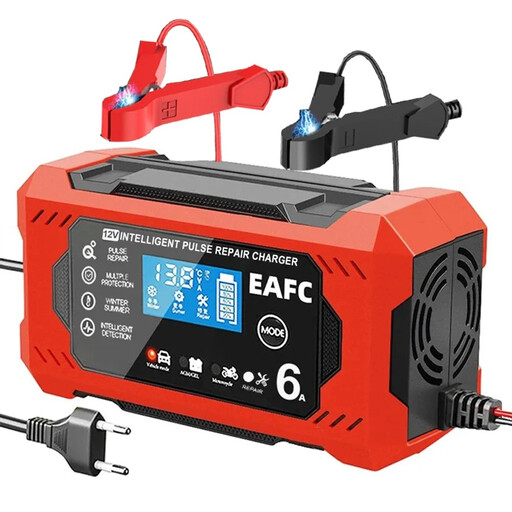
Why this product fits the profile: The device is designed for 12V lead-acid batteries including AGM, GEL, EFB and flooded batteries, and offers an LCD display for the charging status.
The technical specifications state a capacity of 4 to 100 Ah as well as protection functions against reverse polarity, short circuit and overheating.
6 A charging current, LCD display, automatic switching and multiple protection functions according to the product description.
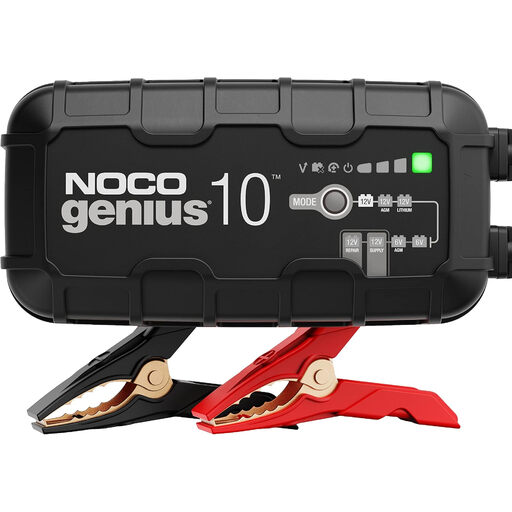
Why this product fits the profile: The fully automatic charger and maintainer supports 6V and 12V batteries as well as AGM, GEL, EFB and LiFePO4 according to the product description.
The supported battery types and the temperature sensor are specifically stated. This makes it easier to check compatibility before buying.
10 A charging current, automatic float charge, temperature monitoring and support for LiFePO4 according to the manufacturer's specifications.
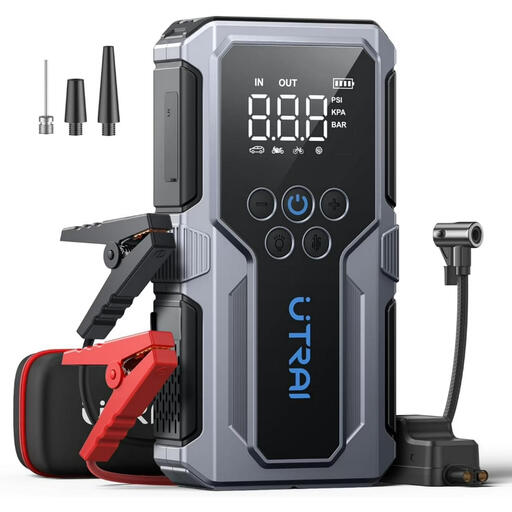
Why this product fits the profile: The combination of jump starter, power bank and tyre compressor is suitable for car drivers, motorhome owners and outdoor users.
The compressor has a pre-settable tyre pressure and automatic shut-off. The stated operating limit of ten minutes should still be observed.
3000 A peak current, 150 PSI compressor, USB and USB-C ports as well as LED display according to the product data.
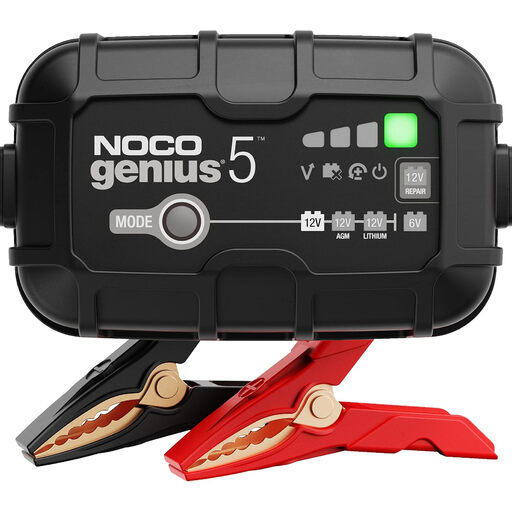
Why this product fits the profile: The compact device is designed for car and motorcycle batteries and supports AGM, lithium LiFePO4 and start-stop batteries according to the product description.
The battery mode is selected to match the respective battery type. Nevertheless, the voltage and battery type must be checked before connection.
5 A charging current, 6V/12V support and float function according to the product information.
We have put together a complete, regularly updated list of products that fully meet these strict selection criteria and the safety regulations in force in the EU.
The duration depends on the battery capacity, state of charge and charging current. A 60 Ah battery with a 6A charger theoretically takes significantly longer than with a 10A device. Charging losses and the charging phases of the electronics extend the process further. The specific manufacturer's information and the device's display are what matter.
A trickle charger is intended for longer connection times, provided the manufacturer explicitly describes this use. With a simple charger without automatic regulation, the battery should not be left connected unattended for a long period. Before use, you should check the operating instructions, battery type and charging programme.
For regular charging, winter storage and battery maintenance, a suitable charger is the practical choice. A jump starter power bank is mainly suitable for a short-term engine start when you're out and about. If you are often away from a mains socket, you can combine both devices. With every use, the instructions regarding 12V, engine size, battery condition and connection sequence must be followed.