
Lieferung heute & morgen

Qualitätsgarantie

Willkommens-Angebote freischalten: KOSTENLOSE Lieferung | Bis zu 80 % RABATT | Kostenlose 30-Tage-JoyPlus-Testphase
App herunterladen
A ceiling light shapes the atmosphere of a room and determines whether your living room, bedroom, hallway or dining area is evenly lit. However, many products advertise with similar terms: "modern", "energy-saving" or "smart". These descriptions alone say little about whether a light suits the room size, the existing electrical installation and your personal lighting habits.
A striking modern ceiling lamp can look great visually, but still cast shadows or create dark areas. Enclosed lights often distribute light differently to a ceiling spotlight with adjustable heads. For a long hallway, a single centrally mounted lamp may be less suitable than several light points or a light with a wide beam angle.
With an LED ceiling light, it should be clearly stated whether it is dimmable and what control method is required. Some models only work with a wall switch, others with a remote control, app or a compatible smart home system. A non-dimmable light cannot easily be made flexible to control later on.
Wattage and a product photo are not enough to make a purchasing decision. Important factors include luminous flux in lumens, colour temperature in Kelvin, dimensions, bulb type and installation instructions. For lights with replaceable bulbs, you must also check whether the fitting and maximum wattage are compatible with the bulb you want.
Luminous flux is given in lumens (lm) and describes the amount of light emitted. A small bedroom ceiling lamp generally needs a different amount of light than a living room ceiling light for a large room. The specific choice also depends on the room colour, ceiling height and any additional lights you have.
Colour temperature is given in Kelvin (K):
A dimmable ceiling light with adjustable colour temperature offers more flexibility. However, the specifications should be clearly stated in the product description.
The diameter or length of the light must match the room size and the connection point. Before ordering, you should check the following:
A ceiling light with a wood-effect finish can add a warm accent, while a ceiling light with a glass shade often stands out more as a visible design element. What matters most is whether the material, shape and light distribution suit your décor.
A ceiling light with a remote control is useful if you want to adjust the brightness or colour temperature from the sofa or bed. With a smart ceiling lamp, you should check compatibility, app requirements and the available control method.
A ceiling light with a motion or presence sensor can be interesting for hallways, entrance areas or utility rooms. You should clarify whether the sensor detects movement or actual presence, and how the run-on time and sensitivity can be adjusted.
Special requirements apply to wet rooms. The protection rating, particularly the IP code, must match the installation location. An ordinary indoor light is not automatically suitable for the bathroom. When searching specifically for ceiling lighting for the bathroom, you should check the protection rating and installation zone information particularly carefully.
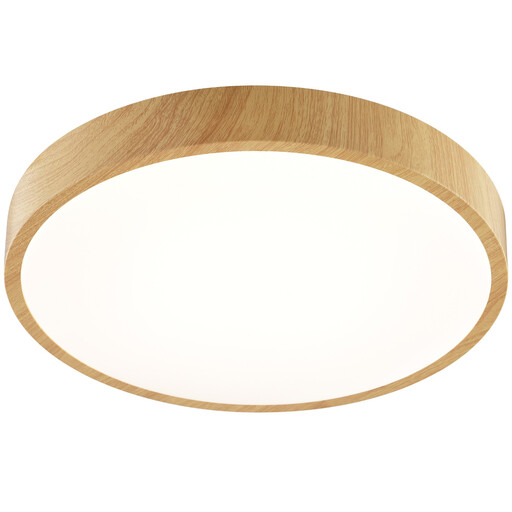
Why this product suits the profile: The integrated LED technology and compact size make it ideal for straightforward general lighting in living rooms, bedrooms, hallways or dining areas.
The product data lists luminous flux, colour temperature and explicitly states "not dimmable". This means you can plan for the lack of a dimming function before you buy.
24 W LED technology, 2,300 lm, 3,000 K, 38.5 cm diameter and wood-effect finish.
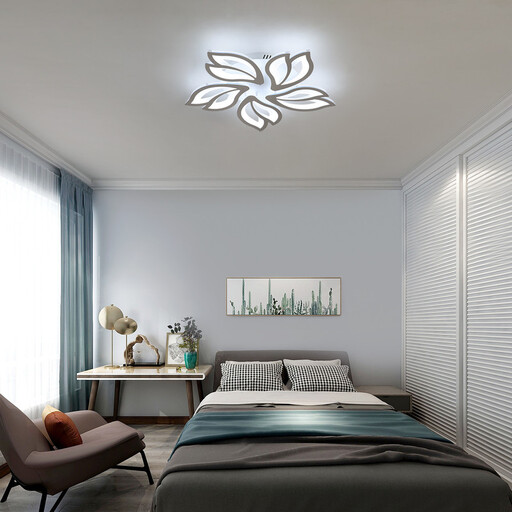
Why this product suits the profile: The floral design combines a decorative shape with adjustable colour temperature and a remote control. This could be of interest for an individually controllable living room ceiling light.
The light control is specifically stated with remote control, dimming function and 3,000–6,500 K. This makes the available settings clearer than with a purely design-focused description.
45 W, five light points, adjustable colour temperature, remote control and app control function according to the product description.
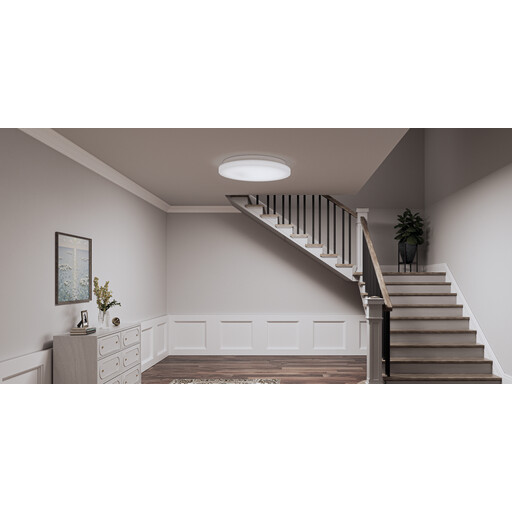
Why this product suits the profile: A light with a sensor function can be interesting for hallway lighting, entrance areas or frequently used passageways where automatic switching on is desired.
The sensor function is already indicated in the product name. However, before installation you should still check the detection range, run-on time and the specific sensor type in the full technical specifications.
Sensor-based control and suitability for automated indoor lighting according to the product name.
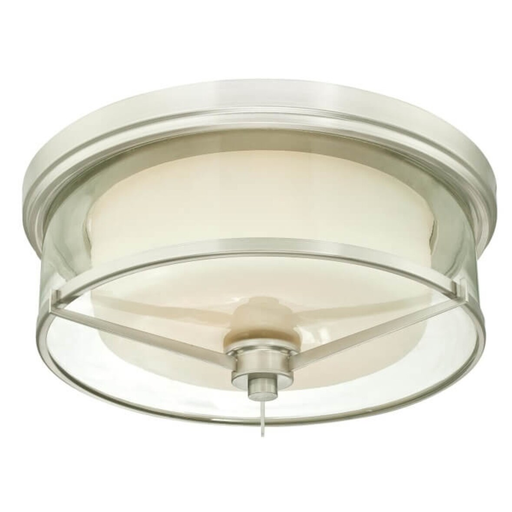
Why this product suits the profile: The combination of a nickel finish with frosted and clear glass suits modern interiors where the light itself is intended to remain visible as a design element.
The light operates with two E27 bulbs. This means you can select suitable bulbs separately and replace them if needed.
Nickel finish, frosted and clear glass, and two E27 fittings.
Before working on the electrical installation, the circuit must be switched off and secured against being switched back on. If you are unsure or lack experience, a qualified electrician should carry out the installation. Proper fixing is particularly important with heavy lights, unusual ceiling materials or older connection points.
For ongoing costs with LED lights, the key factors are the actual power consumption in watts and the daily usage time. For models with replaceable bulbs, the consumption depends on the bulb used. A dimming function can adapt the usage, but it is not a substitute for a suitable luminous flux.
We have put together a complete, regularly updated list of products that fully meet these strict selection criteria and the safety regulations in force in the EU.
For a bedroom, warm white light in the range of around 2,700 to 3,300 K is often chosen. If you also use the light for tidying, reading or other activities, you could consider a dimmable ceiling lamp with adjustable colour temperature.
That depends on the room size, ceiling height, wall colours and any additional lighting. For a sensible choice, you should compare the stated luminous flux in lumens with your specific room, rather than just looking at the wattage.
No. For the bathroom, the installation zone and required protection rating must match the light. An indoor light without a suitable IP rating should not simply be installed in an area exposed to moisture.