
Lieferung heute & morgen

Qualitätsgarantie

Willkommens-Angebote freischalten: KOSTENLOSE Lieferung | Bis zu 80 % RABATT | Kostenlose 30-Tage-JoyPlus-Testphase
App herunterladen
Whether for a camping holiday, long-haul truck journeys, or a family weekend getaway, reliable mobile refrigeration is essential. However, the market for electric coolers is crowded and confusing. If you're not careful, you can easily invest in a unit that doesn't meet your needs. As a Joybuy Product Recommendation Officer, I'll help you identify the crucial features and avoid common purchasing pitfalls.
Many buyers are swayed by advertising claims that don't hold up in practice. Pay close attention to these three points to avoid disappointment:
To make the right choice, you should be guided by technical facts, not marketing buzzwords. These three parameters are crucial for the performance and usability of your cooler.
The technology inside determines what a cooler can do.
A portable cooler must be flexible and safe to operate.
The size of the cooler should match its intended use. The volume is specified in litres.
Some models also offer a dual-zone cooler function. These feature two separately controlled compartments, allowing you to cool and freeze simultaneously. Modern units can also often be operated via a smartphone with app-controlled cooler functionality, which offers added convenience.
Instead of presenting a confusing list, we've selected models that meet specific needs and avoid the pitfalls mentioned.

Why This Fits Their Persona: Perfect for day trips or solo travellers who need true freezing capability in a compact format. It fits easily between car seats and offers enough space for the essentials.
It relies on true compressor technology instead of unreliable thermoelectrics and includes a three-stage battery monitor to protect the vehicle's battery.
Compact Design: Very space-saving and lightweight (approx. 6.7 kg).
True Freezing Function: Cools down to -20°C.
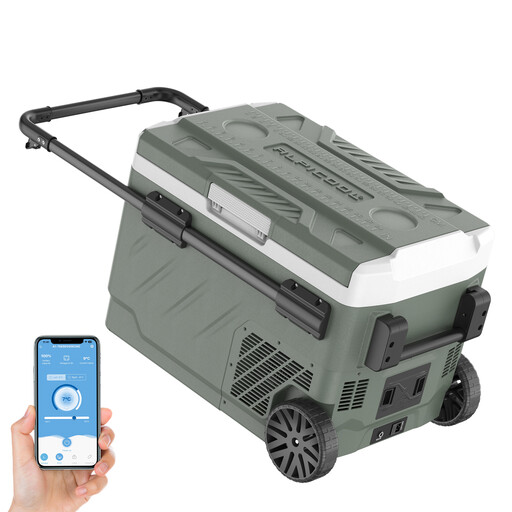
Why This Fits Their Persona: With 40 litres, it offers ample space for a week's worth of groceries or a family's provisions on a camping trip. The dual zones provide maximum flexibility for food and drinks.
It solves the capacity problem with a smart dual-zone layout. Instead of just cooling, one zone can freeze. The app control and sturdy wheels also address common handling weaknesses.
Dual Zone & App Control: Two separately adjustable temperature zones and convenient control via smartphone.
Mobile & Practical: A retractable handle and sturdy wheels for easy transport.

Why This Fits Their Persona: Designed for continuous use in a vehicle. Its large volume, quiet operation (approx. 40 dB), and reliable battery monitor make it a dependable partner on long hauls.
It addresses the "dead battery trap" with an intelligent, three-stage protection system. The robust, shockproof construction is designed for the rough daily life in a truck and prevents defects from vibrations.
High Capacity & Dual Zones: Nearly 50 litres of volume with separate areas to reduce odour transfer.
Quiet & Robust Operation: Very quiet at approx. 40 dB and designed to operate on uneven roads (up to a 30° incline).
We have compiled a complete, up-to-date list of products that fully meet these strict selection criteria and all relevant safety standards.
1. How long can a compressor cooler run on a car battery? The runtime depends on many factors: the car battery's capacity, the set temperature, the ambient temperature, the cooler's insulation, and how often it is opened. An average 40-litre cooler in ECO mode consumes about 45–60 watts. With a healthy 80 Ah car battery, it can often run for 24 hours or more without jeopardising the engine start—provided the battery monitor is set correctly.
2. What is the exact difference between a compressor cooler and a thermoelectric cooler? The main difference lies in the cooling technology. A compressor cooler uses a refrigerant and a compressor to actively remove heat, just like a household refrigerator. It can reach very low temperatures (-20°C is common) regardless of the outside temperature. A thermoelectric cooler uses the Peltier effect to create a temperature difference relative to its surroundings. Its performance is limited and drops significantly in high ambient temperatures.
3. Does a compressor cooler require special maintenance? Compressor coolers are generally very low-maintenance. It is important to always keep the compressor's ventilation slots clear to ensure good air circulation. The interior should be cleaned regularly with a damp cloth. Before first use, it is recommended to let the unit stand upright for a few hours to allow the refrigerant in the system to settle.