
Lieferung heute & morgen

Qualitätsgarantie

Willkommens-Angebote freischalten: KOSTENLOSE Lieferung | Bis zu 80 % RABATT | Kostenlose 30-Tage-JoyPlus-Testphase
App herunterladen
A cordless car polisher makes it easier to wax, refresh and work on small areas of paintwork without a power cable restricting your movement. However, cordless car polishers vary considerably in battery life, polishing action, backing plate size and accessories. If you focus only on speed or battery voltage, you could end up with a tool that isn’t right for the job.
Figures such as 7,000 or 21,000 revolutions per minute may look impressive at first. For car detailing, however, how the speed is controlled and what polishing action the machine uses are what really matter. A rotary polisher turns the backing plate directly around its own axis. This can be useful for precise paint correction, but it requires a controlled technique.
A dual-action polisher also moves the backing plate in an elliptical orbit. This distributes pressure differently across the surface. For beginners, this type of machine can be easier to handle on larger areas of paintwork. Speed alone, then, tells you little about whether a polisher will give you the result you want.
The Ah figure describes a battery’s capacity; it doesn’t automatically tell you how long it will run. Motor power, speed, backing plate and workload all affect consumption. Runtime figures should also be treated as manufacturer claims. For example, the BATOCA S5 and S6 are stated to offer around 30 minutes of no-load runtime per 12 V, 2.0 Ah battery. Runtime may vary under load.
For longer jobs, replaceable batteries are more practical than a built-in battery. Charging time, a battery level indicator and whether replacement batteries are available separately are also worth checking.
A polishing kit with a battery may include plenty of sponges, wool pads and sanding discs, but the sizes need to suit the job. A 125 mm backing plate is better suited to larger bodywork panels. A mini polisher with a 25, 50 or 75 mm backing plate, on the other hand, can be used on badges, wheels, headlights, door handles and narrow edges.
Before you buy, check:
A rotary polisher provides direct power transfer and is suited to precise work. It needs to be guided evenly to avoid unnecessarily heating the paint. A dual-action polisher adds a circular or elliptical movement. For many DIY users, this is an easy-to-control option for applying wax, polish and carrying out light paint-care work.
Some machines combine both systems. According to the product details, the BATOCA S5, S6 and S4 offer a switchable combination of rotary and dual-action movement. The S5 has a rotary setting and dual-action orbits of 3 and 12 mm. The S6 is also listed with 3 and 12 mm orbits.
Multiple speed settings make it easier to match the tool to the material and the task. Lower speeds are typically useful for wax or sealants, medium settings for polishing, and higher settings for more demanding correction work. Always start on the lowest suitable setting and keep the backing plate moving.
According to its product description, the BATOCA S2 has six settings, a soft start and an LCD showing the speed and battery status. The WORKPRO 20 V offers seven settings between 2,000 and 5,000 rpm. A display is particularly useful if you want to repeat the same setting during a longer detailing session.
A small backing plate makes a polisher for hard-to-reach areas easier to use. A larger plate covers more surface area, but can be less manageable around edges and in tight spaces. The weight with the battery fitted matters too. The WORKPRO Mini is listed at 0.88 kg including the battery, while the EAFC 21 V is described as weighing 1.13 kg.
For longer jobs, look for a non-slip grip, an auxiliary handle and easy-to-reach controls. If you’re working on delicate paintwork, start in an inconspicuous area. Have damaged or very thin paintwork assessed by a professional before polishing.
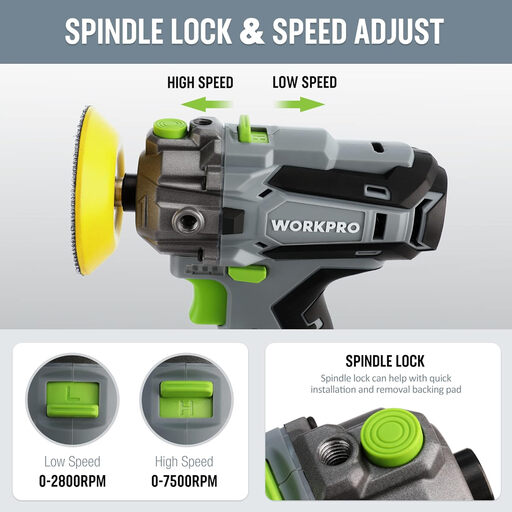
Why this product suits this type of user: This compact tool is designed for occasional care work on cars, furniture, metal, wood or tiles. The product details state that two batteries and a charger are included.
The two speed settings, from 2,600 to 7,000 rpm, keep things simple. A battery level indicator helps you plan your work.
Weighs 0.88 kg including the battery, with a quick charge in around an hour according to the product details, plus several sponges, a wool pad and a bag.
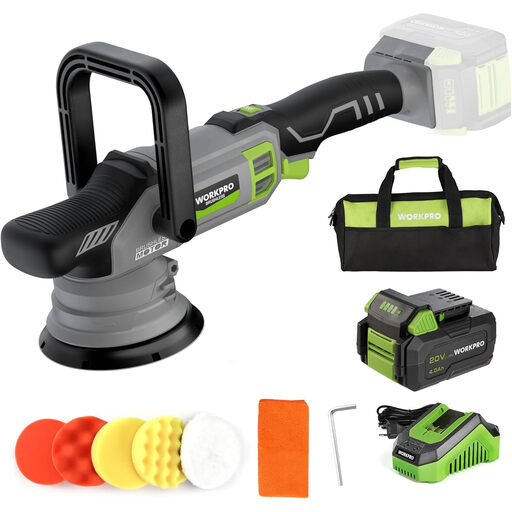
Why this product suits this type of user: For larger areas on vehicles, floors or tiles, this model combines a 20 V, 4.0 Ah battery with dual-action movement.
The seven settings, from 2,000 to 5,000 rpm, give you more choice than a machine with just two speeds.
Brushless motor according to the product description, 4.0 Ah battery, safety switch and storage bag.
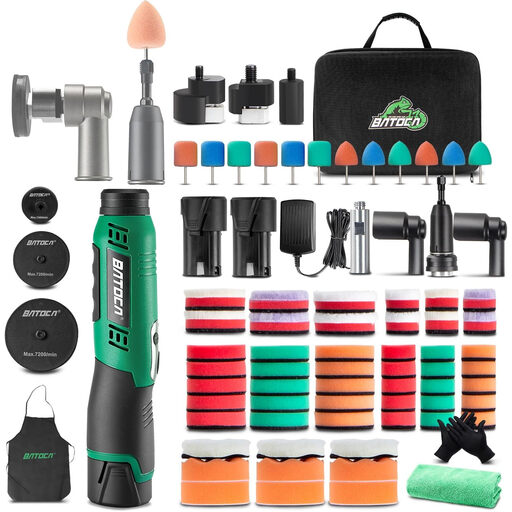
Why this product suits this type of user: This kit is for anyone looking to carry out detailing work on cars, motorbikes, wheels, headlights or hard-to-reach areas.
The combination of rotary, 3 mm and 12 mm dual-action movements means you’re not limited to a single polishing action.
25, 50 and 75 mm backing plates, six settings from 1,000 to 5,000 rpm, and two 12 V, 2.0 Ah batteries according to the product details.
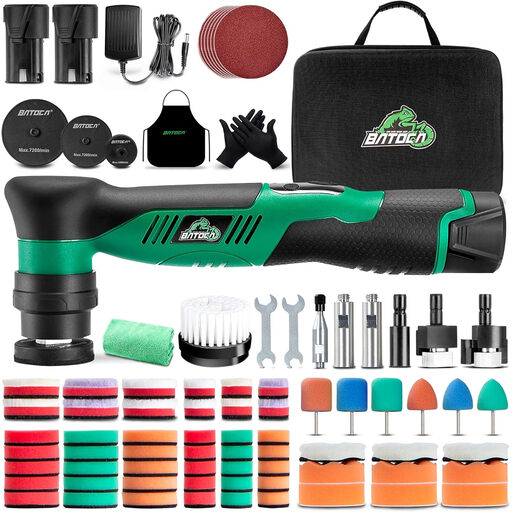
Why this product suits this type of user: For anyone looking to combine several polishing actions in one compact cordless car polisher, without carrying multiple tools.
According to the product description, you can switch between the three drive units without tools in around five seconds. This lets you adapt the polishing action to the size of the area and the level of detail required.
Three backing plates measuring 25, 50 and 75 mm, six speed settings from 2,000 to 5,500 rpm, and two 12 V, 2.0 Ah batteries.
We’ve put together a complete, regularly updated list of products that meet these strict selection criteria and fully comply with the safety regulations in force in the EU.
It depends on battery capacity, speed, pressure and the material you’re working on. Manufacturer figures often refer to no-load or ideal conditions. Two replaceable batteries can reduce interruptions, but you’ll still need to plan your work realistically.
A dual-action polisher may be easier for many DIY users to control, as its movement isn’t limited to direct rotation. Even so, start at a low speed, apply light pressure and test it on a small area first.
Backing plates around 125 mm are commonly used on larger bodywork panels. A mini polisher with a 25 to 75 mm backing plate is useful for headlights, wheels, badges, edges and other hard-to-reach areas. The important thing is to make sure the pads and backing plates are compatible with the machine.