If a high fibre content is your priority at Sunday breakfast, the nutrition information is what counts: Nestlé Cereals Deutschland lists 9,4 g of fibre per 100 g for FITNESS® and Kölln lists 13 g per 100 g for Haferkleie Fleks. Unsweetened cornflakes may be a better choice if you mainly want to keep the sugar content of the product low. Check the sugar, ingredients and fibre separately on the current packaging.
Which breakfast cereals suit you?
For Sunday breakfast, your choice may come down to the verifiable fibre content, an unsweetened corn base or the flavour everyone around the table enjoys.
If you want to compare fibre content
You want to check a figure rather than assume that terms such as wholegrain or organic mean a product is high in fibre. Under EU Regulation (EC) No 1924/2006, a product can be described as “high in fibre” if it contains at least 6 g of fibre per 100 g or 3 g per 100 kcal.
If you prefer unsweetened cornflakes
You’re looking for a simple corn base and want to add your own fruit or yoghurt. Compare the product’s sugar content with its fibre content: low sugar alone doesn’t prove that a product is high in fibre.
If you’re choosing for a shared breakfast table
You’re thinking about which variety will taste good at breakfast. If a high fibre content matters too, check the nutrition information even for products that list a wholegrain content.
What to look for when buying
Wholegrain cereals in flake form
A good choice if: you’re looking for crunchy wholegrain cereals with a stated high fibre content. Nestlé Cereals Deutschland lists 9,4 g of fibre per 100 g for FITNESS®.
The trade-off: The manufacturer lists 61,1% wholegrain wheat and 8,8 g of sugar per 100 g, so this isn’t a pure cornflake.
Oat bran flakes
A good choice if: you’re open to an alternative to cornflakes. Kölln lists 13 g of fibre per 100 g for Haferkleie Fleks.
The trade-off: According to Kölln, the product contains 70% oat bran and barley malt extract, and has 11 g of sugar per 100 g.
Unsweetened cornflakes
A good choice if: a simple corn base with a low sugar content matters more to you than a verified high fibre content.
The trade-off: REWE lists 4,1 g of fibre per 100 g for its unsweetened organic cornflakes. Check the figure separately for other varieties.
Start by comparing the nutrition information per 100 g, then consider how much will actually go into your bowl.
| Criteria |
What to check |
Who it matters to |
| Fibre content |
Check the fibre per 100 g and compare it with the EU threshold for “high in fibre” of 6 g per 100 g; alternatively, the threshold is 3 g per 100 kcal. |
If fibre is my main reason for choosing a product, I need a verifiable figure rather than a wholegrain claim. Around 46% of consumers put this first. |
| Sugar and ingredients |
Compare the sugar per 100 g and the ingredients list for the specific product; don’t treat “unsweetened” as a statement about fibre content. |
I want a simple corn base and to decide for myself what to add to breakfast. This is the priority for around 36% of consumers. |
| Flavour at the breakfast table |
Choose the type of cereal you want, then assess the wholegrain content, sugar and fibre separately. |
For a shared Sunday breakfast, I want to serve a variety everyone enjoys. Flavour comes first for around 18% of consumers. |
Common selection mistakes
-
Assuming wholegrain means “high in fibre”
A wholegrain content doesn’t replace a fibre figure. Nestlé Cereals Deutschland lists 33% wholegrain for CINI MINIS®; that alone isn’t enough to support the claim “high in fibre”.
Check the fibre per 100 g and compare it with the EU threshold of 6 g per 100 g, or the alternative threshold per 100 kcal.
-
Assuming unsweetened means high in fibre
According to REWE, REWE Bio Cornflakes ungesüßt contain less than 0,5 g of sugar, but 4,1 g of fibre per 100 g. These figures answer different questions.
If both sugar and fibre matter to you, compare both figures in the nutrition information.
-
Assuming the per-100-g figure applies to your portion
The amount of fibre in your bowl depends on how many grams of cereal you use. A figure per 100 g isn’t automatically the amount per serving.
Work out the figure for your portion, and consider the other parts of your breakfast separately.
-
Overlooking ingredients and allergen information
Corn, wheat and oat bran flakes contain different ingredients. For example, Kölln lists barley malt extract in Haferkleie Fleks; several of the products discussed here may also contain traces of other ingredients.
If allergies or intolerances are relevant to you, check the ingredients and allergen information on the current packaging before buying.
Brands and product ranges to help you choose
Nestlé FITNESS®
Wholegrain cereals in flake form for comparing stated fibre content.
- Nestlé Cereals Deutschland lists 9,4 g of fibre and 8,8 g of sugar per 100 g for FITNESS®, as well as 61,1% wholegrain wheat.
- The manufacturer lists possible traces of nuts and milk. If the recipe changes, the information on the pack you buy is what counts.
Kölln
Haferkleie Fleks are a crunchy alternative to pure cornflakes.
- Kölln lists 70% oat bran and 13 g of fibre per 100 g for Haferkleie Fleks.
- According to the manufacturer, the flakes contain barley malt extract, have 11 g of sugar per 100 g and may contain tree nuts and milk.
REWE Bio
Unsweetened cornflakes for a simple breakfast base.
- REWE lists 99% corn, less than 0,5 g of sugar and 4,1 g of fibre per 100 g for its Bio Cornflakes ungesüßt.
- The stated fibre content is below the EU threshold for “high in fibre”. Also check the precautionary allergen information on the pack.
EDEKA Bio
Unsweetened organic cornflakes for consumers who prefer a corn base.
- EDEKA24 lists 99,4% corn and 0,6 g of sugar per 100 g for EDEKA Bio Cornflakes ungesüßt.
- You’ll also need the fibre content on the specific pack to assess whether it qualifies as “high in fibre”.
Kellogg’s
Kellogg’s Corn Flakes are classic cornflakes for breakfast with milk, yoghurt or fruit.
- Kellogg’s Germany describes Corn Flakes as cornflakes on its product page.
- You can only tell whether a specific pack qualifies as “high in fibre” by checking its fibre content.
Joybuy products to consider
This selection features wholegrain cereals in flake form for Sunday breakfast. To assess the specific pack, compare its fibre content with your other options.
 No image available
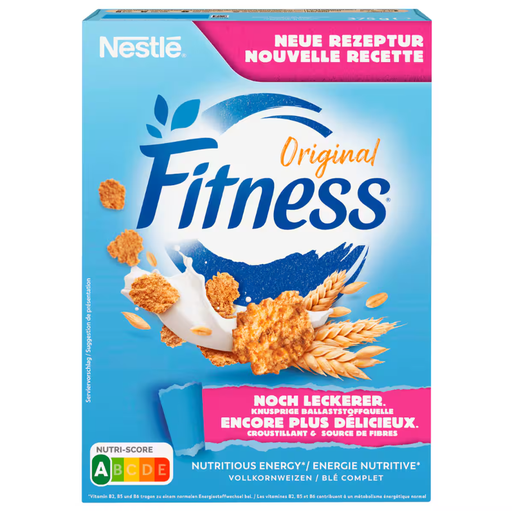
Nestlé Fitness Original Whole Grain Cereal, 375 g
For a Sunday breakfast with wholegrain cereals instead of pure cornflakes. The pack contains 375 g; check the fibre content and the ingredients and allergen information on the specific pack.
View on Joybuy
Frequently asked questions
When can a product be described as “high in fibre”?
For the nutrition claim “high in fibre”, EU Regulation (EC) No 1924/2006 requires at least 6 g of fibre per 100 g or at least 3 g per 100 kcal. Check the nutrition information for the specific product; wholegrain content and fibre content aren’t the same thing.
Are unsweetened cornflakes automatically high in fibre?
No. “Unsweetened” doesn’t describe the fibre content. REWE lists less than 0,5 g of sugar and 4,1 g of fibre per 100 g for Bio Cornflakes ungesüßt; for another variety, you’ll need to check its own fibre content.
How do I compare the fibre content with my portion?
Convert the figure per 100 g to match the weight of your portion. This shows you how much fibre comes from the flakes themselves, rather than assuming the pack’s per-100-g figure is the amount in your bowl.
What should I look out for if I have allergies?
The ingredients and allergen information on the current pack are what matter. Kölln lists barley malt extract and possible traces of tree nuts and milk for Haferkleie Fleks; Nestlé Cereals Deutschland lists possible traces of nuts and milk for FITNESS®.


