For shoppers who prioritise fibre
You’re looking specifically for cornflakes or cereal with a high stated fibre content, and also compare sugar and ingredients.


If fibre is a priority at breakfast on weekdays, choose cornflakes or cereal by checking the nutritional information for the specific variety, rather than relying on labels such as ‘organic’ or ‘unsweetened’. Under EU Regulation (EC) No 1924/2006, a product can only be described as ‘high in fibre’ if it contains at least 6 g of fibre per 100 g or 3 g per 100 kcal. Also compare sugar, ingredients and any allergen information relevant to you.
You’re looking specifically for cornflakes or cereal with a high stated fibre content, and also compare sugar and ingredients.
You prefer simple cornflakes with a low stated sugar content and may want to add fibre through other parts of your breakfast.
You need to check the ingredients, allergen information or any required gluten labelling for the specific variety, while also taking your individual tolerance into account.
First decide whether fibre content, sugar and ingredients, or how well a product suits you is your priority. Then compare the information per 100 g and consider how much you actually put in your bowl.
| Criteria | What to check | Who should pay particular attention |
|---|---|---|
| Fibre content | Compare the fibre per 100 g. Under EU Regulation (EC) No 1924/2006, a product can only be described as ‘high in fibre’ if it contains at least 6 g per 100 g or 3 g per 100 kcal. | I want to choose a variety where fibre is the deciding factor for my weekday breakfast. Around 37% of consumers are likely to prioritise a high fibre content when buying. |
| Sugar and ingredients | Compare sugar and salt per 100 g, as well as the ingredients list. ‘Unsweetened’ alone tells you nothing about the fibre content. | When I have simple cornflakes in the morning, I want to keep an eye on sugar and ingredients, even if the fibre content is lower. Around 36% of consumers are likely to put low sugar and simple ingredients first. |
| Suitability | Read the ingredients and allergen information on the current pack; check for explicit gluten labelling if needed. | If I have an allergy or intolerance, I need to check the specific recipe, so fibre content isn’t the only deciding factor. Suitability is likely to be the main buying criterion for around 27% of consumers. |
The unsweetened organic cornflakes listed by REWE contain 4.1 g of fibre per 100 g; REWE lists 3.6 g for Davert organic cornflakes. Both figures are below the threshold of 6 g per 100 g.
Check the fibre content on the specific pack rather than trying to work it out from the product name.
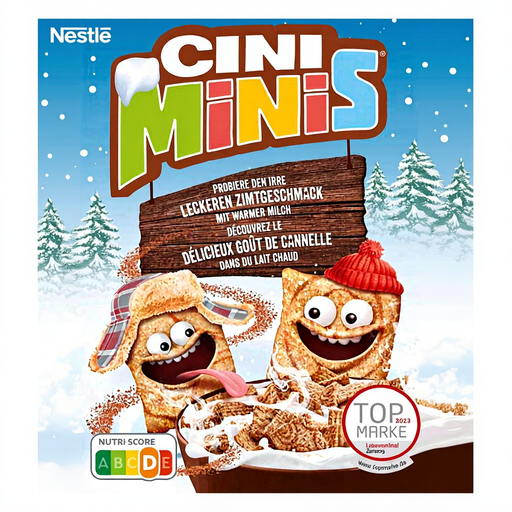
Nestlé lists 6.4 g of fibre and 24 g of sugar per 100 g for the Cini Minis shown. A high fibre content doesn’t tell you how much sugar a product contains.
For any varieties you’re considering, compare the sugar and salt per 100 g too.
The Cini Minis described by Nestlé contain wholemeal wheat flour. If you’re looking at a different variety or pack size, check the information for the version you’re buying.
If you have specific requirements, check the current ingredients list, allergen information and, where relevant, the explicit gluten labelling.
The addition of an ingredient such as oligofructose doesn’t prove that it will have a particular effect on your gut flora. The Verbraucherzentrale also notes that prebiotic fibres may cause symptoms in people who are sensitive to them.
Base your choice on the nutritional information, ingredients and how well you tolerate the product, rather than broad claims about its effects.
The unsweetened Verival organic cornflakes listed by REWE are one option to compare by fibre content.
The Cini Minis described by Nestlé are cinnamon cereal, not classic cornflakes.
REWE Bio unsweetened cornflakes are a cornflake option for shoppers who pay particular attention to sugar and ingredients.
The Kellogg's Corn Flakes listed by REWE are included here as a benchmark for classic cornflakes.
EDEKA Bio unsweetened cornflakes are another cornflake option for comparing sugar and ingredients.
This selection features a cinnamon cereal for weekday breakfasts. Check the labelling to see whether the specific pack meets your fibre goals and ingredient requirements.
 No image available
If you’re looking for cinnamon cereal rather than classic cornflakes for your weekday breakfast, this could be an option. Check the information on the specific pack when choosing by fibre content, and for details about sugar, ingredients and allergens.
Under EU Regulation (EC) No 1924/2006, this nutrition claim requires at least 6 g of fibre per 100 g or at least 3 g per 100 kcal. Even so, compare sugar and ingredients, and consider the portion size you’ll actually eat.
No. ‘Unsweetened’ doesn’t describe the fibre content. REWE lists 4.1 g of fibre per 100 g for its organic unsweetened cornflakes and 3.6 g for Davert organic cornflakes; both figures are below the threshold of 6 g per 100 g.
You can combine cornflakes with other plant-based foods, such as fruit, nuts or seeds, to put together the breakfast you want. The fibre content on the cornflakes pack still applies to the product itself, not the finished bowl.
Check the ingredients and take your individual tolerance into account. Nestlé lists oligofructose in the Cini Minis described here; the Verbraucherzentrale notes that prebiotic fibres may cause symptoms in people who are sensitive to them.
No, suitability can’t be assessed for all cornflakes as a whole. The Cini Minis described by Nestlé contain wheat, while the Alnavit organic cornflakes listed by Müller are labelled gluten-free. If you have specific requirements, always check the labelling on the particular pack.