
Lieferung heute & morgen

Qualitätsgarantie

Willkommens-Angebote freischalten: KOSTENLOSE Lieferung | Bis zu 80 % RABATT | Kostenlose 30-Tage-JoyPlus-Testphase
App herunterladen
A digital kitchen scale is an essential part of the equipment for many home cooks, baking enthusiasts and coffee lovers. It helps measure flour, spices, coffee beans and portion sizes. However, not every electronic kitchen scale is suited to every application. Terms such as “precise”, “multifunctional” or “smart” reveal little about how practical a model is in everyday use.
Before buying, you should therefore assess the weighing range, readability, operation, cleaning requirements and power supply. The following recommendations for 2026 are based on transparent product specifications and a range of usage scenarios.
A 5 kg kitchen scale can display weights of up to 5,000 grams. That does not automatically mean it measures with the same precision across the entire range. Many models use 1 g increments. For everyday ingredients, baking recipes and portion control, this is usually sufficient. For espresso recipes or very small quantities, a finer resolution of around 0.1 g may be more suitable.
The minimum load is also important. A scale may be less accurate with very small quantities, particularly when the specifications do not state a minimum weighing capacity.
The tare function resets the displayed weight to zero, allowing ingredients to be weighed one after another in the same bowl. What matters is whether the button is easy to reach and whether the display responds quickly after it is pressed. With large bowls, the platform should provide enough space and remain stable.
App connectivity, a nutritional database, a timer or Bluetooth are useful only if they fit your routine. For example, an app may require registration, a compatible smartphone and a stable connection. If you simply want to weigh flour and sugar, these features are not essential. Before buying, it is therefore worth considering how you will actually use the scale rather than focusing on the number of advertised features.
A kitchen scale accurate to 1 g is suitable for most cooking and baking tasks. Check that the resolution is actually specified as 1 g and review which units are supported. Common options include:
For coffee preparation, a precision kitchen scale with 0.1 g increments may be more suitable below a certain weight. Maximum capacity should not be considered in isolation: a model with 0.1 g resolution may switch to 1 g increments at higher weights.
For normal household use, 3 to 5 kg is often sufficient. A higher capacity may be useful when weighing heavy pots, large quantities of dough or several ingredients in one bowl. Make sure the bowl does not obscure the platform and that the display remains visible.
An stainless steel kitchen scale with a smooth surface can generally be wiped clean easily with a soft, slightly damp cloth. Stainless steel and glass surfaces should still never be immersed in water. With glass models, avoid hot pots, impacts and abrasive cleaning products.
Place every digital scale on a level, dry and stable surface. Uneven worktops can affect the displayed reading. Features such as overload warnings, automatic shut-off and battery indicators are practical for everyday use, but they do not replace careful handling.
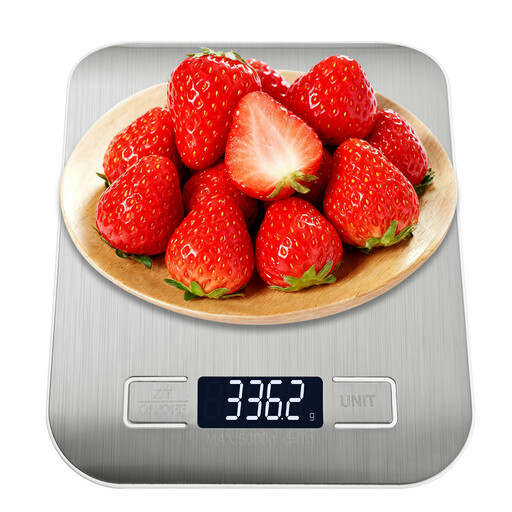
Why This Fits Their Persona: For beginners in the home kitchen, this compact model offers a weighing range of up to 5 kg and 1 g increments. Its operation is designed for everyday cooking, baking and portioning.
The product specifications list capacity and accuracy separately. They also include a tare function, automatic shut-off, overload warning and low-battery warning.
Stainless steel surface with anti-fingerprint coating, LCD display, and switching between g, oz, lb:oz and ml. Dimensions: 18 × 14 × 1.5 cm.

Why This Fits Their Persona: Coffee lovers who want to monitor brew time and water volume simultaneously get a device tailored to pour-over and espresso preparation.
The 0.1 g resolution is explicitly stated. The model also includes a timer and flow-rate function; it is not designed as a conventional 5 kg kitchen scale.
Weighing range of up to 2,000 g, rechargeable battery via USB-C, LED display and heat-resistant silicone mat. Clean only with a damp cloth.

Why This Fits Their Persona: For users who weigh large quantities or want to process portion data via Bluetooth, the higher 10 kg capacity is particularly relevant.
App connectivity is specified as a Bluetooth function. At the same time, the minimum weighing capacity, resolution and maximum capacity are listed separately, so the product’s use is not based solely on a marketing promise.
10,000 g capacity, 1 g increments, multiple units and easy-care 3 mm tempered glass surface. Dimensions: 20 × 14 × 1.95 cm.
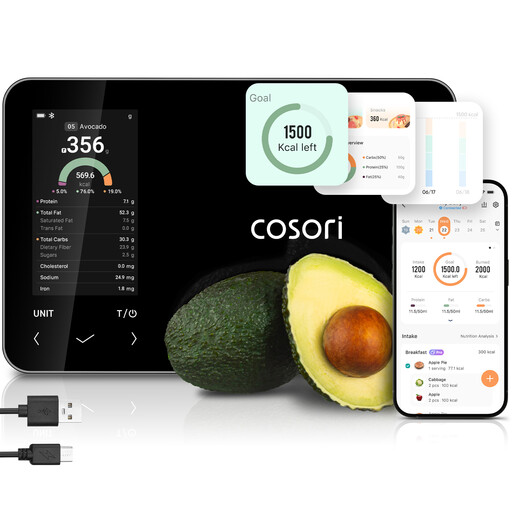
Why This Fits Their Persona: Users focused on portion control can connect weight data to a compatible app and use stored food data for personal tracking.
Nutritional information is based on app and database functions. Values should therefore be understood as a tracking aid, not as medical advice.
1 g increments from 3 to 5,000 g, seven units, USB-C charging and information on 19 nutritional categories according to the product description.
Before first use, the digital kitchen scale should be placed on a level surface. Weigh items as centrally as possible and press the tare button after placing the container on the platform. Do not exceed the stated capacity. Liquids must not run over the buttons or housing; clean the surface with a soft cloth.
Models powered by two AAA batteries do not depend on a charging cable, but they do require replacement batteries. Rechargeable models reduce the need for battery changes but must be charged regularly. Automatic shut-off can help limit energy consumption during standby.
Browse the full selection of digital scales for cooking, baking, portion control and coffee preparation, with a range of capacities and features.
For cooking, baking and everyday portion control, 1 g increments are usually sufficient. For coffee or very small quantities, a scale with 0.1 g resolution may be more suitable. Also check the minimum weighing capacity and the overall weighing range.
Lifespan depends on usage, cleaning, batteries and protection from moisture. Storing the scale in a dry place, setting it down carefully and observing the maximum capacity can help extend its service life. Electronic scales should never be immersed in water.
Bluetooth or app functionality can increase energy consumption, particularly when the connection is used repeatedly. Models with a USB-C rechargeable battery need to be charged regularly; battery-powered versions require replacement batteries depending on usage and automatic shut-off settings. Check whether the digital features genuinely add value to your routine.