
Lieferung heute & morgen

Qualitätsgarantie

Willkommens-Angebote freischalten: KOSTENLOSE Lieferung | Bis zu 80 % RABATT | Kostenlose 30-Tage-JoyPlus-Testphase
App herunterladen
Freezer bags help you portion food, keep your supplies tidy and make smart use of freezer space. But not every bag suits every task. A bag that’s too small is hard to seal, a weak closure can leak with liquids, and an unsuitable material can turn brittle in the freezer compartment.
Before you buy, households, families, meal prep users, bulk and stock‑up shoppers, as well as catering businesses, should look beyond pack count or a low price. What really matters are capacity, material thickness, type of closure and the specific intended use.
A 1L freezer bag is handy for smaller portions, berries, veg or leftovers. For a large loaf of bread or a family‑sized portion, this format may not always be enough. Conversely, extra‑large freezer bags take up unnecessary space if you regularly only freeze single portions.
External dimensions matter too: a 2‑litre bag measuring 20 x 31 cm has a different shape to one with similar volume but a narrower opening. So, check width and height as well as capacity.
A bag may be described as leakproof, but overfilling, sharp edges or a closure that isn’t fully shut will compromise it. For soups, marinades and sauces, leakproof freezer bags with a secure closure track are a sensible choice. Liquids should also be frozen as flat as possible so the contents don’t keep the closure under constant stress.
BPA‑free freezer bags refer to the material specification of the product. That doesn’t automatically mean the bag suits every temperature, the microwave or heating. Vacuum food bags, in turn, usually need a compatible vacuum sealer and are not the same as a simple food storage bag.
Vacuum bags for clothing serve a different purpose: they reduce the volume of textiles and protect them from dust and moisture during storage or travel. You shouldn’t use them for food unless they’re explicitly labelled as food‑safe.
The right size depends on the portion and contents:
Leave a little headroom when filling. Liquids expand as they freeze, and an overfilled bag is hard to seal securely.
Multi‑layer films can offer higher tear and puncture resistance than very thin single‑layer designs. According to the product information for the pely models, a BPA‑free, three‑layer film is used. Several variants are also stated to remain flexible down to −40 °C. You should always compare these claims with the guidance on the specific pack before buying.
Regardless of material: don’t press sharp‑edged foods such as bones or frozen points directly against the film. Damaged bags shouldn’t be used for continued food storage.
A write‑on panel for contents and freeze date helps you keep stores organised. Especially for meal prep and larger freezer stocks, labelling prevents older portions being overlooked.
Freezer bags with a double closure have two sealing lines. They can offer extra reassurance for liquids or frequent transport, but they don’t replace careful sealing. Resealable stand‑up food storage bags are easier to fill and can be placed upright in the fridge or larder.
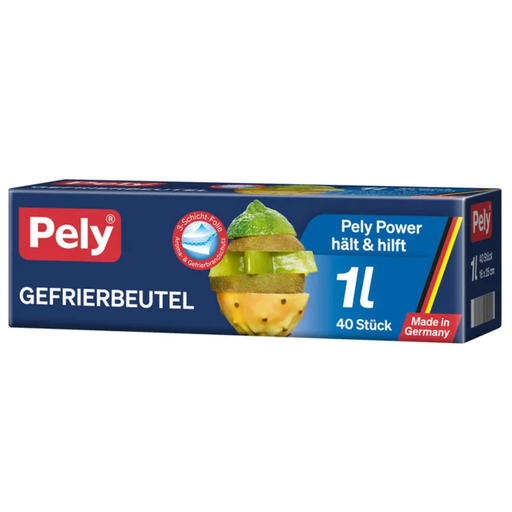
Why this product suits the profile: The 1‑litre format is ideal for everyday portions and, with 40 bags, offers a manageable pack size for getting started.
The 16 x 25 cm dimensions and the write‑on panel help you judge size and organise your stores realistically.
According to the product information: three‑layer film, BPA‑free, write‑on panel and suitability for temperatures down to −40 °C.
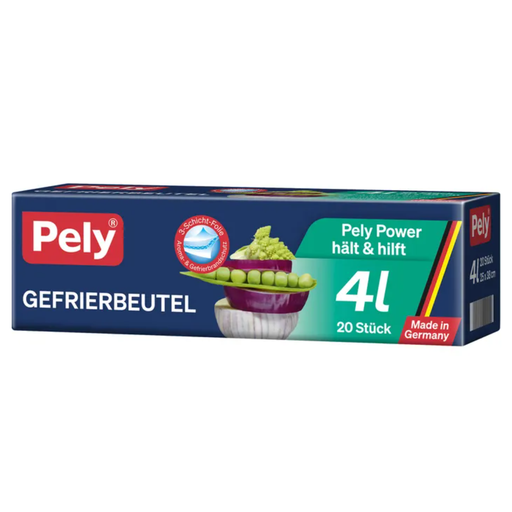
Why this product suits the profile: The 4‑litre format targets families, keen cooks and households that freeze larger portions or baked goods.
The larger 25 x 38 cm size reduces the temptation to cram bulky foods into bags that are too small.
According to the product information: 20 bags, three‑layer BPA‑free film, write‑on panel and flexibility down to −40 °C.
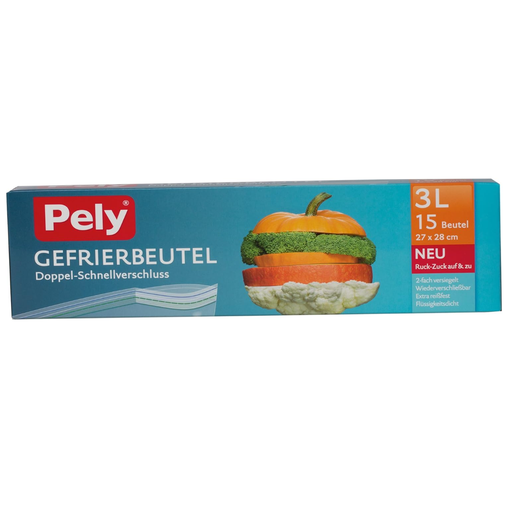
Why this product suits the profile: For soups, marinades and bigger meal‑prep batches, the 3‑litre bag provides a resealable format with a double closure.
The double sealing line addresses the common weak point of simple closures, but it still needs to be pressed fully shut.
According to the product information: 3‑litre capacity, two press‑seal lines, write‑on panel and extra‑strong film.
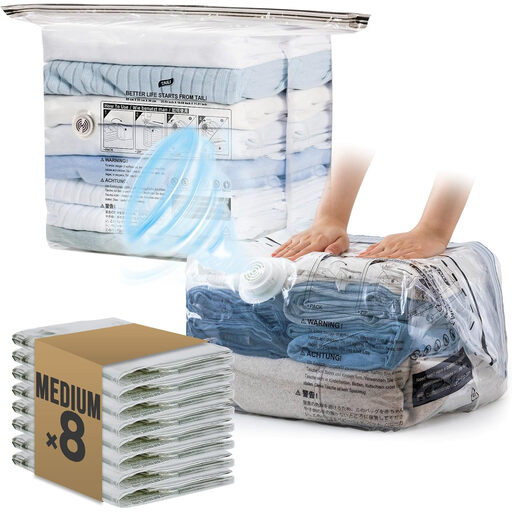
Why this product suits the profile: These vacuum bags for clothing are intended for textiles, blankets and luggage, not for storing food.
The clear separation of purposes prevents mixing up vacuum bags for clothing with food bags.
According to the product information: eight medium bags made from PA+PE, hand compression without a pump, double zip and a transparent design.
We’ve compiled a comprehensive, continuously updated list of products that fully meet these strict selection criteria and the safety regulations in force in the EU.
For single portions, berries or leftovers, a 1L freezer bag often suffices. For meals for two people, 2L to 3L are usually more suitable. Large loaves of bread, poultry or substantial stores typically need 4L or 6L. Always check the actual external dimensions as well.
Yes, provided the product states the bag is suitable for liquids and the closure is correctly sealed. Freezer bags with a double closure or a sturdy secure zip track are more practical for soups and marinades. Leave enough space when freezing and lay the bag flat in the freezer at first.
There’s no fixed service life. Check bags for tears, brittle spots and an intact closure before each use. Bags used once for raw meat or fish shouldn’t be reused for other foods for hygiene reasons. Vacuum bags for clothing can be used for longer if the film is undamaged and the closure still works.