
Lieferung heute & morgen

Qualitätsgarantie

Willkommens-Angebote freischalten: KOSTENLOSE Lieferung | Bis zu 80 % RABATT | Kostenlose 30-Tage-JoyPlus-Testphase
App herunterladen
Freezer bags are a kitchen essential in many households. They help you portion food, reduce freezer burn and make better use of the space in your freezer. But choosing the wrong bags can lead to unnecessary costs: some are too small for the amount you want to freeze, others don’t seal securely enough for liquids, and some tear as soon as you fill them.
This buying guide explains what households, families, meal-preppers, home cooks, kitchens and catering businesses should look out for.
A freezer bag with a capacity of 1 litre won’t necessarily suit every 1-litre food item. The shape of the bag, the width of the opening and the space needed to close it all affect how much you can actually fit inside. 1L freezer bags are often enough for flat portions. For larger cuts of meat, bread or several portions, 2L freezer bags or 4L freezer bags are more practical.
A simple clip or knot may be enough for dry foods. For soup, stock, marinades or defrosted liquids, freezer bags with a zip closure or freezer bags with a double closure are a better choice. Fill the bag upright and don’t fill it to the brim. Even a double closure still needs to be checked carefully.
The description extra-strong freezer bags should be backed up by specific details, such as the film construction, dimensions, temperature range and pack size. Multi-layer film can improve tear resistance, but sharp bones, sharp-edged packaging or overfilling can still damage a bag. If you regularly stock up, the price per bag is also a more useful guide than the pack price alone.
The right size depends on the portion and shape of the food you’re freezing:
Capacity isn’t the only thing to consider: check whether the filled bag can be stored flat. Flat portions usually take up less space in the freezer and are easier to stack.
When choosing plastic freezer bags, food-safe materials and a clearly stated temperature range are important. The product details should make it clear whether the bag is suitable for freezing. Some models are described as remaining flexible down to -40 °C.
Multi-layer film, such as 3-layer film, is listed for several pely models. When used correctly, it can offer greater resistance to wear and tear. BPA-free freezer bags are another consideration, but check the details for the specific model. The product information for the pely products mentioned here states that they are made from BPA-free material.
Don’t use freezer bags in an oven, under a grill or near direct heat unless the packaging explicitly says they’re suitable. Nor should you assume a bag is microwave-safe simply because it’s described as “suitable for freezing”.
Bags with a clip or knot may be enough for dry, solid foods. For liquids, leak-proof freezer bags with a double or zip closure are a practical option. Before freezing, press out as much air as possible without overstretching the bag.
A space for labelling makes it easier to keep track of what’s in your freezer. Write the contents and freezing date directly on the bag, so you can use older portions first.
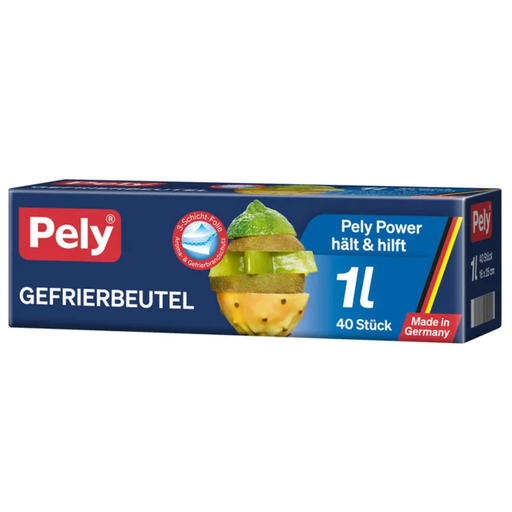
Why this product suits this type of user: The 1-litre size is ideal for everyday individual portions, and the pack contains 40 bags for an affordable introduction to freezer bags.
The product details specify dimensions of 16 × 25 cm, a space for labelling and 3-layer film. This makes it easier to check the size and material than relying on a general marketing claim.
1-litre capacity, 40 bags per pack, BPA-free 3-layer film according to the product details, and made in Germany.
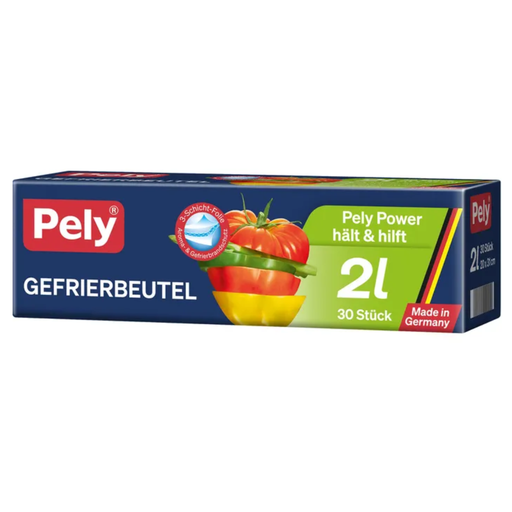
Why this product suits this type of user: The 2-litre capacity gives you more room for meal prep, family-sized portions and medium-sized ingredients, without having to jump straight to a very large bag.
The product description gives the dimensions as 20 × 31 cm and mentions a space for labelling and flexibility down to -40 °C. This makes it easier to check the bag against your freezer compartment and intended use.
30 bags per pack, 2-litre capacity, 3-layer film, and BPA-free and made in Germany according to the product details.
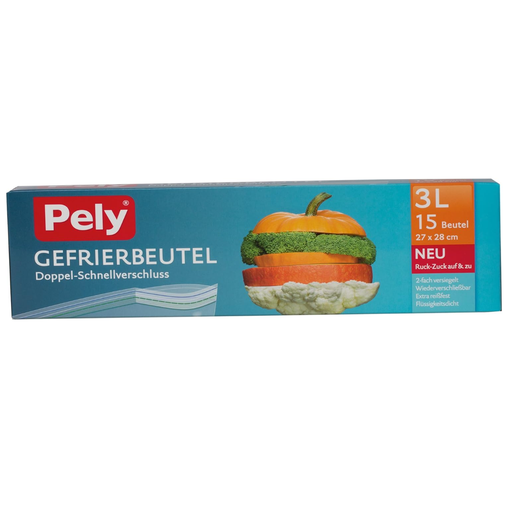
Why this product suits this type of user: The double closure is a useful feature if you regularly freeze soups, stocks, marinades or larger family-sized portions.
Two sealing strips help reduce the risk of a simple zip closure not being fully closed. You should still keep the bag upright and leave enough space at the top when sealing it.
3-litre capacity, double closure, a space for labelling and extra-strong PE film according to the product details.
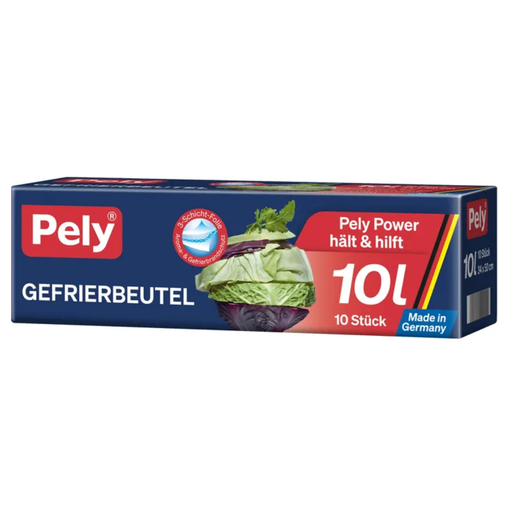
Why this product suits this type of user: This large format is designed for buyers who want to portion seasonal harvests, large joints, poultry or substantial quantities of food.
The stated dimensions of 34 × 50 cm let you check the size against your freezer before buying, helping you avoid finding that a large bag won’t fit in the compartment.
10-litre capacity, 10 bags per pack, 3-layer PE film and a space for labelling according to the product details.
We’ve put together a complete, regularly updated list of products that meet these strict selection criteria and the safety regulations in force in the EU.
Keep plastic bags away from babies and young children, as they pose a suffocation risk. Reuse a bag only if the product details allow it and there are no hygiene concerns. Don’t put raw and cooked food in the same type of bag without thoroughly cleaning it first.
1L freezer bags are usually enough for individual portions, fruit, vegetables or small amounts of leftovers. For meals for several people or larger ingredients, bags of 2 to 4 litres are a good choice. Check the dimensions as well as the stated capacity.
That depends on the closure and the product’s specific approval for use. Freezer bags for liquids should have a reliable zip or double closure. Leave space at the top when filling bags with soup, sauce or marinade, and freeze them upright to start with.
The recommended storage time depends on the food, temperature, packaging quality and hygiene. Label every bag with its contents and the date, and follow standard guidance on freezer storage. Replace any damaged or leaking bag, regardless of the date.