
Lieferung heute & morgen

Qualitätsgarantie

Willkommens-Angebote freischalten: KOSTENLOSE Lieferung | Bis zu 80 % RABATT | Kostenlose 30-Tage-JoyPlus-Testphase
App herunterladen
Freezer bags are a staple in many British households. They help you portion meat, vegetables, bread, soups and prepared meals. However, a low price does not automatically mean you are getting the right solution. If you only look at the number of bags or phrases such as “extra strong”, you can easily overlook important details.
1. The litre capacity is confused with the actual usable size.
A 1-litre freezer bag is generally suitable for individual portions, berries or leftovers. It often does not have enough capacity for family meals or larger pieces of meat. Conversely, extra-large 6-litre freezer bags take up unnecessary space when used for small portions. You should therefore also check the dimensions, such as 16 × 25 cm for a 1-litre model or 29 × 44 cm for a 6-litre bag.
2. A basic closure is used for liquids.
Soups, stocks and marinades can leak if the bag is not fully sealed. A freezer bag with a double closure or zip closure provides an additional sealing line by design. Even so, every bag should be filled while upright, not overfilled and checked for leaks before freezing.
3. Material thickness is judged only by advertising claims.
“Robust” or “extra strong” are difficult to compare without specific product information. More useful details include references to multi-layer film, stated temperature resistance, bag dimensions and the type of closure. Freezer bags for food should also clearly state that they are suitable for the intended food contact.
Choosing the right size reduces the amount of air in the bag and makes it easier to keep your freezer organised:
The stated capacity does not replace checking the dimensions. Wide openings are practical for bulky food, while flat portions make better use of the available freezer space.
For dry food, a basic closure may be sufficient depending on the product, provided the opening is securely sealed. When using freezer bags for liquids, two points are particularly important:
A double closure can reduce the risk of leaks, but it is no substitute for careful sealing. Leave some space at the top, as liquids expand when frozen.
According to the product information, multi-layer plastic film can offer greater tear resistance than very thin film. The pely models featured here are specified as having an optimised 3-layer film. Some products have a labelling panel. Write the contents and freezing date directly on the bag so that older portions can be used first.
BPA-free freezer bags are an important selection criterion for many shoppers. However, the specific information on the product page and packaging is always decisive. Plastic bags should always be kept out of reach of babies and young children, as they pose a suffocation risk. Damaged or badly deformed bags should no longer be used for food.
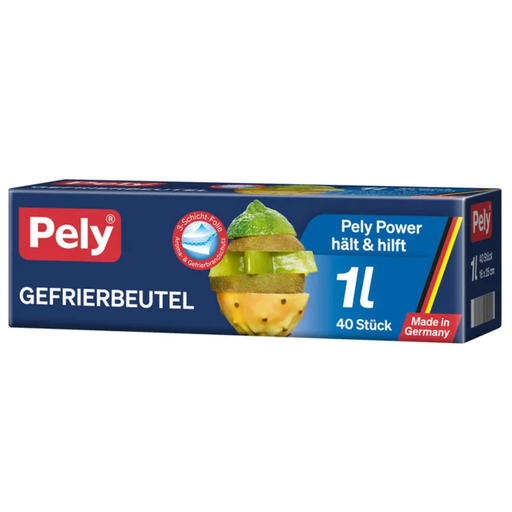
Why this product suits this profile: The 40 1-litre bags are ideal for regularly portioning fruit, vegetables, meat and leftovers.
The stated dimensions of 16 × 25 cm and the labelling panel make the actual use and later identification more straightforward.
According to the product information, BPA-free 3-layer film, suitable for temperatures down to -40 °C, 40 bags per pack.
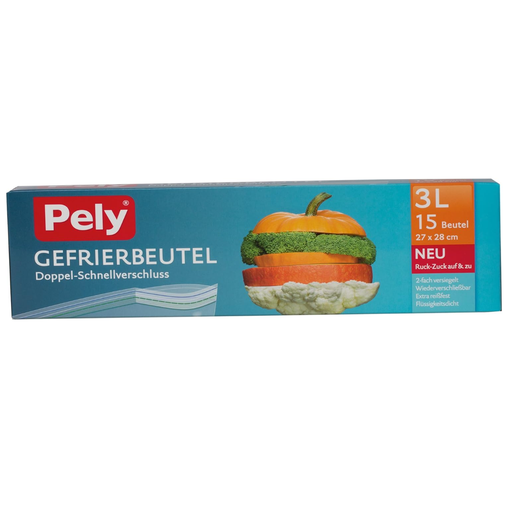
Why this product suits this profile: The 3-litre format with a double closure is designed for households wanting to store larger portions and liquids.
Two press-to-close lines address the risk of a single closure not being fully sealed; the bag must still be closed correctly.
According to the product information, extra-strong PE film, 3-litre capacity and 15 bags with a labelling panel.
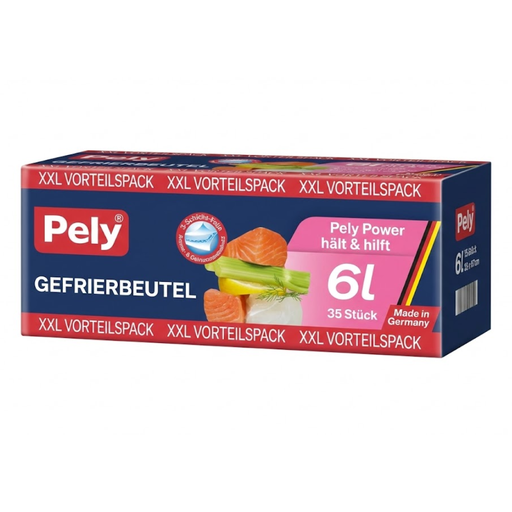
Why this product suits this profile: The XXL format is designed for large pieces of meat, whole poultry pieces, loaves of bread or substantial harvests.
The dimensions of 29 × 44 cm prevent bulky food from being forced into bags that are too small and putting unnecessary strain on the film.
According to the product information, 35 bags, 6-litre capacity, 3-layer film, wide opening, BPA-free and Made in Germany.
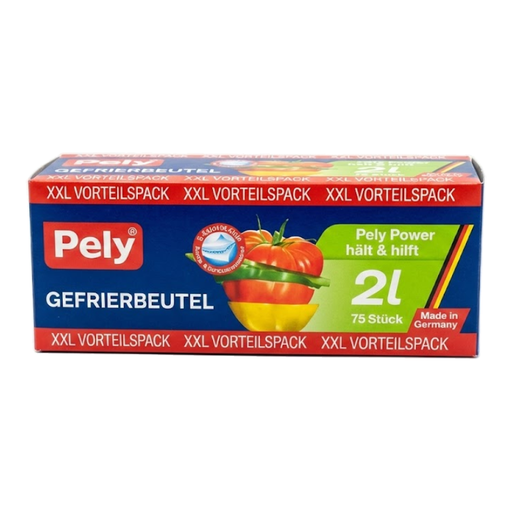
Why this product suits this profile: 75 bags in the 2-litre format provide a reliable supply for weekly meal preparation and regular freezing.
The medium capacity prevents typical family portions from taking up unnecessary air and freezer space in very large bags.
According to the product information, 20 × 31 cm, 3-layer film, labelling panel and manufactured in Germany.
We have put together a complete, regularly updated list of products that fully meet these strict selection criteria and the safety regulations applicable in the EU.
A few simple steps are essential for hygienic, space-saving use:
Freezer burn can be reduced by keeping the amount of trapped air to a minimum and ensuring the packaging remains intact. However, a freezer bag is not a substitute for a suitable cold chain. The recommended storage time depends on the food, the temperature and its condition when frozen.
Models with a double closure or a sturdy press-to-close strip are suitable for soups, sauces and marinades. Fill them while upright and leave room for expansion. The closure should be checked for leaks before freezing completely.
Single-use freezer bags are generally intended for one-time use, particularly if they have contained raw meat, fish or liquids. Reusable models may only be cleaned and used again in accordance with the manufacturer’s instructions. Damaged, cloudy or brittle bags should not be used again for storing food.
The country of origin alone says nothing about the size, type of closure or intended use. When choosing, you should also check the material information, dimensions, capacity and suitability for food contact. According to the product information, the pely products mentioned in this article are manufactured in Germany; nevertheless, their specific design remains the decisive purchasing criterion.