
Lieferung heute & morgen

Qualitätsgarantie

Willkommens-Angebote freischalten: KOSTENLOSE Lieferung | Bis zu 80 % RABATT | Kostenlose 30-Tage-JoyPlus-Testphase
App herunterladen
Whether for meal prep, garden surpluses, family-sized portions or your food cupboard: freezer bags should store food in a space-saving, hygienic and as leak-proof a way as possible. In practice, however, problems are often caused not by the freezer but by an unsuitable bag size, a weak closure or material that is too thin.
The Joybuy Product Recommendation Officer’s selection therefore focuses on clear, practical criteria rather than marketing promises. Capacity, dimensions, material thickness, closure type and pack size are the key factors.
A 1L freezer bag is not automatically suitable for every food with a volume of one litre. The width, height and opening determine whether items such as bread, flat portions or bulky ingredients can be filled conveniently. For large roasts, whole poultry portions or garden surpluses, large freezer bags with capacities of 4L, 6L or 10L are usually more practical.
Soups, stocks and marinades place greater demands on a bag than dry foods. A knot or simple clip can come undone when the bag is being moved. For these applications, freezer bags with a double closure or freezer bags with a zip closure are more suitable. Even so, the bag should also be frozen upright in a bowl until the contents are completely solid.
A shiny surface says little about tear resistance. Check the material information and the bag’s construction. Several pely models specify three-layer film. According to the manufacturer, selected variants are made from BPA-free polyethylene and remain flexible down to a stated temperature of -40 °C. These details should be checked against the product packaging.
The dimensions help you assess suitability: a 1-litre bag measuring 16 × 25 cm is suited to different uses than a 6-litre bag measuring 29 × 44 cm. Also allow some extra space, particularly for liquids and foods that expand when frozen.
Resealable freezer bags with a zip closure make everyday use easier. A stand-up base can be helpful when filling the bag, as it allows it to remain upright. A double closure provides two sealing lines and is a sensible option for liquids or marinades. With conventional bags without an integrated closure, you will need a clip, peg or knot.
For food use, bags should be expressly suitable for the intended type of contact. Information such as BPA-free freezer bags, polyethylene or three-layer film provides an initial point of reference. According to the manufacturer, several pely products are made in Germany; if you are specifically looking for freezer bags made in Germany, check the country of origin and the responsible company on the packaging.
Label every bag with its contents and freezing date. This helps you avoid unnecessary thawing and refreezing. Sharp bones or edges can damage the film; where necessary, wrap them beforehand or cover them with an additional protective layer.
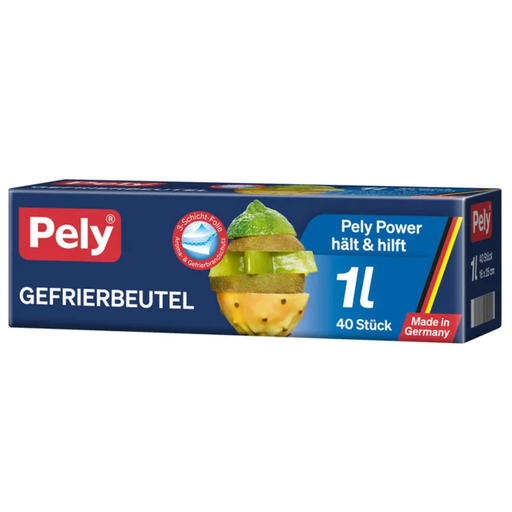
Why this product suits this profile: The 40-pack with a capacity of 1 litre is suitable for regularly portioning leftovers, fruit, vegetables and smaller meals.
The stated size and writing panel make it easier to choose suitable portions and identify them later.
16 × 25 cm, 40 bags per pack and, according to the manufacturer, BPA-free three-layer film.
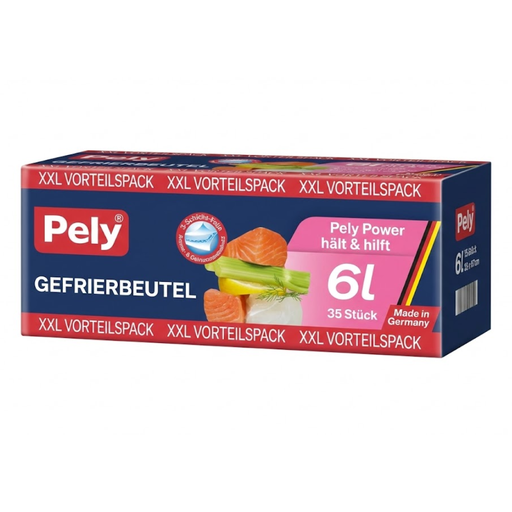
Why this product suits this profile: The 6-litre size is designed for households with large portions, baked goods, garden surpluses or bulky foods.
The extra-wide opening reduces the risk of damaging large foods on the edges when filling the bag.
35 pieces, 29 × 44 cm and, according to the manufacturer, three-layer BPA-free film; Germany is stated as the country of manufacture.
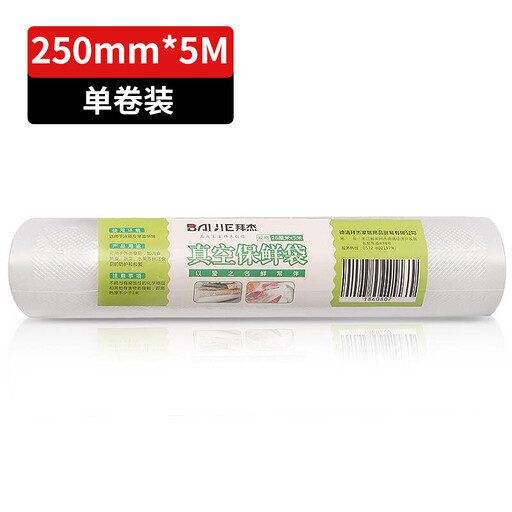
Why this product suits this profile: The roll can be cut to the desired length, making it suitable for users who frequently vacuum-seal different food portions.
The adjustable length prevents small portions from being placed in unnecessarily large bags or large pieces from failing to fit.
250 mm width, 5 m roll length and designed for use with standard vacuum sealers.
For particularly large quantities, 4L, 6L or 10L freezer bags may be useful. Smaller formats are generally more space-efficient for individual portions. If you want to store food under vacuum, however, you will need vacuum bags for food and a compatible appliance; ordinary food storage bags cannot replace this function.
We have put together a complete, regularly updated list of products that fully meet these strict selection criteria and the safety regulations applicable in the EU.
A 1L freezer bag is often sufficient for individual meals, berries or chopped vegetables. For two or more portions, 2L or 3L bags are more practical. The width of the opening is just as important as the volume.
A double closure can reduce the risk of leaks when it is fully sealed. Even so, the bag should not be overfilled and should be kept upright when freezing. Placing it in an additional bowl before freezing is a sensible way to protect against leaks.
The possible storage time depends on the food, temperature, amount of air and quality of the packaging. Label every bag with the date and contents, and check it for freezer burn, unusual odours or damage before use. The manufacturer’s information on suitability and storage should always take priority.