
Lieferung heute & morgen

Qualitätsgarantie

Willkommens-Angebote freischalten: KOSTENLOSE Lieferung | Bis zu 80 % RABATT | Kostenlose 30-Tage-JoyPlus-Testphase
App herunterladen
A glass measuring cup is a practical addition to many households: you can see liquids as you measure them, mix ingredients directly in the cup and, depending on the model, even heat them in the microwave. However, products vary considerably in terms of material, capacity, scale markings and cleaning requirements.
If you focus solely on a low price or particularly extensive features, you can easily overlook important details. Four common purchasing pitfalls occur particularly often:
A borosilicate glass measuring cup is often chosen when you want a transparent vessel with good temperature resistance. Compared with conventional glass, borosilicate glass has lower thermal expansion. This can be useful when temperatures change, but it does not replace the manufacturer’s instructions.
Even a heat-resistant glass measuring cup should not be moved directly from a very hot environment onto a cold surface or into cold water without checking first. Such sudden temperature changes can damage glass. For hot liquids, a model with a sturdy handle and spout is also recommended.
Important: Terms such as ‘oven-safe’, ‘microwave-safe’ or ‘heat-resistant’ should be stated in the specific product description or on the packaging. If this information is missing, the vessel should not automatically be assumed to be suitable for these uses.
The most common sizes are suitable for different tasks:
The stated capacity is not the only factor to consider. Check whether there is enough room above the final marking. A vessel that has to be filled to the brim is more difficult to carry and pour.
A measuring cup with a scale should have clear, easy-to-see markings. For UK households, metric measurements in millilitres are particularly useful. If additional graduations for different ingredients are included, it should be clear which measuring method they refer to.
A spout helps to reduce spillage when pouring. An ergonomically shaped handle can be useful when the contents are warm, although hot liquids must always be handled carefully. A glass measuring cup can generally be used for dry ingredients, but a kitchen scale may offer a different level of measuring accuracy for flour, sugar or rice.
When it comes to cleaning, it is important to distinguish between ‘easy to clean’ and ‘dishwasher-safe’. The smooth, non-porous glass surface generally absorbs odours and colours less readily than some plastic surfaces. Whether a model can actually be put in the dishwasher must be confirmed in the relevant product information.
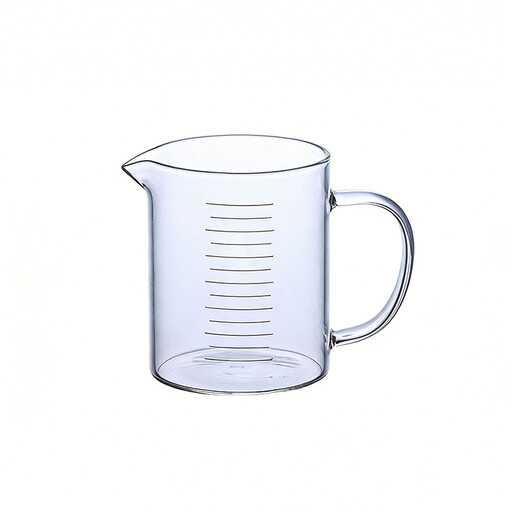
Why this product suits this profile: With a capacity of 350 ml, it is manageable for smaller kitchen tasks and takes up little space. The product name indicates that it is made from borosilicate glass.
The clearly stated size helps you avoid choosing a vessel that is too large or unnecessarily heavy for small quantities. Before buying, check the scale using the product images.
Compact capacity and borosilicate glass according to the product name.
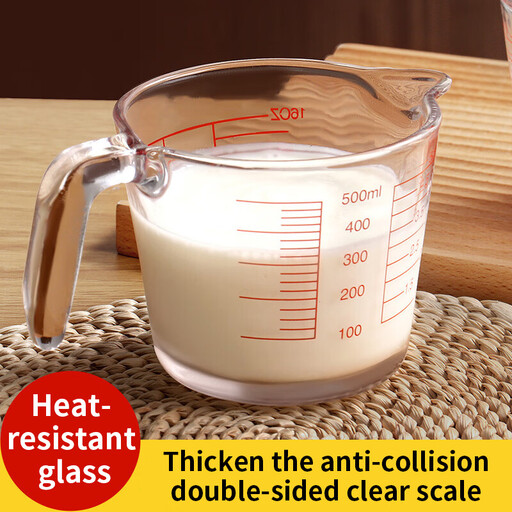
Why this product suits this profile: The product description specifies heat-resistant borosilicate glass, a metric scale, spout and handle, as well as suitability for the oven, microwave and dishwasher.
The stated usage information reduces the risk of choosing a glass vessel without guidance on temperature and cleaning. Before use, the markings on the product remain crucial.
500 ml capacity, metric scale and, according to the product description, suitability for the oven, microwave and dishwasher.
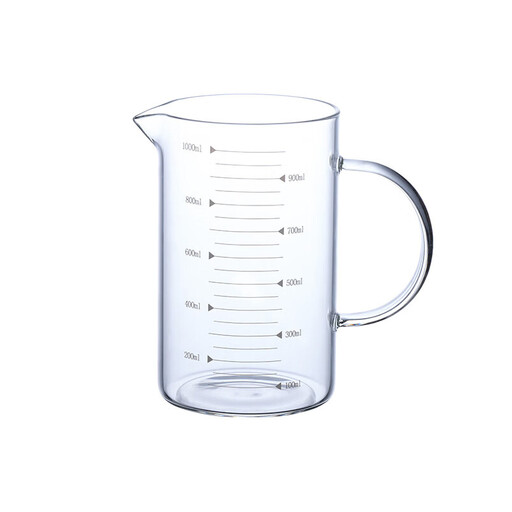
Why this product suits this profile: A capacity of 1000 ml is suitable for larger quantities when cooking and baking, preparing drinks or mixing several ingredients.
The large capacity means you do not have to divide larger recipe quantities between several small vessels. Because of its size and weight, the cup should still not be filled to the brim.
1000 ml capacity, clear volume markings according to the product description and borosilicate glass.
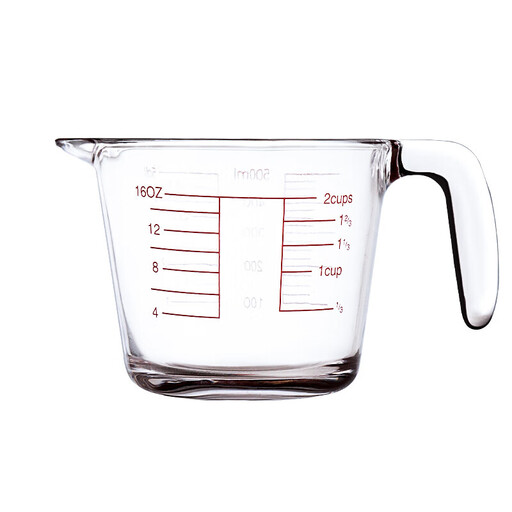
Why this product suits this profile: The product name highlights its integrated scale. The 500 ml format is suitable for many standard quantities in the kitchen and for baking.
The purchase is based not only on the glass material, but also on the explicitly stated scale. Check the graduations and readability in the product view beforehand.
500 ml capacity and a scale stated in the product name.
We have put together a complete, regularly updated list of products that fully meet these strict selection criteria and the safety regulations applicable in the EU.
Before ordering a glass measuring cup, check the following:
This depends on the type of glass and the manufacturer’s information. Borosilicate glass is often used for applications involving higher temperatures. Nevertheless, there should be specific guidance on heat resistance, microwave or oven use. Sudden temperature changes should always be avoided.
A 500 ml measuring cup is sufficient for many sauces, drinks and baking ingredients and is usually easier to store. A 1000 ml measuring cup provides more space for larger quantities and several ingredients. For a household that often cooks in batches, the larger option may be more practical.
Only if the specific item is expressly labelled as dishwasher-safe. Even then, it should be positioned so that it cannot knock against other hard objects. If no information is provided, washing by hand with warm water, washing-up liquid and a soft cloth is the more cautious option.