
Lieferung heute & morgen

Qualitätsgarantie

Willkommens-Angebote freischalten: KOSTENLOSE Lieferung | Bis zu 80 % RABATT | Kostenlose 30-Tage-JoyPlus-Testphase
App herunterladen
A glass measuring cup is part of the everyday kitchen equipment for many home cooks and baking enthusiasts. It is suitable for measuring water, milk, oil, stock or liquid batter, while transparent designs usually make it easy to check the contents at a glance. However, models differ considerably in terms of material, graduations, capacity and heat resistance.
Focusing solely on the millilitre marking or an appealing product photo can mean overlooking important details. The following guidance will help you choose a glass measuring cup that suits your kitchen and cooking habits.
Not every glass measuring cup is suitable for boiling liquids, microwave use or the oven. Ordinary glass can be damaged by sudden temperature changes. Moving a cup directly from a cold cupboard into a very hot environment is particularly risky.
A borosilicate glass measuring cup is often explicitly labelled as heat-resistant on the product page. However, this does not replace the manufacturer’s instructions regarding maximum temperature and use in the microwave, oven or dishwasher.
A measuring jug with graduations may display several units, such as millilitres, cups or ounces. What matters is whether the scale is easy to read, permanently applied and divided finely enough for the quantities you want to measure. For small quantities, a 1000 ml measuring cup with coarse graduations may be less practical than a smaller model.
Also check whether the scale remains visible from the outside when the cup is filled. Hard-to-read or cluttered markings can lead to inaccurate measurements when baking.
The “500 ml” specification describes the maximum capacity, not necessarily a comfortable working volume. When mixing or pouring, it is helpful to leave some space above the required quantity. A 500 ml glass measuring cup is generally suitable for everyday kitchen portions, while a 1000 ml model offers more room for soups, sauces or larger baking recipes.
Also check the height and diameter. A tall measuring cup may not fit beneath every tap or inside every kitchen cupboard.
For hot liquids, the manufacturer must clearly specify that the cup is heat-resistant. Borosilicate glass is frequently used for heat-resistant kitchenware. Even so, do not place a filled cup on an ice-cold or wet surface unless the manufacturer expressly approves this type of use.
If the type of glass is not specified, use the measuring cup only within the stated temperature range. Details such as “microwave-safe”, “oven-safe” or “dishwasher-safe” should be clearly listed in the product information.
For most households, the following sizes are practical:
A clearly legible millilitre scale is particularly useful for recipes from the UK and Europe. If you frequently prepare international recipes, cup or ounce markings can be a valuable addition. For dry ingredients, use the scale only if the manufacturer explicitly permits this, as volume and weight are not interchangeable.
A measuring cup with a pouring spout makes it easier to transfer liquids and can help reduce drips beside the bowl. A sturdy handle is particularly useful when the cup is full or its contents are warm. Check that the handle provides sufficient clearance from the body of the cup and that the overall weight remains comfortable to handle.
Ease of cleaning also matters. A narrow spout or an awkward, hard-to-reach junction between the handle and the glass can increase maintenance effort. Dishwasher suitability should only be assumed when it is explicitly stated in the product description.
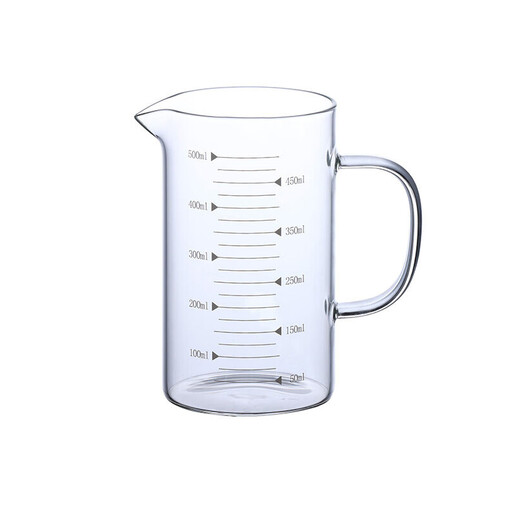
Why this model is a good fit: With a 500 ml capacity, this model is practical for many standard tasks in everyday kitchens while taking up little space. The product name specifies borosilicate glass.
The clearly defined capacity makes it easier to choose than an unspecified drinking or serving glass. Check the temperature specifications on the product page before use.
500 ml format; borosilicate glass specified in the product name.
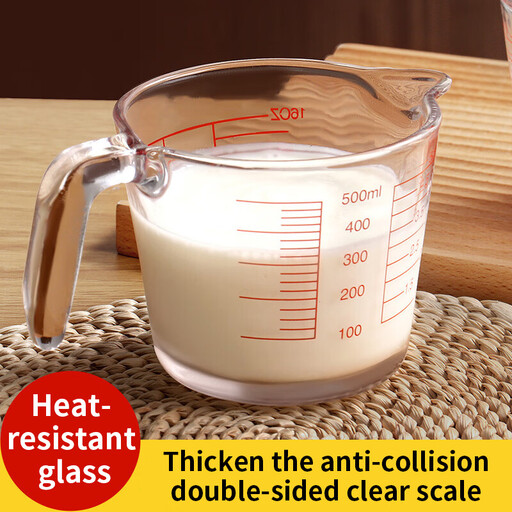
Why this model is a good fit: The product description specifies heat-resistant borosilicate glass, a metric scale, a pouring spout and suitability for the oven, microwave and dishwasher.
Several clearly stated usage features make it easier to assess the product before purchase. The relevant temperature and care instructions should still be followed.
Metric scale; pouring spout and handle; described as suitable for the microwave, oven and dishwasher.
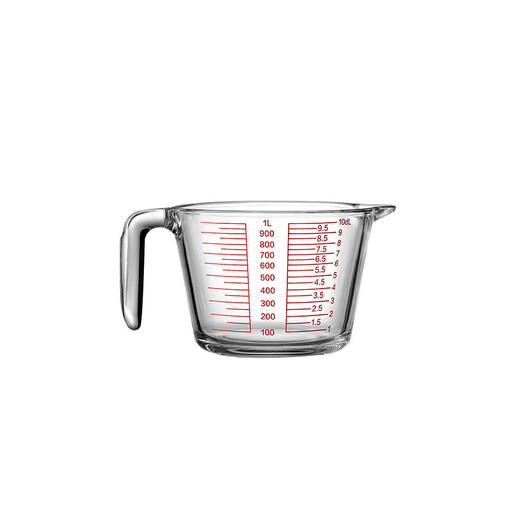
Why this model is a good fit: A 1000 ml measuring cup provides additional capacity for soups, sauces, drinks or larger baking quantities. The product name indicates a graduated design.
The larger capacity reduces the need to transfer the same liquid multiple times. Material, microwave suitability and dishwasher approval should be checked separately before purchase.
1000 ml capacity; graduated measuring jug for larger quantities.
For smaller quantities, a 350 ml model such as the BJ 350ml Borosilicate Glass Measuring Cup may be worth considering. If you only need a scale, the BJ 500ml Glass Measuring Cup with Scale offers another 500 ml option. Plastic and stainless-steel models differ in break resistance, weight and heat performance, so they are not automatically equivalent alternatives to glass.
The complete category includes a range of measuring cups and drinking vessels for comparing capacity, material and design.
That depends on the type of glass and the manufacturer’s approval. Borosilicate glass may offer a higher level of temperature resistance. The decisive factor is the specific guidance regarding use with boiling liquids, in the microwave or in the oven.
A 500 ml measuring cup covers many everyday cooking and baking tasks. For soups, larger quantities of batter or several liquids, a 1000 ml measuring cup is more practical. For very small quantities, a smaller vessel may be easier to read accurately.
With proper use, glass can remain functional for many years. Its service life depends primarily on avoiding drops, sudden temperature changes and scratches. Do not continue using the measuring cup if it shows visible damage.