When choosing granola for everyday life with diabetes, don’t rely on claims such as “high in fibre” or “less sugar” alone. Compare fibre, sugar and carbohydrates per 100 g, then calculate the values for the portion you actually eat. If you count carbohydrates to plan your insulin, diabetesDE also advises including carbohydrates from milk, yoghurt, plant-based drinks and other accompaniments in your meal total.
Who are these buying criteria important for?
Shoppers mindful of sugar and carbohydrates
You want a crunchy breakfast and compare the sugar, sweetening ingredients and carbohydrates in the portion you actually eat. If you calculate insulin based on carbohydrates, diabetesDE advises that the carbohydrate content of the whole meal is what matters.
Shoppers focused on fibre
You’re looking for a mix with clear information about its fibre and wholegrain content, perhaps from oats. However, the fibre content alone doesn’t tell you how much sugar, carbohydrate or energy a portion contains.
Shoppers with ingredient or allergen requirements
You may need to check ingredients in a particular mix, such as cereals, nuts or sesame, so you look at the ingredients list, allergen information and, where relevant, any precautionary allergen statements on the pack.
What should you look for when buying?
Start by comparing the nutritional information per 100 g across similar types of product. For your own breakfast bowl, the amount you eat and the ingredients you add also matter.
| Criteria |
What to check |
Who it matters to |
| Sugar and sweetening ingredients |
Compare sugar per 100 g and per portion; check for ingredients such as syrup, honey and dried fruit. |
If I’m looking for a crunchy breakfast with a manageable amount of sweetening ingredients, I want to know the actual sugar content. For around 33% of consumers, comparing sugar and ingredients comes first. |
| Fibre and wholegrain |
Compare fibre per 100 g across similar mixes and check the grain base. |
I want to prioritise wholegrains and fibre at breakfast without overlooking other nutritional values. Around 27% of consumers put this fibre comparison first. |
| Carbohydrates and portion size |
Calculate the carbohydrates per 100 g for the amount you eat; account for accompaniments separately. |
If I need to calculate the carbohydrates in my meal, I need to be able to measure my granola portion and account for accompaniments. For around 27% of consumers, portion size and carbohydrates take priority. |
| Allergens and energy density |
Check allergen information, as well as energy and fat per 100 g, particularly for mixes containing nuts and seeds. |
Whether I have an allergy or want to assess a mix dominated by nuts and seeds, I need to check its composition carefully. Around 13% of consumers put allergens or energy density first. |
Common comparison mistakes
-
Assuming “less sugar” means a low sugar content
A percentage reduction refers to a comparison product. According to Verbraucherzentrale, expressions such as “less sweet” don’t tell you the actual sugar content on their own.
Check the sugar, carbohydrates and energy in the nutritional information, and look at the ingredients list for syrup, honey and dried fruit, too.
-
Looking only at the fibre content
A stated fibre value doesn’t also answer questions about sugar, carbohydrates and energy. The product information from Kölln and Seitenbacher shows why you should consider these values together.
Compare similar types of product per 100 g, then work out the values for your portion.
-
Forgetting accompaniments when calculating carbohydrates
The carbohydrates in your breakfast bowl don’t come from the granola alone. diabetesDE advises that carbohydrate content is relevant for people who calculate their insulin dose based on it.
Measure the amount of granola you eat and account for milk, yoghurt, plant-based drinks or fruit in line with your individual treatment plan.
-
Assuming seed-based granola is automatically low in energy
A lower carbohydrate value per 100 g doesn’t tell you the energy content: EDEKA lists 556 kcal and 37.2 g of fat per 100 g for its Bio Kerne & Saaten Granola.
For a mix like this, check energy, fat, portion size and any allergens that are relevant to you separately.
Brands and ranges to help you choose
Kölln
Oat and crunchy mueslis; the Knusper Klassik 50 % weniger Zucker variety provides specific nutritional information for comparing products.
- According to Kölln, this variety contains 17 g of fibre, 8 g of sugar and 52 g of carbohydrates per 100 g.
- Kölln also lists sugar and glucose-fructose syrup among the ingredients. The claim “50 % less sugar” doesn’t replace checking the actual figures.
Seitenbacher
A muesli range featuring wholegrain, nut and seed varieties; Bio Müsli Knackig & Zuckerarm #583 is one specific product you can compare.
- According to Seitenbacher, this mix contains 2 g of sugar, 9 g of fibre and 46 g of carbohydrates per 100 g.
- The ingredients include hazelnuts, almonds, cashews and sesame. Seitenbacher also lists 440 kcal per 100 g. Check which portion suits you and read the allergen information.
EDEKA Bio / GUT&GÜNSTIG
Two different recipes to compare: a granola dominated by kernels and seeds, and a reduced-sugar crunchy muesli.
- EDEKA lists 31.9 g of carbohydrates, 7.6 g of sugar and 556 kcal per 100 g for its Bio Kerne & Saaten Granola.
- Despite its comparative sugar claim, EDEKA’s GUT&GÜNSTIG Knusper Müsli weniger süß also contains glucose-fructose syrup, sugar and honey. The figures on the specific pack are what count.
REWE Bio / REWE Beste Wahl
REWE stocks crunchy muesli and granola from a range of brands, including its own-label ranges. For the product you choose, compare the recipe and nutritional information rather than assuming it’s suitable based on the range name.
- The different mixes make it possible to compare ingredients and nutritional values within each product type.
- The characteristics of one variety don’t apply to the whole range; check the label on the individual product.
Crunchy muesli and other mixes at Joybuy
This selection mainly includes crunchy oat mueslis, as well as an oat, fruit and nut mix and a fruit muesli. The products and their recipes differ, so compare the stated values and check which information you need for your portion.
 No image available
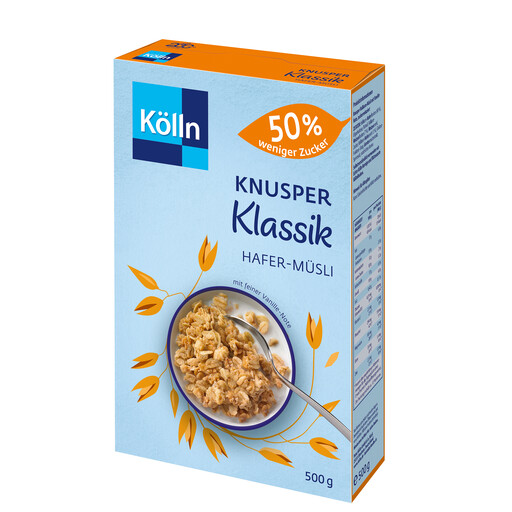
Kölln Crunchy Oat Muesli 50% Less Sugar, 375 g
A crunchy oat muesli to compare using its stated fibre, sugar and carbohydrate values.
The stated values per 100 g are 17 g of fibre, 8 g of sugar and 52 g of carbohydrates, with 70 % wholegrain. The ingredients also include sugar and glucose-fructose syrup. Before buying, check the pack size on the product page and on the packaging.
View at Joybuy
 No image available
Dr. Oetker Vitalis Less Sweet Pure Crunchy Muesli, 600 g
For shoppers looking for a crunchy muesli with an oat wholegrain base and comparable nutritional information.
The stated values per 100 g are 14 g of fibre, 13 g of sugar and 57 g of carbohydrates; the mix contains 58 % wholegrain oats. Despite the “Less Sweet” name, the listed ingredients include sugar, glucose syrup and honey.
View at Joybuy
 No image available
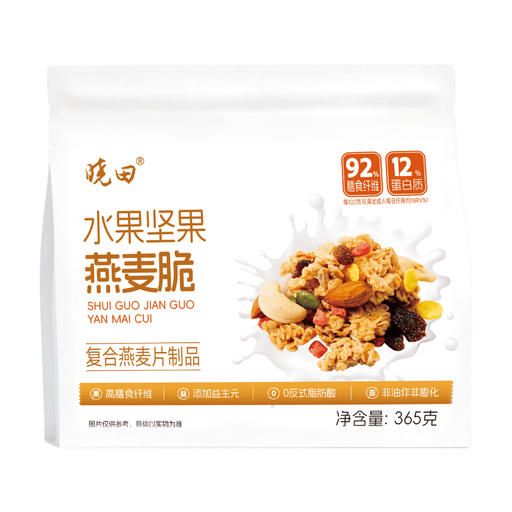
Xiao Tian Fruit & Nut Oat Crunch, 365 g
For shoppers who want to assess a crunchy oat, fruit and nut mix based on its fibre and carbohydrate content.
The stated values per 100 g are 22.9 g of fibre, 42.5 g of carbohydrates and 20.3 g of fat; the mix contains at least 47 % oats. It contains almonds and cashews. Check the sugar content and allergen information on the current pack.
View at Joybuy
 No image available
Jeden Tag Less Sweet Crunchy Oat Muesli, 750 g
A crunchy oat muesli to compare using its stated nutritional values and wholegrain base.
The stated values per 100 g are 8 g of fibre, 12 g of sugar and 65 g of carbohydrates. The mix contains 55 % wholegrain oats and 15 % wholegrain wheat flakes; it also contains sugar and glucose-fructose syrup.
View at Joybuy
 No image available
Kölln 50% Fruit Muesli No Added Sugar, 500 g
For shoppers looking to try a fruit muesli with an oat base; this isn’t a crunchy granola.
The stated values per 100 g are 7.8 g of fibre and 22 g of sugar, with 51 % wholegrain oats. The “No Added Sugar” claim doesn’t tell you the sugar content of your portion on its own. To calculate your portion, check the carbohydrates, ingredients and allergen information on the pack.
View at Joybuy
Frequently asked questions
Is a high fibre content enough on its own as a buying criterion?
No. Even with a mix that states its fibre content, you should check the sugar, carbohydrates and the portion you actually eat. The fibre value alone doesn’t tell you whether it’s suitable for you if you have diabetes.
How should I account for granola when planning my carbohydrates?
Use the nutritional information to calculate the carbohydrates per 100 g for the amount of granola you eat, and include the carbohydrates in any accompaniments. If you have insulin-treated diabetes, your individual calculations should form part of your personalised treatment plan, developed with your healthcare team; diabetesDE identifies carbohydrate information as the basis for this.
Is the claim “less sugar” enough to help me decide?
No. It describes a comparison with a reference product, not the absolute sugar or carbohydrate content of your portion. Compare the nutritional information and read the ingredients list; Verbraucherzentrale also highlights this when it comes to sugar claims.
What should I check on a granola pack if I have allergies?
Check the ingredients and allergen information on the specific pack, along with any relevant precautionary allergen statements. Depending on the recipe, it may contain cereals containing gluten, nuts or sesame, for example; the product name alone won’t tell you.


