Those looking to increase their fibre intake
You’re looking for muesli with wholegrains or bran and want to compare the stated fibre content per 100 g across different products.


For a breakfast that’s mindful of sugar when you have diabetes, don’t choose muesli and breakfast cereals based solely on wholegrain claims or a label saying “diabetes-friendly”. Compare fibre, sugar and carbohydrates per 100 g, as well as the ingredients. It’s also important to consider how many carbohydrates are in the portion you actually eat and whether the ingredients suit your individual needs.
You’re looking for muesli with wholegrains or bran and want to compare the stated fibre content per 100 g across different products.
You enjoy crunchy or sweet cereals, but want to check how much sugar they actually contain. The consumer advice centre points out that ingredients such as glucose syrup, honey, fruit juice and dried fruit also contribute to the sugar content.
You need to check ingredients and allergens, or take the carbohydrates in your portion into account as part of an individual plan. In either case, check the information on the specific pack and consider how much you actually eat.
First, compare the nutritional values per 100 g. Then check the ingredients and work out how many carbohydrates are in the amount you actually plan to eat.
| Criteria | What to check when buying | Who should pay particular attention |
|---|---|---|
| Fibre and wholegrains | Fibre per 100 g, and whether wholegrain cereals or bran appear in the ingredients list. | If I’m looking for a mix with a clearly stated fibre content, I need more than a wholegrain claim on the front of the pack. This is a priority for around 39% of consumers. |
| Sugar and carbohydrates | “Of which sugars” and carbohydrates per 100 g, plus any sweetening ingredients in the ingredients list. | When choosing sweet cereals, I want to see how the sugar and carbohydrate content fits with the portion I’m planning to eat. This is the main reason for buying for around 38% of consumers. |
| Allergens and portion size | Allergens highlighted on the current pack; calculate nutritional values for the amount you eat. | If I need to avoid certain ingredients or plan my portion carefully, I can’t rely on the product name alone. This is the first thing around 23% of consumers look for. |
The wholegrain content doesn’t tell you how much sugar a product contains. Nestlé states that CINI MINIS contains 33% wholegrain, as well as 24 g of sugar per 100 g.
Compare fibre, sugar and carbohydrates per 100 g, then work out the amounts for your portion.
Terms such as “naturally sweet” don’t tell you how much sugar a product contains overall. The consumer advice centre says that honey, fruit juice and dried fruit can also contribute to the sugar content.
Read the ingredients list and the “of which sugars” line, and compare products using the same serving basis.
When buying a product because of an allergy, the labelling on the specific pack is what matters. According to the EU information portal Your Europe, allergens in pre-packed foods must be highlighted in the ingredients list.
Check the current ingredients list and any precautionary allergen statements before buying.
A muesli brand with a clearly labelled wholegrain and bran mix that provides a useful point of comparison.
A cereal and granola brand where the nutritional values of each variety are what count.
A cereal range in which, according to Nestlé, wholegrains are an important recipe ingredient.
Cinnamon cereal in the Nestlé range; an example of why it’s worth looking at wholegrain and sugar figures together.
A Swiss muesli brand; the figures for familia c.m.plus Original refer to the Swiss product.
This selection includes crunchy muesli and a fruit muesli to compare for a breakfast that’s mindful of sugar. For each pack, check fibre, sugar, carbohydrates and ingredients; similar product names don’t mean the nutritional values are the same.
 No image available
For anyone looking for crunchy muesli who wants to compare the fibre, sugar and carbohydrate content per 100 g.
“Less Sweet” doesn’t replace checking the nutritional information on the pack.
 No image available
For anyone who prefers crunchy oat muesli and wants to compare sugar and carbohydrates with other mueslis before choosing.
As well as the nutrition table, check the ingredients list on the current pack.
 No image available
For anyone considering fruit muesli who doesn’t want to judge the sugar content from the words “No Added Sugar” alone.
Check the sugar and carbohydrate content per 100 g on the pack, and take the amount in your bowl into account.
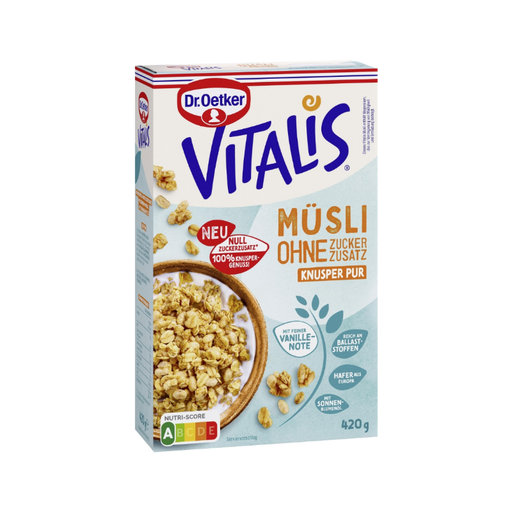 No image available
For anyone looking for crunchy muesli with this product description who also needs to plan their carbohydrate intake.
Use the sugar and carbohydrate figures on the current pack; the product name alone doesn’t tell you what you need to know.
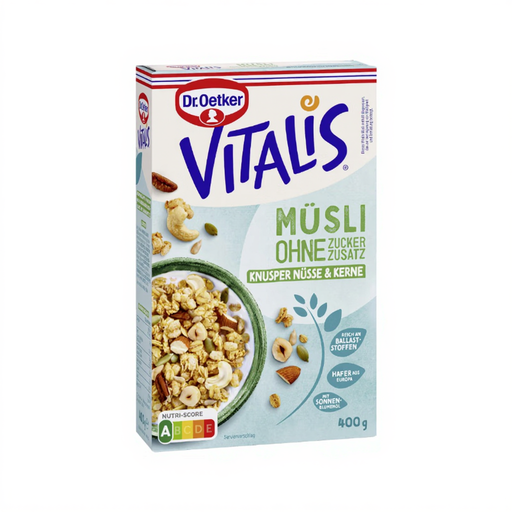 No image available
For anyone considering nutty crunchy muesli who wants to pay particular attention to allergen labelling.
Also check the fibre, sugar and carbohydrate content per 100 g on the current pack. The sugar figure alone doesn’t show the total carbohydrate content.
No. A wholegrain claim alone doesn’t tell you enough about the sugar and carbohydrate content. For example, Nestlé states that CINI MINIS contains 33% wholegrain and 24 g of sugar per 100 g. Compare the nutritional values for the specific variety and take your portion into account.
Still check “of which sugars”, total carbohydrates and the ingredients list. The consumer advice centre points out that fruit juice and dried fruit, among other ingredients, can contribute to a food’s sugar content.
Read the ingredients list on the pack and look for highlighted allergens, as well as any precautionary allergen statements. According to the EU information portal Your Europe, allergens in pre-packed foods must be clearly identified in the ingredients list.