
Lieferung heute & morgen

Qualitätsgarantie

Willkommens-Angebote freischalten: KOSTENLOSE Lieferung | Bis zu 80 % RABATT | Kostenlose 30-Tage-JoyPlus-Testphase
App herunterladen
With Ibergrif plumbing accessories, appearance is not the only factor that determines suitability. For basins, taps, washing machines, dishwashers and showers, the threads, connection sizes and intended use must all match. A chrome-plated component may look high-quality yet still be unusable if, for example, a G3/8 to G1/2 adapter is fitted to the wrong type of thread.
As a Joybuy Product Recommendation Officer, I filter the relevant product data and show you which details are particularly important before you buy. This can help you avoid common purchasing mistakes, unnecessary returns and leaks later on.
The measurements 1/2 inch, 3/8 inch and 3/4 inch do not automatically describe the same type of connection. A classic Ibergrif angle valve, for example, may have a G1/2 wall connection and a G3/8 outlet. By contrast, a device connection valve for a washing machine or dishwasher often uses a 3/4-inch outlet.
Before buying, you should therefore check:
Terms such as “universal” usually refer to specific standard connections, not every plumbing installation. A 1/2-inch device connection valve with a 3/4-inch outlet is suitable for many household appliances, but will not necessarily fit a 3/8-inch hose. With an adapter featuring G3/8 to G1/2, the direction must also be correct: are you extending an existing G3/8 connection to G1/2, or reducing a G1/2 connection to G3/8?
Chrome, stainless steel and brass initially tell you something about the material and surface, but not on their own whether the entire installation is suitable. The thread design, seals, permitted load and correct installation are also decisive. Avoid abrasive cleaners and hard tools when working with chrome-plated parts, as these can damage the surface.
For many basin installations, the combination 1/2-inch wall connection to 3/8-inch outlet is relevant. This exact configuration is found on several Ibergrif angle valves. Appliance valves, on the other hand, often specify G1/2 at the wall inlet and G3/4 at the appliance outlet.
The designation BSP refers to a standardised Whitworth pipe thread family. Even so, you should compare the thread type and sealing surface with the product description and your existing installation. If you are unsure, it is advisable to consult a plumbing professional.
A self-sealing angle valve can make installation easier because, according to the product information, no additional sealing material is required on the wall connection. However, this does not mean that every connection will be leak-free without checking. Hose connections still require suitable seals. After installation, the connection should be pressurised slowly and checked for drips.
Brass bodies with chrome-plated surfaces are used in many plumbing replacement parts. Depending on the model, Ibergrif products are specified as featuring brass, stainless steel, plastic components or chrome-plated metal parts. The adapter set is stated to withstand pressure of up to 16 bar. This value must not be exceeded and cannot automatically be applied to the entire household plumbing system.
Also pay attention to:
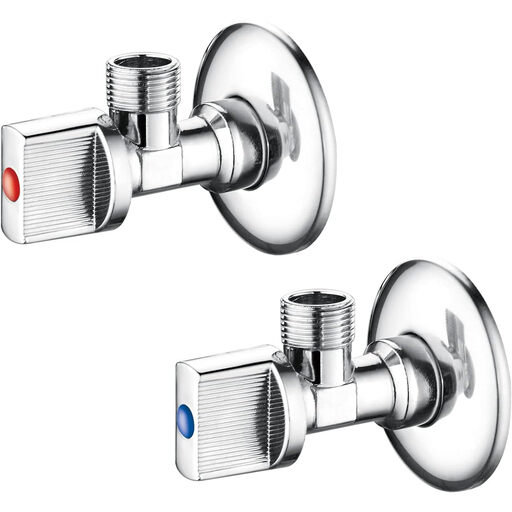
Why this product suits this profile: The 2-piece set is designed for wall-mounted basins and hot-water systems, covering two separate water connections.
The specified G1/2 inlet and G3/8 outlet make the intended area of use clearer than a simple “universal” designation.
Two valves per set; chrome-plated brass according to the product information; angled design for confined spaces.
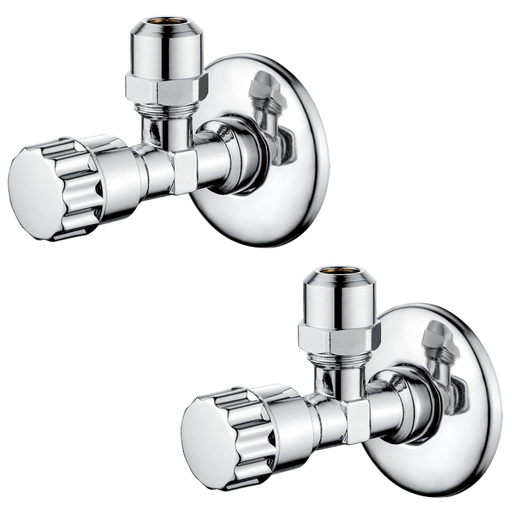
Why this product suits this profile: The self-sealing design and large control knob are intended to make operation straightforward at basins or cisterns.
The product data explicitly specifies the wall connection, outlet and self-sealing function. Nevertheless, a final leak test is still required.
2-piece set; G1/2 wall connection and G3/8 outlet; large control knob according to the product description.
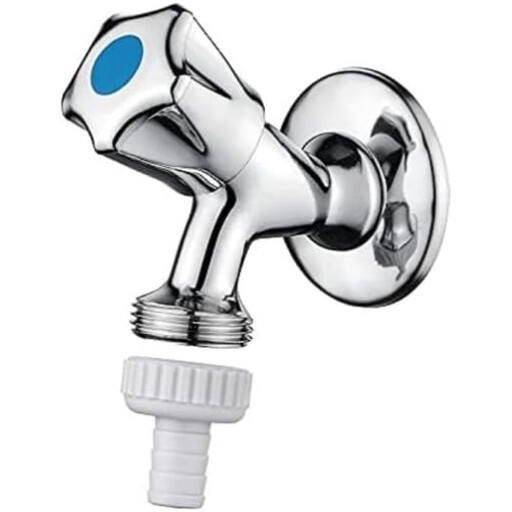
Why this product suits this profile: The valve is designed for washing machines or dishwashers and combines a G1/2 wall connection with a G3/4 outlet.
The intended appliance connection is specified as 3/4 inch. This helps avoid the common confusion with a 3/8-inch basin connection.
Backflow preventer, pipe aerator and installation kit according to the product information; brass body with chrome finish.
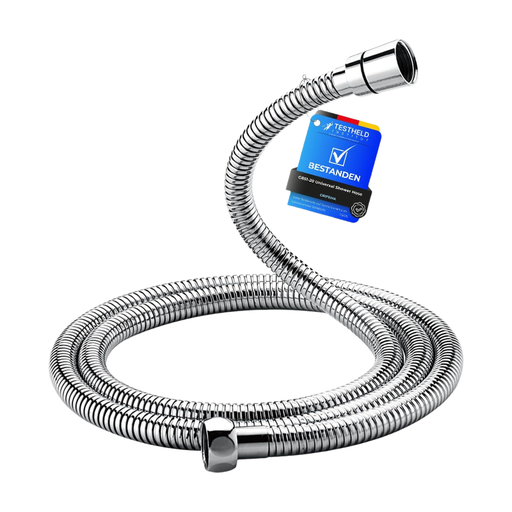
Why this product suits this profile: The flexible replacement hose is designed for shower systems with a G1/2 connection and provides extra length for greater freedom of movement.
The connections, seals and kink-resistant design are listed in the product data. Check the length before buying, as the description also mentions 1.5 m.
G1/2 screw connection; stainless steel design according to the product information; rotating union nut to prevent twisting.
A M24 tap aerator may be worth considering if the spout actually has an M24 thread. According to the product description, the Ibergrif 6-piece aerator set includes seals and an installation key. The stated potential water saving of up to 40 per cent comes from the product description and should not be regarded as a guaranteed figure for every tap.
If you need to adapt an existing connection, you can also consider the Ibergrif G3/8 to G1/2 adapter. The set contains two metal adapters and two sealing rings. Before installation, check the thread direction, sealing surface and available installation space.
We have put together a complete, regularly updated list of products that fully meet these strict selection criteria and the safety regulations applicable in the EU.
No. The outlet, thread type and hose connection are also decisive. A G3/8 outlet is common on many basin models. Check the existing pipework or use a suitable adapter.
A 1/2-inch device connection valve often has a larger 3/4-inch outlet for washing machines or dishwashers. A standard angle valve with a 3/8-inch outlet is more commonly used for taps or cisterns. A built-in backflow preventer may also be included on a device valve.
It is not possible to give a reliable fixed service life for every installation. This depends, among other things, on water quality, pressure, temperature, installation, seals and frequency of use. Visible corrosion, difficult operation or recurring moisture are reasons to inspect the component and have it professionally replaced if necessary.