
Lieferung heute & morgen

Qualitätsgarantie

Willkommens-Angebote freischalten: KOSTENLOSE Lieferung | Bis zu 80 % RABATT | Kostenlose 30-Tage-JoyPlus-Testphase
App herunterladen
An LED outdoor floodlight with a motion sensor can provide targeted lighting for paths, driveways, patios and entrances. But eye-catching marketing claims don’t automatically mean you’ve found the right solution. What matters are the technical specifications, installation requirements and where you plan to use it.
A high lumen rating tells you the light output, but it doesn’t guarantee even coverage. The beam angle, mounting height and position of the light heads all affect whether the light reaches your driveway, door or garden path. A 1700-lumen outdoor floodlight may be enough for a small area of wall, while a larger driveway may benefit from a different light distribution.
Claims such as weatherproof, waterproof or suitable for outdoor use should be backed up by a specific IP rating. The first digit indicates protection against solid objects, while the second indicates protection against water. If this information is missing, check the product documentation before exposing the floodlight to rain, snow or splashes without protection.
Many outdoor wall lights are wired directly into the mains. For installation in Germany, check the mains voltage, installation method and components supplied. A product rated AC 120 V, 60 Hz won’t necessarily be suitable for a standard German 230-volt supply. Fixed-wired lights should be installed by a suitably qualified electrician.
A 4000K LED outdoor light produces neutral white light. This colour temperature is often a good choice for entrances, patios and general garden lighting, as it looks crisp while rendering colours relatively naturally.
A 5000K LED outdoor light produces daylight white light. It may suit garages, sheds and driveways if you want a brighter, more contrast-rich view. Bear in mind that how the light appears will depend on your personal preference and surroundings.
Watts measure electricity consumption; lumens measure light output. A 20-watt floodlight producing 1700 or 1800 lumens may be suitable for domestic outdoor use if you point the light heads correctly. To choose the right one, also check:
For an LED outdoor floodlight with a motion sensor, the detection angle, range, on-time and dusk threshold are all important specifications. Not every floodlight on the market actually has a sensor. Even when a sensor is included, position the light so it doesn’t unnecessarily detect pets, passing vehicles or public paths.
The models below vary in colour temperature, sensor function, construction and installation requirements. Always check the current product description and compatibility with your electrical installation before buying.
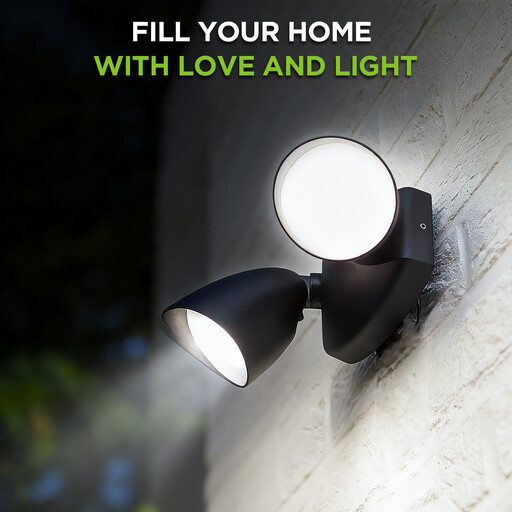
Why it suits this buyer: This twin-head outdoor floodlight combines 1800 lumens with two light heads and a neutral white colour temperature of 4000K. It’s a good fit for an entrance, patio, garage or smaller driveway, provided the installation requirements are met.
The product name clearly states the light output, power and 4000K colour temperature. Still, check the IP rating and whether a motion sensor is actually included before installation.
1800 lumens, 20 watts, two light heads and a waterproof outdoor housing according to the product name.
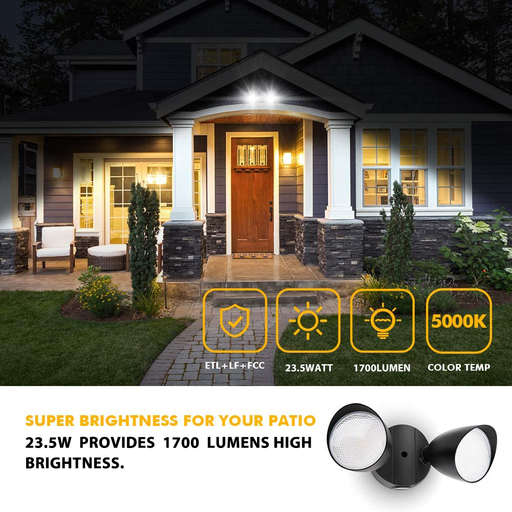
Why it suits this buyer: Its die-cast aluminium construction, toughened glass and black powder-coated finish will appeal to buyers who look for clear material specifications and adjustable LED floodlights for a garage, shed or driveway.
The materials are clearly specified. Important: the stated power supply is AC 120V, 60Hz, so you must check its suitability before using it in Germany.
Two heads adjustable through 180°, integrated LED technology, die-cast aluminium and toughened glass covers.
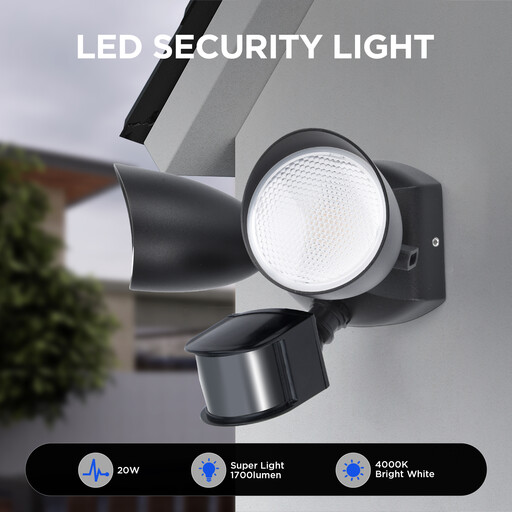
Why it suits this buyer: The product name specifies a sensor, 1700 lumens, 20 watts and 4000K. This makes it worth considering if you’re looking for an LED security light for your driveway, garden, garage or entrance to your property.
The product name confirms that it has a sensor. Before buying, check the detection range, time delay, IP rating and supply voltage in the detailed specifications.
1700 lumens, 20 watts, 4000K and an integrated sensor according to the product name.
You can estimate running costs using this simple formula: power in kilowatts × operating hours × electricity price. A 20-watt floodlight uses 0.02 kilowatt-hours for every hour it’s on. A motion sensor can limit how long it stays on, provided the detection range and time delay are set appropriately.
A soft, slightly damp cloth is usually all you need for cleaning. Don’t use abrasive cleaners, check the fixings regularly and switch off the power at the circuit breaker before carrying out any maintenance.
The right height depends on the detection range, beam angle and layout of your property. Avoid pointing the sensor at passing vehicles unnecessarily, while making sure the light won’t be difficult to reach for maintenance. Always follow the manufacturer’s guidance on positioning.
Its lifespan depends on the LED module, heat dissipation, switching cycles, exposure to moisture and the quality of the power supply. Check the product specifications for a specific lifespan. If an integrated LED fails, you may need to replace the entire light.
At a power consumption of 20 watts, one hour of operation uses 0.02 kilowatt-hours. The actual cost depends on your electricity tariff and how long the light runs each day. A sensor can reduce consumption by preventing the light from staying on longer than necessary.