
Lieferung heute & morgen

Qualitätsgarantie

Willkommens-Angebote freischalten: KOSTENLOSE Lieferung | Bis zu 80 % RABATT | Kostenlose 30-Tage-JoyPlus-Testphase
App herunterladen
LED wall and stair lighting can add practical illumination to hallways, stairwells, bedrooms and entrances. But modern design isn’t the only thing to consider. The installation method, colour temperature, IP rating and controls all need to suit the intended location. If you focus only on wattage or product images, you could end up with a light that’s too bright, too dim, technically unsuitable or simply not right for the space.
Wattage mainly indicates how much electricity a light uses, not how much light it produces. Luminous flux, measured in lumens, is a more useful way to compare lights. Depending on its design and efficiency, a 2.5 W LED light can produce different amounts of light. A decorative LED wall light in a living room also has different requirements from LED step lighting in a stairwell.
A dimmable light needs a compatible dimmer. According to the product descriptions, the stair lights available are designed for use with trailing-edge dimmers. Before buying, check the dimmer, connection type and electrical installation. If connecting directly to 230 V, have the light installed by a suitably qualified person.
The IP44 rating indicates protection against solid objects larger than 1 mm and splashing water from different directions. This may be suitable for indoor spaces, bathroom areas outside zones exposed to direct water, or covered entrances. However, IP44 is not automatically sufficient for exposed outdoor areas or direct jets of water. An IP44 LED light should therefore not be recommended indiscriminately for every outdoor installation.
Colour temperature is measured in kelvins:
A 3CCT LED lighting solution offers a choice of colour temperatures. The stair lights described here offer 3000 K, 4000 K and 6500 K. Depending on the model, you can select the setting using an integrated switch. Choose your preferred setting before installation.
A surface-mounted LED wall light is installed differently from a recessed stair light. For recessed lights, the wall box, cut-out dimensions and recess depth are all important. The round and square ALUSSO models are described as having a recess depth of around 3 cm. Depending on the installation method, they can be fixed with spring clips or screws.
Before you buy, measure:
An LED night light with a motion sensor is particularly useful in hallways, children’s rooms, bedrooms and on stairs at night. Check the detection angle, range and switch-off time. According to the product description, the GRIFEMA model detects movement up to 3 m away within a 120° angle and switches off automatically after 60 seconds without movement. It also has a built-in dusk sensor, so the light comes on in dark surroundings.
For busy staircases, constant or dimmable LED step lighting may be a better choice. A motion sensor, on the other hand, can reduce unnecessary operating time in areas that are used less often.
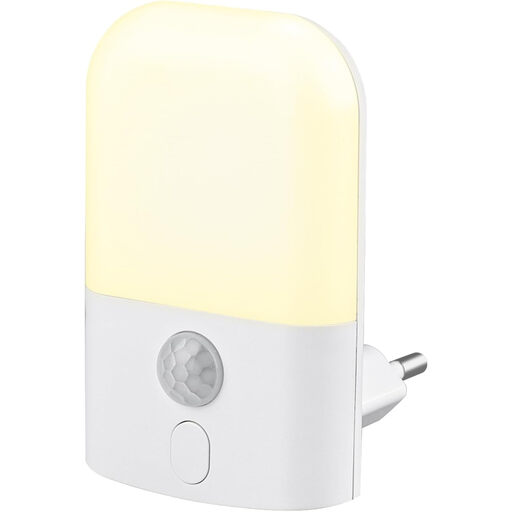
Why it suits this type of buyer: This plug-in light is designed for indoor spaces such as children’s rooms, hallways, bathrooms and staircases, and doesn’t need batteries.
Five brightness levels let you adjust the light instead of being limited to one fixed setting. The dusk sensor prevents it from switching on automatically when it’s already light.
0.5 W power consumption according to the product details; motion detection range of up to 3 m and switches off after 60 seconds without movement.
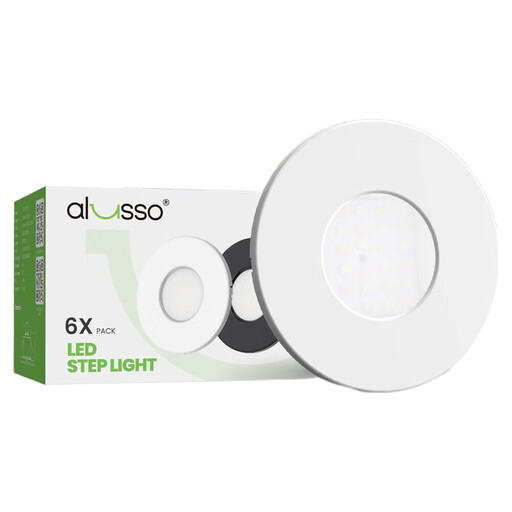
Why it suits this type of buyer: Designed to create consistent lighting across several steps, this set offers three colour temperatures and dimmable brightness.
The product details give specific figures for colour temperature, power and IP rating, making it easier to match the light to the room and installation location.
3000/4000/6500 K, 0.5/1.5/2.5 W and a dimming range of 10–100 % according to the product description; IP44 for suitable indoor and covered areas.
Why it suits this type of buyer: For renovations involving several steps, this set includes six lights with round fronts and two installation options.
The choice of spring clips or screws makes it easier to fit the lights to existing recessed boxes. The IP44 rating is clearly stated and isn’t presented as protection for exposed outdoor areas.
86.2 mm diameter and around 30 mm depth according to the product details; up to 220 lm and a 230 V connection.
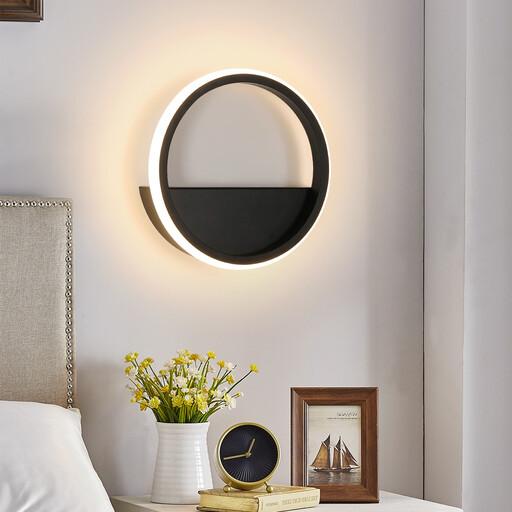
Why it suits this type of buyer: This round aluminium light, measuring 20 cm in diameter, is designed for living rooms, bedrooms, hallways and stairwells, with a warm white glow.
The product description gives the diameter, power and colour temperature, so you can check whether the size and light colour will suit your room before buying.
12 W power, aluminium housing, round design with a 20 cm diameter and 3000 K warm white light according to the product details.
We’ve put together a complete, regularly updated list of products that meet these strict selection criteria and fully comply with the safety regulations in force in the EU.
Before installing a permanently wired wall or stair light, switch off the power supply. Also check that the existing wall box is deep enough for the light. Lights connected to 230 V should only be installed in accordance with the applicable wiring regulations.
Power consumption affects running costs. A 0.5 W light uses less energy than a 12 W wall light over the same period. Motion sensors and automatic switch-off can further limit operating time. For LED lights with an integrated light source, also check whether the bulb can be replaced or whether you’ll need to replace the entire fitting.
Warm white light of around 2700 to 3000 K is often chosen for a cosy feel. Neutral white at around 4000 K may be a better option if you want to light the staircase or hallway more brightly for practical use. With 3CCT lights, you can adjust the setting before installation.
This depends on the light’s power and how long it’s switched on. A 0.5 W light uses 5 Wh after ten hours of operation. With several steps, consumption increases in line with the number of lights. A motion sensor can reduce the actual time they’re switched on.
IP44 may be suitable for areas exposed to occasional splashes. However, the light cannot be used in every bathroom zone or directly in a shower. Before installation, check local wiring requirements, the installation location and the manufacturer’s instructions.