
Lieferung heute & morgen

Qualitätsgarantie

Willkommens-Angebote freischalten: KOSTENLOSE Lieferung | Bis zu 80 % RABATT | Kostenlose 30-Tage-JoyPlus-Testphase
App herunterladen
A night light with motion sensor is designed to provide automatic orientation at night without staying permanently bright. For parents in the nursery, children's bedroom or on the way to the bathroom, however, it's not just brightness and design that matter. The type of sensor, light colour, power supply and mounting all determine whether the LED night light is truly suitable for everyday use.
A motion sensor night light reacts to movement, usually only when the ambient light is low. A night light with a twilight sensor, on the other hand, switches on and off depending on the available light. For a hallway night light that needs to glow dimly for several hours, a light sensor can be more practical. For short trips on the stairs or getting up during the night, a motion detector often provides on-demand activation.
Look for specific details such as detection range, detection angle, lux threshold and shut-off time. If these values are missing, it's difficult to assess how suitable the light will be for everyday use.
The power consumption in watts describes energy usage, not directly the brightness. For orientation, lumens are also relevant. A model with 0.3 W and 20 lm may be sufficient for a socket area, while a more powerful LED night light is needed for a longer hallway.
The light colour also affects how you use it. Warm white night light around 2700 to 3200 K tends to feel more subtle in bedrooms. Cool white light around 6500 K can make outlines more visible, but it doesn't suit every night light in a bedroom or nursery.
A rechargeable night light works independently of a socket and can be placed flexibly on a bedside table, shelf or another suitable spot. However, the battery needs regular charging. So check the stated run time, charging port and compatibility with your existing USB charger.
With plug-in night lights, this hassle is eliminated. They stay in a fixed location, but need a suitable, undamaged socket and should not be used in damp areas unless a suitable ingress protection rating is specified.
For a night light with motion sensor, the following details are particularly important:
For night-time orientation, moderate brightness is usually more practical than very strong illumination. A dimmable night light with several levels can be adjusted to suit the room. Models with multiple colour temperatures are versatile: warm white for the bedroom, more neutral light for the hallway or bathroom.
Lumen and Kelvin values should be clearly stated in the product specifications. A high colour rendering index, for example CRI or Ra ≥ 80 or >85, describes the colour rendering of the light source. It is not a medical quality promise, but can serve as a technical comparison value.
ABS, PC and metal are commonly used for many indoor lights. What matters is not just the material, but also the intended use. Pay attention to:
A night light is not a toy. Products with batteries, plugs or electronic components should only be used by small children under supervision.
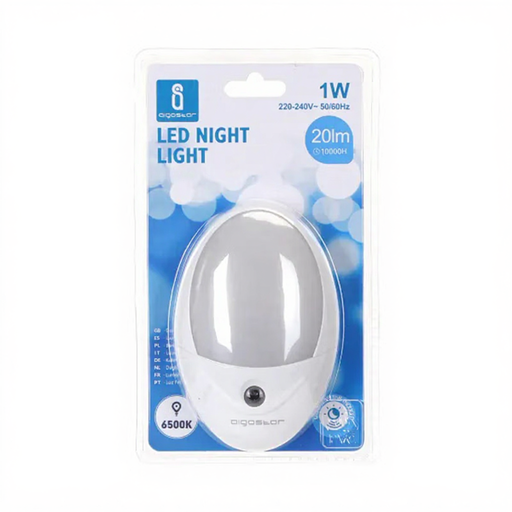
Why this product fits the profile: This plug-in night light works without batteries and without recharging. The integrated sensor switches the light on in darkness and off in daylight.
The power consumption of 1 W and the automatic day/night operation are clearly stated. No manual switch is needed in everyday use.
20 lm, 120° beam angle and IP25 according to product specifications; direct installation on a 220–240 V socket.
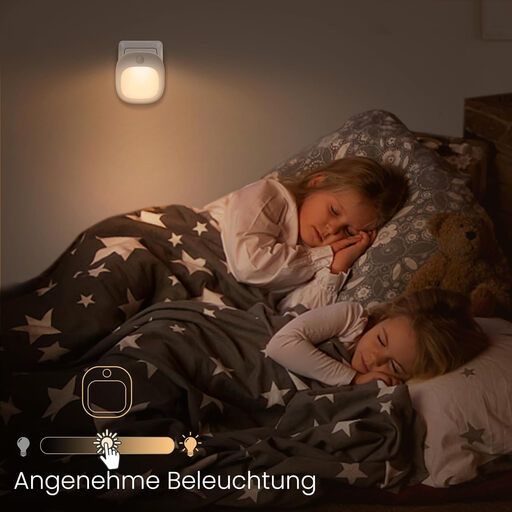
Why this product fits the profile: This model offers USB charging, three colour temperatures and five brightness levels. It is suitable for flexible placement in the bedroom, nursery or hallway.
Run time, charging method, sensor range of 3–5 m and activation at a maximum of 20 lux are all specified. This makes it easier to plan its use before buying.
30 lm, CRI >85, five dimming levels and up to 10 hours of run time in sensor mode according to product specifications.
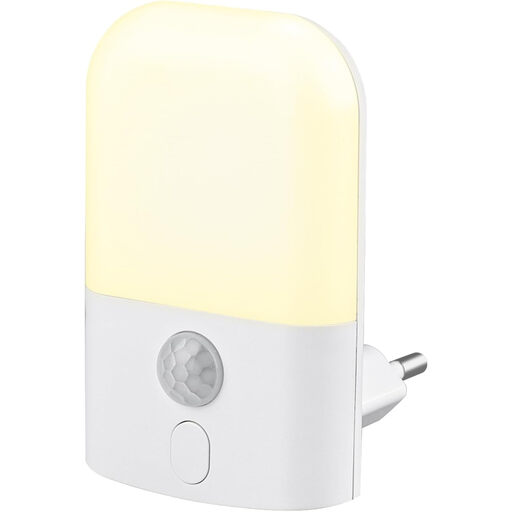
Why this product fits the profile: For stairs, hallways, kitchens or bathrooms indoors, it combines motion detection with a twilight sensor.
The specifications state a detection range of up to 3 m, an angle of 120° and a switch-off after 60 seconds without movement.
Five brightness levels from 20% to 100%, warm white light at 2700 K and 0.5 W power consumption according to the product description.
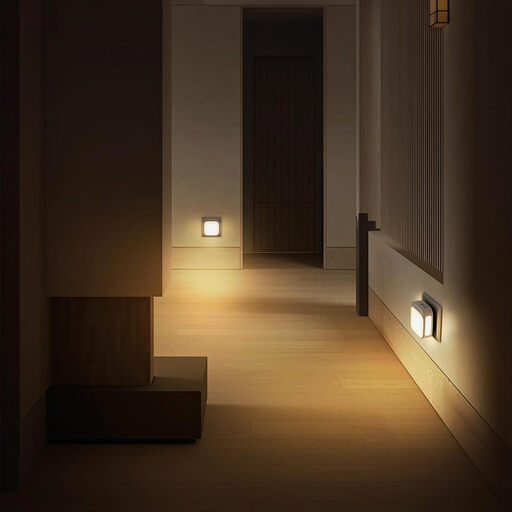
Why this product fits the profile: Two lights can be used, for example, in the bedroom night light and hallway night light. The focus is on consistently low power consumption.
The stated power consumption of 0.3 W and the automatic on/off switching at around 20 lux make ongoing operation more predictable.
20 lm, warm white light at 2800–3000 K, stepless dimming from 10% to 100% and universal voltage rating of 110–240 V.
We have put together a complete, regularly updated list of products that fully meet these strict selection criteria and the safety regulations in force in the EU.
Place the device so that the sensor covers the desired walking path and is not blocked by furniture, curtains or decorations. For stairs, a sideways alignment towards the first steps works well. With a plug-in light, the socket should remain easily accessible and the device should not be covered with textiles.
The consumption depends on the power rating and the operating time. A model with 0.5 W running for 1000 hours uses 0.5 kWh in theory. With a motion detector night light, the actual consumption can be lower if the light only activates when movement is detected. For an accurate cost comparison, you will need your household's current electricity price.
For plug-in models, a nominal LED lifespan is often stated, for example 10,000 or 25,000 hours. This figure is a product parameter and not a guarantee of the actual service life of the entire device. With a rechargeable night light, the battery, charging cycles, ambient temperature and the chosen brightness level also affect the lifespan.