
Lieferung heute & morgen

Qualitätsgarantie

Willkommens-Angebote freischalten: KOSTENLOSE Lieferung | Bis zu 80 % RABATT | Kostenlose 30-Tage-JoyPlus-Testphase
App herunterladen
A well-organised kitchen is the foundation for efficient household management and mindful eating. The right LocknLock food container can be a game-changer in this regard—whether for meal prepping, securely storing leftovers, or transporting lunch. However, the market is flooded with containers that promise similar features. Choosing the wrong model often leads to leaky lids, rapid material wear, or a lack of space in the fridge.
This guide highlights the most common pitfalls to avoid when buying and explains which technical features truly matter, enabling you to make an informed decision.
Many buyers focus on superficial features, overlooking the crucial details that determine long-term durability and everyday functionality.
To avoid these mistakes, you should check three core aspects before buying. These determine whether a LocknLock storage container will meet your needs.
The heart of every LocknLock container is the patented four-sided locking system. The four clips press the lid evenly onto the container's rim. However, the integrated silicone seal is what truly determines its leak-proof quality. Look for a hollow-centre silicone seal, as it offers greater elasticity and adaptability, forming a reliable barrier against air and liquids. For thorough cleaning, it is also advantageous if the seal can be easily removed and reinserted.
All LocknLock products are BPA-free and therefore safe for food contact. Nevertheless, there are differences in the plastics used:
For maximum space efficiency, rectangular or square shapes are ideal. A good storage container is stackable when it features a thoughtful design where the lid and base interlock. This ensures a stable stack in the fridge or cupboard. Modular systems, where different sizes are designed to fit together, allow for particularly flexible and tidy storage.
Based on these criteria, we have identified several LocknLock models that are well-suited for specific user profiles.
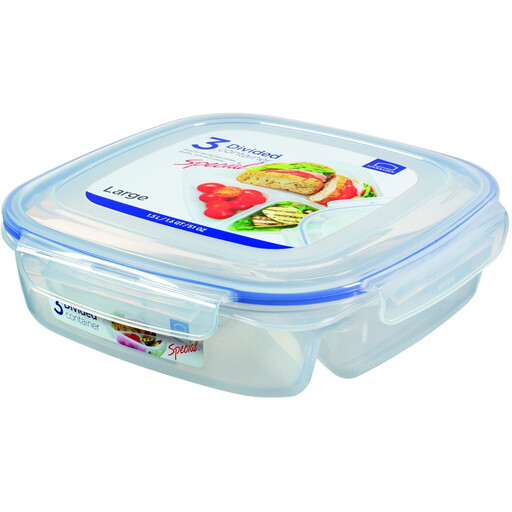
Why This Fits Their Persona: Ideal for those who prepare balanced meals and want to keep components separate. The three compartments allow for portioning a main course and sides in a single container.
The 4-sided locking system ensures a tight seal, preventing aromas from transferring between compartments during transport. The dividers keep solid foods from mixing.
The integrated dividers eliminate the need for separate containers, simplifying the preparation and transport of complete meal prep boxes.
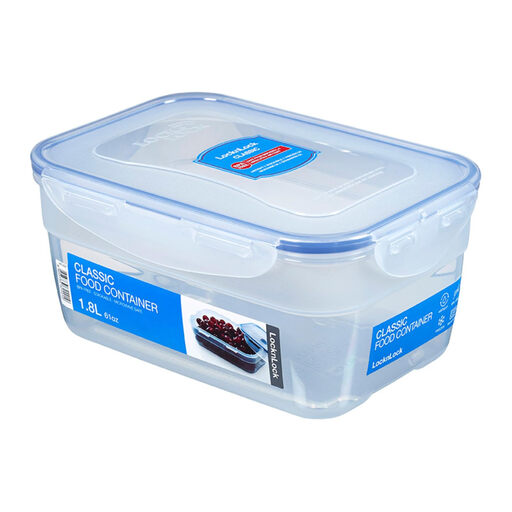
Why This Fits Their Persona: Families often need larger containers for dinner leftovers, batch cooking for the week, or storing baking ingredients. This set provides uniform, large, and stackable boxes.
The set is made from durable PP plastic that withstands daily use. Its design is consistently focused on stackability, solving the problem of cluttered cupboards.
The large 1.8-litre volume of each container is versatile. The patented locking system ensures that even liquids can be transported securely.
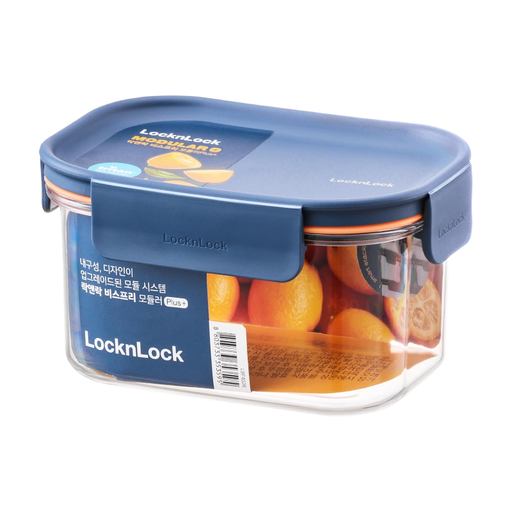
Why This Fits Their Persona: Perfect for individuals or small households where every inch of fridge space counts. The compact size is ideal for snacks, small portions, or individual ingredients.
The high-quality Tritan material is extremely resistant to stains and odours. The modular design ensures exceptionally stable and space-saving stacking.
The combination of durability from Tritan and maximum spatial efficiency from the modular system makes this container a long-term, practical investment.
We've compiled a complete, up-to-date list of products that fully meet these strict selection criteria and all relevant safety standards.
1. Can LocknLock containers really go in the dishwasher? Yes, most LocknLock containers are dishwasher-safe. It is recommended to place them on the top rack to protect them from direct heat. For optimal hygiene and to extend the life of the seal, it should be occasionally removed from the lid and cleaned separately by hand.
2. What is the difference between the standard plastic (PP) and the Bisfree material (Tritan)? Both materials are BPA-free and safe for food. The main difference lies in durability and appearance. Polypropylene (PP) is a proven, robust plastic for everyday use. Tritan, used for the Bisfree series, offers glass-like clarity, is significantly more resistant to staining and odour absorption, and is considered exceptionally durable.
3. How do I use the containers safely in the microwave? LocknLock containers are microwave-safe, but only for reheating food at a moderate temperature (usually up to 120°C / 250°F). The lid must always be removed before heating, or at the very least, all four locks must be unfastened to allow steam to escape. Heating with a tightly sealed lid can lead to a dangerous build-up of pressure.