
Lieferung heute & morgen

Qualitätsgarantie

Willkommens-Angebote freischalten: KOSTENLOSE Lieferung | Bis zu 80 % RABATT | Kostenlose 30-Tage-JoyPlus-Testphase
App herunterladen
As a Joybuy Product Recommendation Officer, I see every day how the right window treatment can transform a room. For many renters and homeowners in the UK, a no-drill pleated blind is the ideal solution: it provides privacy and sun protection without damaging the window frame. However, the market is flooded with products of widely varying quality. False promises and unclear product descriptions often lead to disappointment.
Before you make a decision, you should be aware of the three most common pitfalls that can lead to a bad purchase:
blackout no-drill pleated blind for the bedroom who receives a merely opaque model will be disappointed by the remaining light penetration.To avoid these problems, it's important to pay attention to a few key features.
A well-considered purchase decision is based on objective criteria, not marketing promises. Focus on the following three parameters to find a durable and functional product.
The drill-free installation method is the heart of the product. The most common variant is the Klemmfix pleated blind.
The function of your pleated blind is determined by the fabric. A no-drill privacy screen for windows has different requirements than a solution for complete blackout.
no-drill pleated roller blind is the right choice for bedrooms and children's rooms.A common mistake is incorrect measuring. Follow the manufacturer's instructions carefully. As a general rule:
A no-drill folding blind that fits precisely not only looks better but also functions perfectly.
Based on these objective criteria, we have identified some products that are well-suited for specific needs and living situations in the UK.
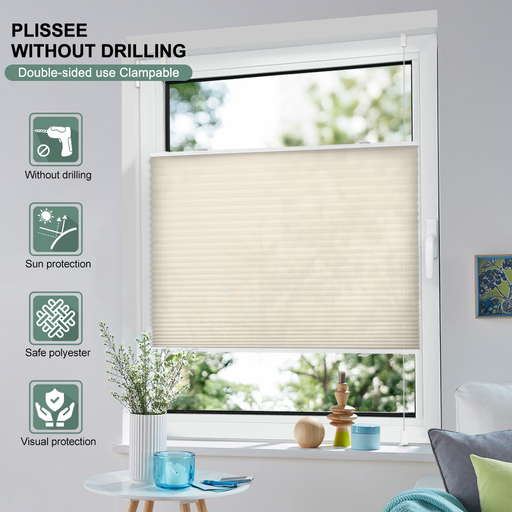
Why This Fits Their Persona: Ideal for renters seeking a straightforward, residue-free removable solution for standard uPVC windows. The installation requires no tools and protects the window frame, which is crucial when moving out.
The product relies on a clear Klemmfix system with a defined suitability for common frame thicknesses. This minimises the risk of unstable brackets (Pitfall 1). The description as an opaque privacy screen correctly manages expectations regarding light ingress (Pitfall 3).
The tool-free Klemmfix installation is simple and damage-free. The blind offers a good balance of privacy and light transmission for living areas.

Why This Fits Their Persona: Perfect for those who value darkness, quiet, and a pleasant room climate in the bedroom or home office. The honeycomb structure provides additional thermal and acoustic insulation.
The honeycomb structure ensures greater stability and shape retention, which counteracts sagging tension cords (Pitfall 2). The clear labelling as "Blackout" and "Thermal" prevents false expectations about light-blocking capabilities (Pitfall 3).
Provides effective blackout and contributes to heat and sound insulation thanks to the insulating air pockets of the honeycomb structure. The Klemmfix brackets are adjustable for frame thicknesses of 10-23 mm.
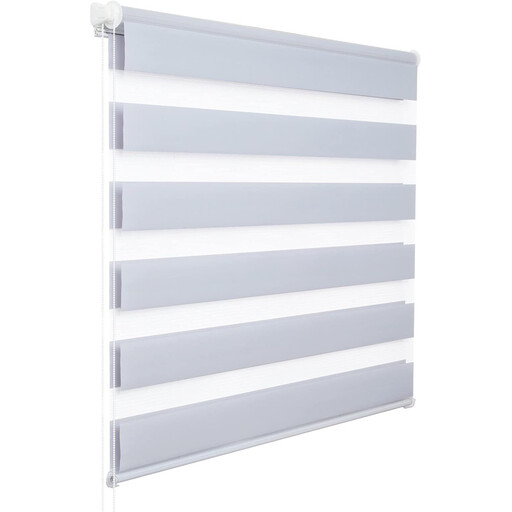
Why This Fits Their Persona: While not a classic pleated blind, this roller blind offers an excellent no-drill alternative for anyone wanting maximum flexibility in light control. Ideal for living rooms or offices where light conditions vary throughout the day.
The operating principle with alternating stripes makes light regulation transparent and avoids misunderstandings (Pitfall 3). The clamp brackets are designed for a specific frame thickness range of 13-23 mm, ensuring a stable installation (Pitfall 1).
Allows for stepless regulation of light from transparent to opaque by shifting the fabric panels. Installation is possible without drilling thanks to the Klemmfix system.
We have compiled a complete, up-to-date list of products that fully meet these strict selection criteria and UK regulations.
The lifespan of a no-drill pleated blind depends heavily on the material quality and usage. Models with robust metal clamp brackets and high-quality, shape-retaining tension cords can last for many years with normal use. Regular, gentle cleaning with a feather duster or a soft brush also contributes to their longevity.
This is not always possible. Most clip-on pleated blinds for windows are designed for the standardised profiles of modern uPVC windows. Wooden windows often have wider, narrower, or differently shaped frames. Therefore, always check the product description, which often explicitly states whether the system is suitable for wooden windows or not. Measure the frame thickness of your wooden window accurately and compare it with the manufacturer's specifications.
pleated blind and folding blind are often used interchangeably. Both refer to a window covering made of a fabric folded into pleats, which can be compressed and expanded like an accordion. In contrast, a classic roller blind winds smoothly onto a tube. The key advantage of the pleated blind is that it can often be freely positioned on the window, both from top to bottom and from bottom to top.