
Lieferung heute & morgen

Qualitätsgarantie

Willkommens-Angebote freischalten: KOSTENLOSE Lieferung | Bis zu 80 % RABATT | Kostenlose 30-Tage-JoyPlus-Testphase
App herunterladen
As a Joybuy Product Recommendation Officer, I see daily how a well-thought-out product choice can make everyday life easier. Especially in rented flats or for those who want flexible use of space, the question often arises: How can I create more storage for clothes without having to drill into walls or ceilings? A no-drill telescopic clothes rail is an obvious solution. However, the market is flooded with models of widely varying quality. A bad purchase not only leads to frustration but, in the worst case, to a collapsed wardrobe.
This guide highlights the most common pitfalls and explains which technical features you need to look for to find a stable and durable no-drill clothes rail system.
Many buyers are drawn to attractive product images but overlook crucial design weaknesses. Pay special attention to these three points to avoid disappointment:
To identify a reliable adjustable wardrobe system, you should focus on objective technical features rather than marketing promises.
The stability of a telescopic system depends directly on the material and wall thickness of the tubes used.
The mechanism that holds the system in place is crucial for safety and longevity.
A good clothes storage system adapts to your space, not the other way around.
Based on the criteria above, we have identified some models that are suitable for different user profiles and room situations.
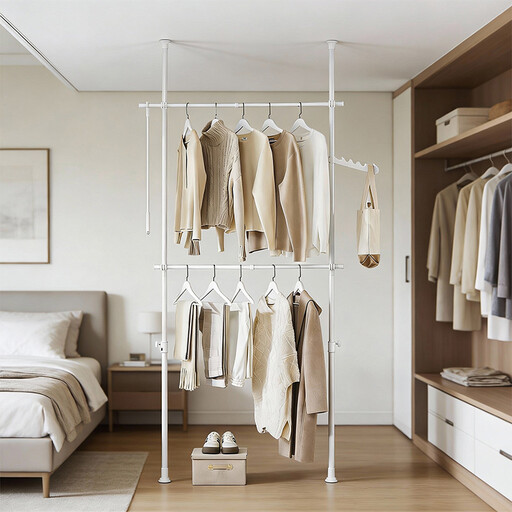
Why this model is a good fit: Ideal for student flats, small bedrooms, or unused alcoves. The variable width of 75 to 126 cm allows for a perfect fit even in limited spaces. It offers a basic but stable solution for your daily wardrobe.
The specified load capacity of 25 kg is a realistic figure for a two-rail system, avoiding the problem of exaggerated promises. The iron tube construction is sufficiently dimensioned for this load class.
High flexibility in height (200–295 cm) and width (75–126 cm) to utilise alcoves. Simple, tool-free assembly.
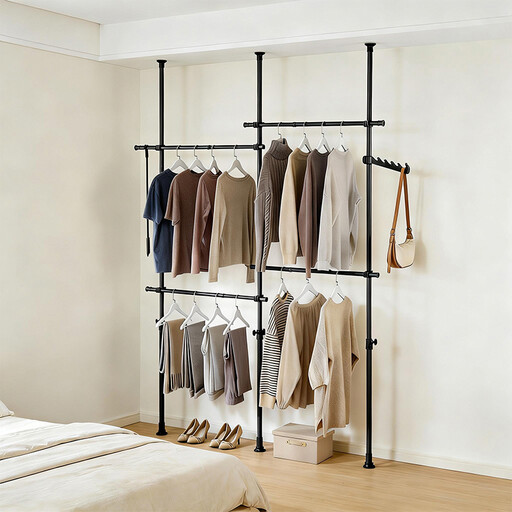
Why this model is a good fit: For individuals with an extensive wardrobe or families looking for an alternative to a traditional closet. This system can serve as a fully-fledged open wardrobe in a dressing room or bedroom.
The design with three vertical telescopic rods effectively distributes the load of up to 65 kg, directly countering the instability trap. The load is distributed across three points instead of just two, significantly increasing stability.
High load capacity and a substantial width of up to 226 cm provide space for a large amount of clothing, including heavy jackets and coats.
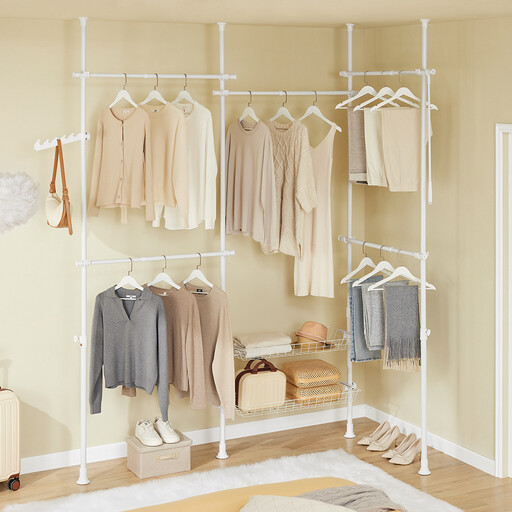
Why this model is a good fit: Perfect for setting up a walk-in closet or a complete wardrobe corner. It combines clothes rails with storage baskets for shoes, bags, or folded clothes, creating a comprehensive clothes storage system.
This system is designed as a single unit. All parts are matched, which avoids the compatibility and stability issues that can arise when combining individual parts from different manufacturers. The four vertical rods provide a very stable base.
Integrated storage solution with five clothes rails and two wire baskets. The enormous width of up to 311 cm makes optimal use of even large, empty walls.
We have compiled a complete, up-to-date list of products that meet these strict selection criteria and enable flexible storage.
Stability largely depends on three factors: the quality of the materials (steel is often more stable than aluminium), the robustness of the tension mechanism, and correct assembly. A high-quality system, firmly tensioned between a solid floor and a sturdy ceiling, can be very reliable. Distribute the weight of the clothes evenly and do not exceed the manufacturer's specified maximum load capacity.
High-quality models feature large end caps made of rubber or soft plastic. These distribute the contact pressure and have a non-slip effect, which prevents damage or marks on standard surfaces like parquet, tiles, or plastered ceilings. However, caution is still advised on very delicate surfaces (e.g., soft wood floors or plasterboard ceilings).
The load capacity varies greatly depending on the model. Simple systems with just one rod often only hold 10–20 kg. Larger, multi-part systems with several vertical supports can carry 60 kg or more, according to manufacturer specifications. Always check the specific load capacity in the product details and consider this value as an upper limit under ideal conditions.