
Lieferung heute & morgen

Qualitätsgarantie

Willkommens-Angebote freischalten: KOSTENLOSE Lieferung | Bis zu 80 % RABATT | Kostenlose 30-Tage-JoyPlus-Testphase
App herunterladen
Whether you're a renter or a homeowner, you often face the same challenge: you need effective privacy and sun protection but don't want to damage your window frames with drill holes. A no-drill pleated blind seems like the ideal solution. However, the market is flooded with products of widely varying quality. Misleading claims and inferior materials can quickly lead to frustration and unnecessary expenses.
This guide highlights the three most common pitfalls to avoid and shows you how to properly evaluate key technical features to find a durable, functional solution for your home.
Many buyers focus on colour and price, overlooking critical flaws that severely limit functionality. Pay close attention to these points:
To avoid these pitfalls, you should focus on objective technical parameters. These three features determine the quality and longevity of your sun protection.
The mounting method is the core of any no-drill solution. The most common systems have specific advantages and disadvantages.
The choice of fabric determines the level of privacy and the room's atmosphere. There are essentially four levels:
To prevent light gaps on the sides, precise measurement is crucial. Follow these steps:
Based on the criteria above, we have identified several products that offer a well-designed solution for specific user profiles.
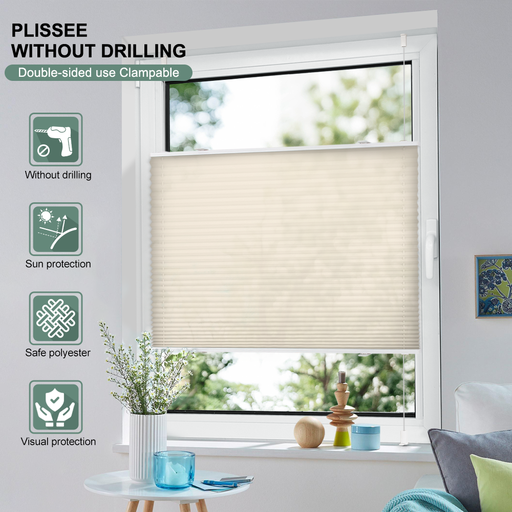
Why it's a good fit: Ideal for renters looking for a straightforward and reliable solution for living rooms or home offices. The clamp-on system requires no tools and leaves no damage, which is crucial when moving out.
The top and bottom rails are made of aluminium, promising greater stability than all-plastic models. The product description clearly differentiates between translucent and opaque versions, setting correct expectations.
Tool-free installation using clamp brackets. The fabric is infinitely adjustable to flexibly control light and privacy.

Why it's a good fit: For families, effective blackout for undisturbed sleep and child safety are paramount. This blind meets both needs with its special coating and cordless design.
The silver-coated back ensures reliable blackout, avoiding the pitfall of misleading fabric claims. The cordless design eliminates the danger of dangling cords, a common safety hazard with traditional blinds.
Offers 100% blackout and thermal insulation, according to the manufacturer. Operation is safe and easy via a handle on the bottom rail.
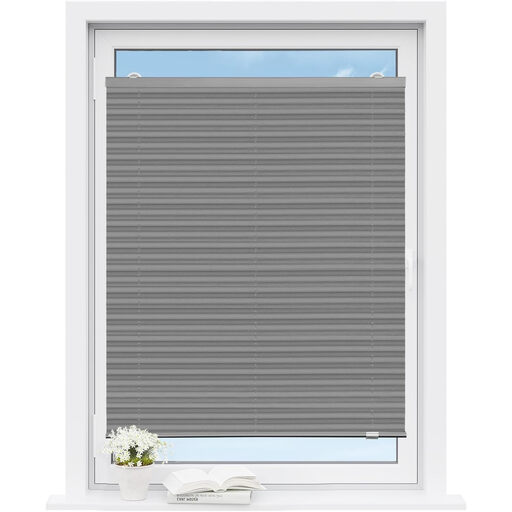
Why it's a good fit: For windows where clamp brackets cannot be attached, such as fixed glass panels, balcony doors, or sloped skylights, this pleated blind with suction cup mounting offers a rare and practical alternative.
This system completely bypasses the issue of unstable clamp brackets by using a different mounting method. The description clearly states it is designed for smooth surfaces like glass, which correctly manages user expectations.
Enables no-drill installation on window types where clamp-on systems are unsuitable. The suction cups can be removed without residue and repositioned.
We have compiled a complete, up-to-date list of products that fully meet these strict selection criteria and German safety regulations.
The lifespan of a clamp-on pleated blind depends heavily on the material quality of the brackets and rails. Models with components made of metal or robust PVC are generally more durable than very cheap versions made of simple plastic. With proper, gentle operation and regular dusting, a quality product can remain functional for several years.
Yes, in most cases, clamp-on systems are suitable for both uPVC and wooden windows. The crucial factor is that the rebate depth (the thickness of the window sash) is within the range specified by the manufacturer. Additionally, the window must have a rubber gasket behind which the clamp bracket can get a secure grip. Always check the compatibility information in the product description before purchasing.
Neither is universally "better"; the choice depends on your personal needs. A clamp-on dual roller blind consists of alternating transparent and opaque fabric strips. By shifting these strips, you can regulate the light level with great precision. A pleated blind, on the other hand, is often tensioned and can be adjusted from both the top down and the bottom up. This allows you to cover only a specific part of the window—for example, to block prying eyes from the street while still letting light in from the top.