
Lieferung heute & morgen

Qualitätsgarantie

Willkommens-Angebote freischalten: KOSTENLOSE Lieferung | Bis zu 80 % RABATT | Kostenlose 30-Tage-JoyPlus-Testphase
App herunterladen
A no-drill roller blind is a practical solution for renters and homeowners alike. It promises privacy and sun protection without leaving permanent damage on window frames or walls. However, the market is flooded with products whose quality and functionality vary greatly. A bad purchase is not only annoying but often involves unnecessary costs.
Before you make a decision, you should be aware of the three most common pitfalls that lead to dissatisfaction:
This guide will help you navigate these issues and find a product that meets your requirements.
To avoid a bad purchase, you should focus on a few crucial technical parameters. These determine the fit, function, and longevity of your new roller blind.
The most important prerequisite for a functional clamp-on roller blind is correct measurement. Proceed in two steps:
Different types of blinds and materials are suitable for different purposes.
Instead of presenting an overwhelming list, we have selected products for specific user profiles.
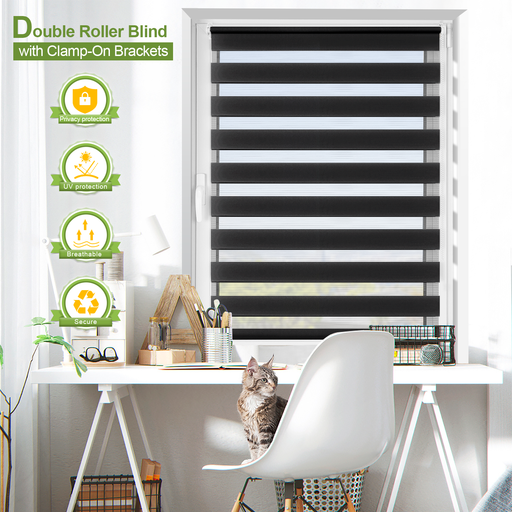
Why it's a good fit: A straightforward and functional solution for living rooms or home offices in rental properties. The dual roller principle allows for flexible control over privacy and brightness without requiring permanent installation.
The clamp brackets are designed for common window frame thicknesses. The dual-layer fabric provides reliable adjustment between privacy and transparency, bypassing the issue of standard fabrics that are not fully opaque.
Infinitely variable light control via alternating woven fabric panels; simple, residue-free installation and removal.
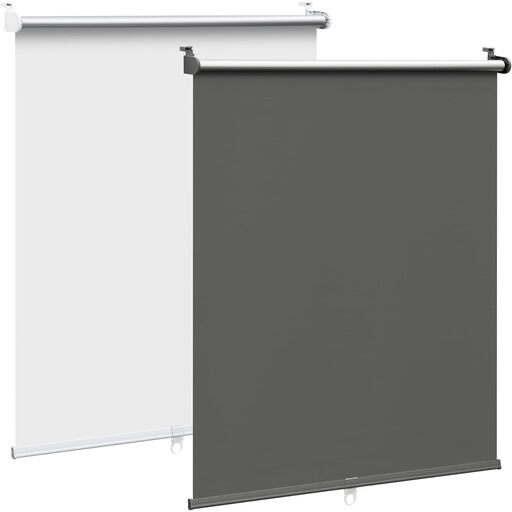
Why it's a good fit: Designed for those who need maximum darkness for restful sleep. Ideal for bedrooms, nurseries, or for shift workers who need to sleep during the day.
The silver coating on the back ensures a high degree of blackout performance, addressing the problem of fabrics that only offer dim-out. The product description explicitly notes the difference between fabric and order width.
Provides 100% blackout and thermal insulation, according to the manufacturer. The blind is certified according to the OEKO-TEX standard.

Why it's a good fit: For users seeking a modern aesthetic and maximum flexibility in light control. Ideal for rooms where privacy is only needed in specific areas of the window, such as in a bathroom or on the ground floor.
As a pleated blind, it bypasses the typical problems of roller blinds. The free-floating positioning offers a superior solution for balancing privacy and daylight. The honeycomb structure also provides enhanced insulation.
Infinitely adjustable from both the top and bottom; the honeycomb structure provides additional thermal and sound insulation.
We have compiled a comprehensive, up-to-date list of products that fully meet these strict selection criteria and UK regulations.
First, measure the width of the glass pane. Add approximately 4 cm to this measurement to get the optimal order width, which will reduce light gaps on the sides. Next, measure the thickness of your window sash to ensure the clamp brackets will fit. Most manufacturers specify a compatible range, e.g., "for frame thicknesses of 13-23 mm".
Yes, but only if it is specifically designed for it. Look for the term "blackout blind" in combination with a light-proof coating on the back (often referred to as a "thermal coating" or "silver coating"). Standard fabrics only provide a dim-out effect. For a near-total blackout, it is also important that the fabric is wider than the glass pane.
When installed correctly on a suitable window frame (usually uPVC/vinyl), high-quality Klemmfix systems generally do not leave any marks. The brackets are often equipped with small protective pads made of plastic or rubber to protect the frame. However, caution is advised with wooden windows or very sensitive surfaces.