
Lieferung heute & morgen

Qualitätsgarantie

Willkommens-Angebote freischalten: KOSTENLOSE Lieferung | Bis zu 80 % RABATT | Kostenlose 30-Tage-JoyPlus-Testphase
App herunterladen
By: Joybuy Product Recommendation OfficerDate: July 28, 2026
A self-adhesive mirror offers a flexible and straightforward way to design and visually enlarge rooms—all without drilling or anchors. But the selection is vast, and not every product lives up to its promise. Before you make a decision, it's crucial to understand the common weaknesses that often only become apparent after the purchase.
This guide highlights the three most common problems with self-adhesive mirrors and explains which technical features you should look for to make an informed choice.
Easy installation is the main advantage, but this is often where flaws that lead to disappointment are hidden. Pay attention to these points to avoid a bad investment.
To avoid the issues mentioned above, you should check three crucial technical aspects before buying. These determine the quality, durability, and functionality of your mirror.
The choice of material is fundamental to the image quality.
A drill-free mirror's success hinges on the quality of its adhesive. Check the manufacturer's specifications carefully: which surfaces is the adhesive suitable for? Smooth, non-porous surfaces like tiles, lacquered wood, or metal provide the best adhesion. For textured wallpaper or porous plaster, a special mounting adhesive is often required.
Important: The surface must be completely clean, dry, and free of grease before application. Clean the area thoroughly and let it dry completely to ensure maximum adhesive strength.
Self-adhesive mirrors come in a wide variety of shapes, allowing for different degrees of design freedom.
Instead of a one-size-fits-all recommendation, we present products tailored to specific needs and projects.
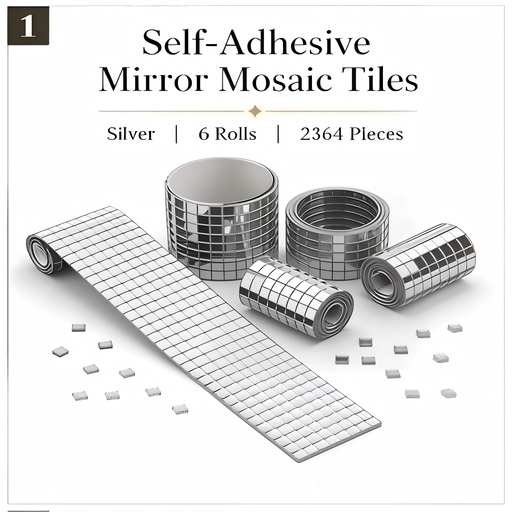
Why This Fits Their Persona: Ideal for hobbyists and DIY enthusiasts who want to create custom designs. The large quantity of small mosaic pieces allows for decorating mirror frames, furniture, or entire wall sections in a mirror mosaic style.
This product is made of real glass, which avoids the problem of distorted reflections common in many acrylic craft mirrors. The reflection is clear and brilliant.
The self-adhesive backing significantly simplifies application. With 2364 individual pieces, the set provides ample material for larger projects.
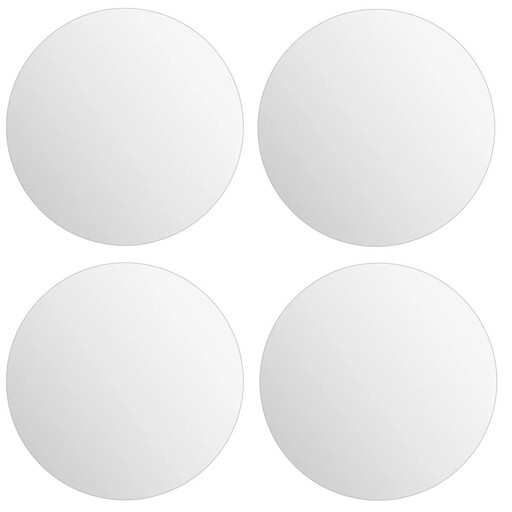
Why This Fits Their Persona: A hassle-free solution for renters seeking stylish, drill-free wall decor. The set of four round mirrors can be flexibly arranged in a hallway, living room, or bedroom to reflect light and enlarge the space.
The mirrors come with specially designed adhesive strips, minimising the risk of insufficient adhesion. As these are real glass mirrors, the reflection is clear and undistorted.
The set is easily expandable and, according to the manufacturer, suitable for all surfaces. The simple installation makes it a quick and effective decorating solution.
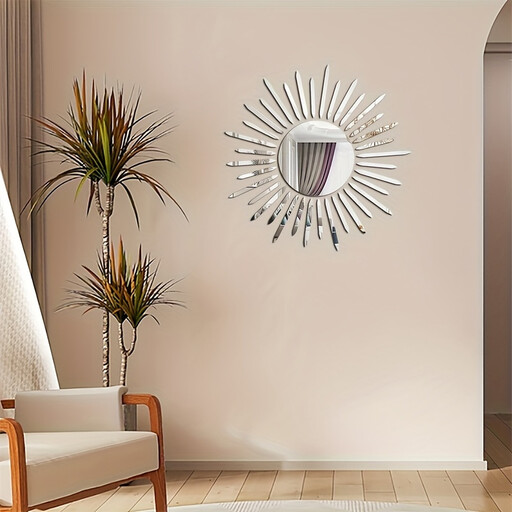
Why This Fits Their Persona: Perfect for anyone wanting to make a strong visual statement with a mirror sticker. The set creates a modern, artistic mural that serves as a central focal point in a room without needing to mount a heavy mirror.
This product is clearly positioned as a decorative mirror sticker. The expectation is set on the design from the outset, not on a perfect, functional reflection, thus sidestepping the "distorted reflection" trap.
The set consists of 37 individual pieces that form a cohesive overall image. The lightweight PVC material adheres reliably to smooth surfaces and is easy to apply.
We have compiled a complete, up-to-date list of products that fully meet these strict selection criteria.
1. On which surfaces does a self-adhesive mirror adhere best? Self-adhesive mirrors adhere best to smooth, clean, and non-porous surfaces. These include tiles, glass, lacquered or veneered wood, metal, and smoothly painted walls. Adhesion may be compromised on rough surfaces like textured wallpaper or coarse plaster. In such cases, using an additional mounting adhesive suitable for the substrate is advisable.
2. How can you remove self-adhesive mirror tiles without damaging the wall? To prevent damage, you should warm up the adhesive before removal. A hairdryer on a low to medium setting is well-suited for this. Heat the edges of the mirror or tile for a few minutes to soften the glue. Then, you can carefully slide a thin string (e.g., dental floss) or a plastic scraper behind the mirror and slowly pry it off the wall. Any remaining adhesive residue can often be removed with rubbing alcohol or a special adhesive remover.
3. Are acrylic mirrors a good alternative to real glass mirrors? That depends on the application. For purely decorative purposes, craft projects, or in environments where shatter resistance is important (e.g., in a child's room or a camper van), acrylic mirrors are an excellent choice. They are lightweight and safe. However, if you need a clear, undistorted reflection for daily use, such as in the bathroom or as a dressing mirror, a real glass mirror is the higher-quality option.