
Lieferung heute & morgen

Qualitätsgarantie

Willkommens-Angebote freischalten: KOSTENLOSE Lieferung | Bis zu 80 % RABATT | Kostenlose 30-Tage-JoyPlus-Testphase
App herunterladen
Self-watering plant pots can make everyday plant care easier. However, not every model is suitable for every plant or location. Offers with big promises deserve particularly close attention to their construction, dimensions and care instructions. A water reservoir cannot replace the right soil or checking the moisture level.
For households with herbs, succulents and houseplants, three common purchasing misconceptions are particularly relevant:
With plant pots featuring a water reservoir, it should be clear how the plant receives water. Depending on the model, this is handled by a wick, a perforated insert or an integrated intake system. Before filling the pot, check that no soil can enter the water channel.
A plant pot with saucer offers additional protection for windowsills, shelves or balconies. The saucer should sit securely and provide enough room for excess water. Even so, water should not be left standing permanently in the reservoir if the plant in question prefers drier conditions.
A consistent supply of moisture is often practical for herbs. Succulents, on the other hand, generally need longer dry periods. Users should therefore adjust the water supply to the plant species, season, room temperature and location.
A diameter of 16.5 cm is generally suitable for small to medium-sized potted plants. Other important factors include:
When repotting, the new pot should not be disproportionately large. Excessively wet soil can cause problems for sensitive roots. However, a larger volume may be beneficial for herbs with vigorous growth.
Beige plastic plant pots are usually lighter than ceramic pots and can be moved easily. A matt surface can make scratches and light dirt less noticeable, but it does not replace regular cleaning. For outdoor use, buyers should look for a stable design, as wind and rain place additional strain on the pot.
For windowsills, kitchens or living areas, subtle colours and matching saucers are useful when several plants are intended to create a coordinated look. With indoor and outdoor plant pots, you should also check whether the manufacturer explicitly specifies the intended area of use.
The following products serve different purposes. Not every model is a self-watering plant pot. This distinction is particularly useful for ensuring that a decorative item is not accidentally purchased as a functional plant pot.
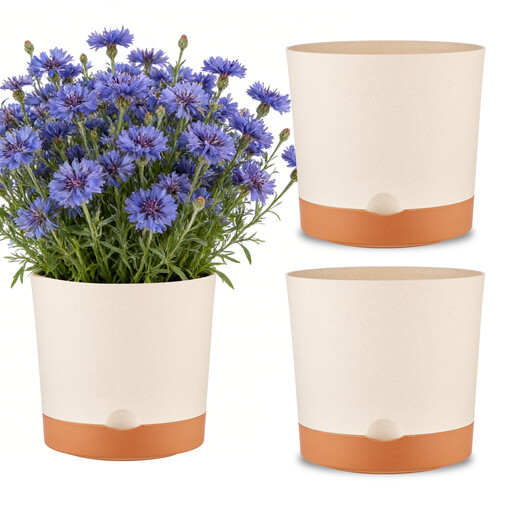
Why this product fits the profile: The three-piece set contains three pots with matching saucers, each measuring 16.5 cm in diameter, making them suitable for small to medium-sized plants, herbs or succulents.
The product description explicitly mentions the water reservoir and saucers. Before planting, the water channel should be kept free from soil and roots.
Three coordinated plastic pots with a matt beige finish, integrated water reservoirs and matching saucers.
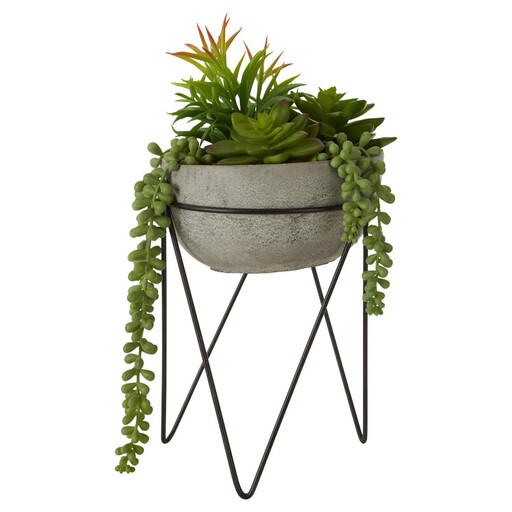
Why this product fits the profile: The combination of a grey ceramic pot, artificial succulents and a black metal stand is designed for decorative display.
The product details specify artificial succulents. Buyers should therefore not expect a water reservoir or the care requirements of living plants.
Ceramic pot, attached metal stand and a stated total height of approximately 36 cm; care simply involves wiping clean.
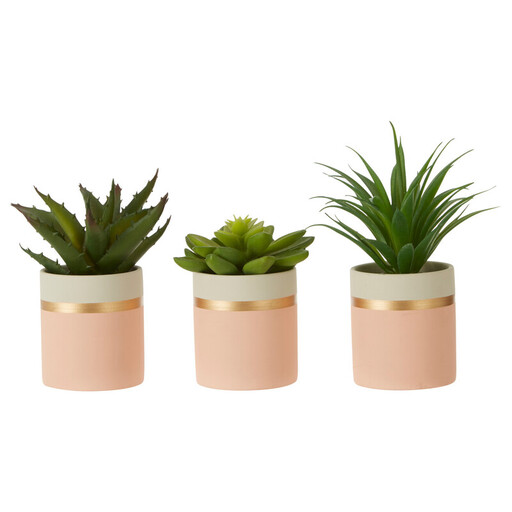
Why this product fits the profile: The set of three small decorative pots is ideal for compact arrangements on shelves, chests of drawers or a sheltered windowsill.
The description specifies artificial plants and does not mention a watering function. The item is therefore clearly intended as low-maintenance decoration.
Three arranged artificial succulents, compact individual dimensions of approximately 10 cm and easy cleaning with a damp cloth.
We have put together a complete, regularly updated list of products that fully meet these strict selection criteria and the safety regulations applicable in the EU.
Before using a self-watering plant pot for the first time, you should read the product description and care instructions. In practice, the following steps can help:
A water reservoir can reduce how often you need to water, but it cannot replace watering altogether. If you are going to be away for an extended period, ask someone you trust to check the condition of the plant, soil and reservoir.
They feature a separate reservoir from which the soil receives moisture through an intake device or wick. The precise function depends on the model. Before buying, make sure the design and cleaning process for the water channel are clearly explained.
They can be, provided the water supply is controlled and the growing medium does not retain excess moisture permanently. Succulents should be allowed to dry out sufficiently between waterings. A constantly full reservoir is not necessarily suitable for these plants.
They do not usually incur any additional energy costs, as they do not require a power connection. Ongoing expenses may include water, soil, plant inserts or replacement parts. When choosing a model, it is therefore important to look for easily accessible, washable components and a pot size that suits the plant.