
Lieferung heute & morgen

Qualitätsgarantie

Willkommens-Angebote freischalten: KOSTENLOSE Lieferung | Bis zu 80 % RABATT | Kostenlose 30-Tage-JoyPlus-Testphase
App herunterladen
A good socket set, also known as a ratchet set, is the foundation for countless projects in the workshop, garage, and home. But the market can be confusing. Anyone looking to buy a new set is faced with a flood of options that often overpromise and underdeliver. As your Joybuy Product Recommendation Officer, I'll help you identify the crucial features and avoid the typical buying traps.
Many buyers focus on superficial features and only realise their new tool is unsuitable when they try to use it. Pay close attention to these three points to avoid a bad investment:
To find the right socket set for your needs, you should focus on three core technical parameters. These determine the durability and practical usability of your tool.
The drive size, specified in inches, defines the size of the square drive that connects the ratchet to the socket. Each size is designed for different torque levels and applications.
Comprehensive sets often include ratchets and sockets in all three sizes to ensure maximum flexibility.
When checking the material specifications, look for the Chrome Vanadium Steel (Cr-V) designation. This steel alloy offers high strength, toughness, and good protection against corrosion. Tools made from Cr-V steel are significantly more durable and resistant to deformation than those made from simple carbon steel. A clean chrome plating or a matte finish provides additional protection against rust and makes cleaning easier.
The number of teeth inside the ratchet head is a crucial quality indicator.
Based on these objective criteria, we have selected a few products from our range that are suitable for different user groups.
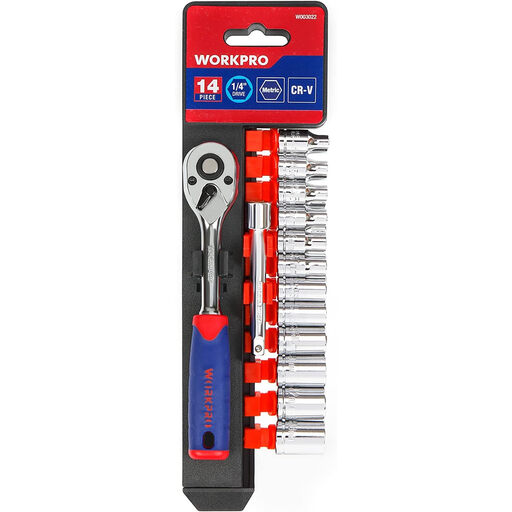
Why This Fits Their Persona: This compact 1/4-inch set is ideal for occasional household repairs and bicycle maintenance. It includes the most common metric sizes and is easy to store thanks to its small footprint.
The set focuses on essential parts without unnecessary filler. It is made of Cr-V steel and features a 72-tooth ratchet, thus avoiding the pitfalls of poor materials and mechanics.
Compact format with the most important metric sockets (4-13 mm). Includes an extension for hard-to-reach places.
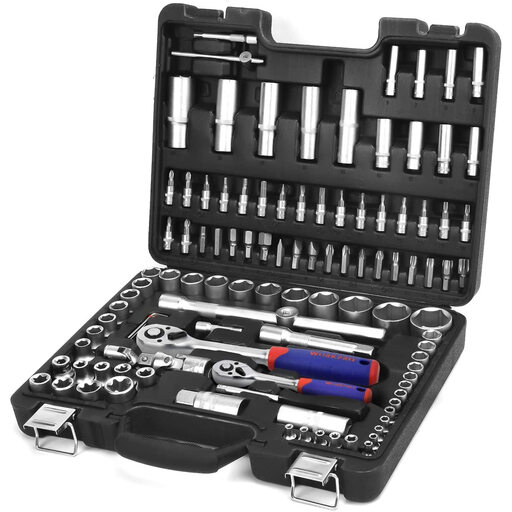
Why This Fits Their Persona: This case is a comprehensive DIY tool kit for anyone who regularly works on cars, motorcycles, or larger projects. The combination of 1/4" and 1/2" drives covers a wide spectrum of torque requirements.
Instead of useless filler parts, this socket set offers a practical selection of sockets, extensions, and specialty parts (e.g., spark plug sockets, E-Torx). The Cr-V steel construction and 72-tooth ratchets ensure quality.
Two drive sizes (1/4" & 1/2") in one case. Comprehensive accessories for automotive work. Robust carrying case for organisation and mobility.
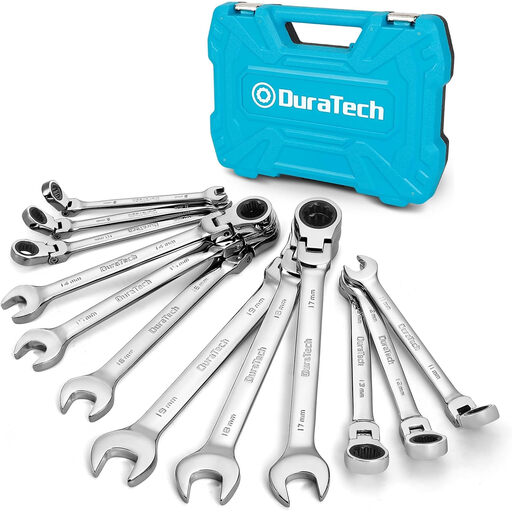
Why This Fits Their Persona: For mechanics and technicians who regularly work in hard-to-reach places. The 180° pivoting head allows the wrench to engage a bolt from almost any angle where a rigid ratchet would fail.
This set is the direct solution to the impractical ratchet mechanism trap. The flex-head and 72-tooth drive are specifically designed for maximum accessibility. The Cr-V steel construction ensures durability.
180° pivoting flex-head for extreme flexibility. 12-point box end profile for a secure grip on bolts. Complete set of common sizes from 8-19 mm.
We have compiled a complete, up-to-date list of products that fully meet these strict selection criteria and all relevant safety standards.
For comprehensive work on a car, a set that covers at least 1/4-inch and 1/2-inch drive sizes is ideal. The 1/2-inch drive is needed for high-torque connections like lug nuts or suspension components. The 1/4-inch drive is suitable for smaller bolts in the engine bay and interior. Ensure that in addition to standard hex sockets, the set also includes spark plug sockets and possibly Torx and E-Torx sockets, as these are common in modern vehicles.
The "72 teeth" specification refers to the fineness of the gearing inside the ratchet head. To complete a full 360-degree rotation, the mechanism engages 72 times. This results in a minimal working arc of just 5 degrees (360° / 72 = 5°). This is particularly advantageous in tight environments where the handle can only be moved slightly. Ratchets with fewer teeth, e.g., 48, require a larger angle (7.5°) and are therefore less flexible.
Proper maintenance is straightforward and ensures the longevity of your tools. Always keep the tools dry to prevent rust. After use, clean sockets and ratchets of oil and dirt with a dry cloth. The ratchet mechanism benefits from an occasional drop of fine mechanical oil to keep it running smoothly. Storing the tools in the supplied case protects them from moisture and loss.