
Lieferung heute & morgen

Qualitätsgarantie

Willkommens-Angebote freischalten: KOSTENLOSE Lieferung | Bis zu 80 % RABATT | Kostenlose 30-Tage-JoyPlus-Testphase
App herunterladen
A good socket set is the cornerstone of every workshop and garage. However, the selection is vast, and differences in quality are often only apparent on second glance. Many DIY enthusiasts and even aspiring pros invest in comprehensive sets, only to find the tools become unusable after a short time. Before you make a decision, it's crucial to understand the typical pitfalls that lead to a bad purchase.
This guide shows you what really matters and helps you find a socket and ratchet set that reliably gets the job done, without you paying for superfluous marketing promises.
It's tempting to grab a set with an impressive number of pieces. But this is precisely where the biggest disappointments lie. Pay attention to these three points to avoid a poor investment:
To identify a durable and versatile socket set, focus on three core technical features. These define the performance and longevity of your tools.
The most important quality indicator is the material used. Look for the Chrome Vanadium (Cr-V) designation. This alloyed steel offers high strength and toughness, making it resistant to deformation and breakage.
Tools made from simple carbon steel are not suitable for demanding fastening jobs, especially on vehicles.
The drive size, specified in inches, determines the maximum torque that can be transferred and the size of the corresponding sockets. A versatile set should cover at least two of these sizes.
The number of teeth in the ratchet mechanism determines the "swing arc"—how far you need to move the handle back to get to the next "click." A ratchet with 72 teeth has a swing arc of just 5 degrees. This is critical when working in tight and hard-to-reach spaces, as is common in an engine bay. Ratchets with fewer teeth (e.g., 48) require more room to operate and are therefore less flexible.
Based on these quality criteria, we have selected a few products from our range that offer a suitable solution for different user profiles.
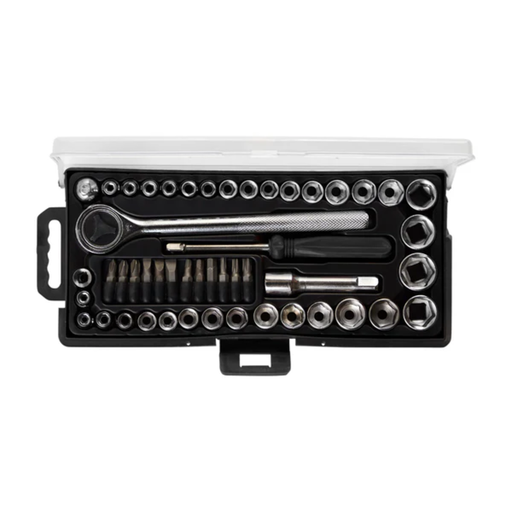
Why this set is a match: Ideal for those who need a solid basic kit for occasional repairs around the house or on a bike without investing a large budget.
This set avoids the pitfall of a limited drive size by including both a 1/4-inch handle and a 3/8-inch ratchet. This makes it significantly more versatile than pure 1/4-inch sets.
A compact starter kit with metric and SAE sockets. The case ensures everything stays organised and easy to transport.
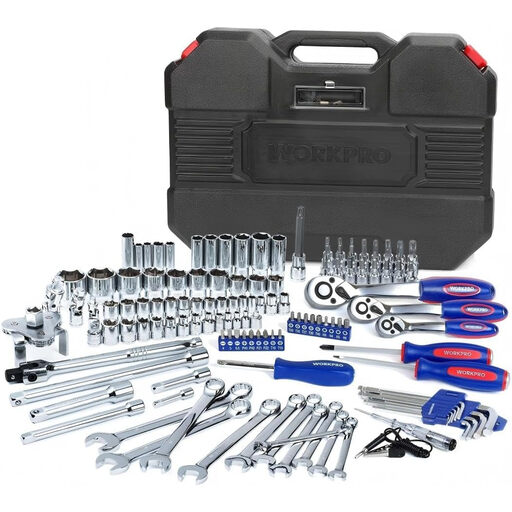
Why this set is a match: Perfect for regular use on your car and around the house. It offers a comprehensive toolkit for almost any fastening job and is built for durability.
This set is made of Chrome Vanadium steel and covers all three relevant drive sizes with 1/4", 3/8", and 1/2". It avoids the pitfalls of inferior material and a lack of versatility.
A true complete tool kit with ratchets, sockets, screwdrivers, and wrenches. The robust case ensures long-term, organised storage.
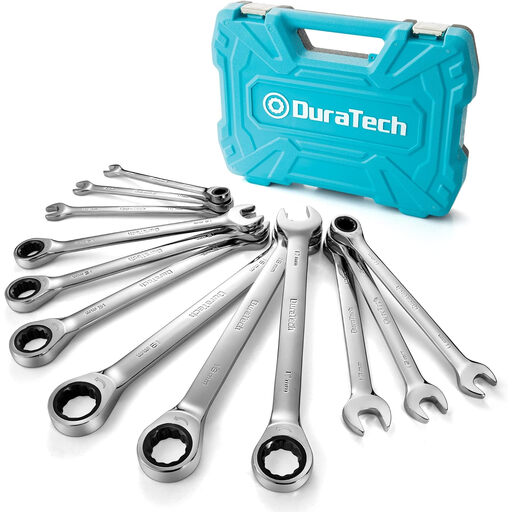
Why this set is a match: For mechanics and DIYers who regularly work in hard-to-reach places where a standard ratchet can't go. A perfect supplement to an existing socket set.
This specialty tool solves a problem that standard sets often ignore: poor accessibility. The flex-head and fine-tooth mechanism are designed for maximum efficiency in confined spaces.
The 180-degree pivoting flex-head and 72-tooth mechanism (5° swing arc) allow you to work in spots that would otherwise be unreachable. Made from Cr-V steel.
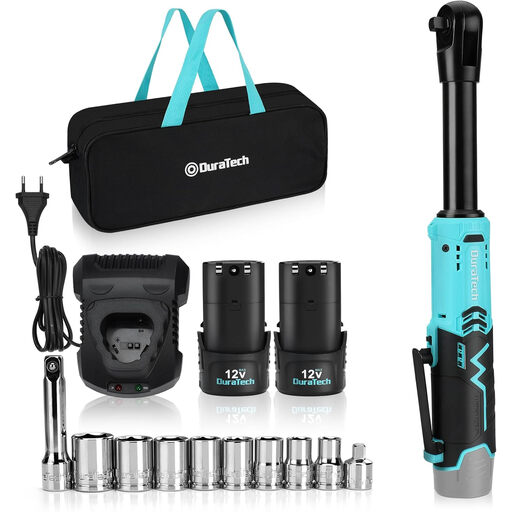
Why this set is a match: For professional users or ambitious DIYers who want to save time and effort on repetitive fastening tasks. Ideal for serial assembly or extensive disassembly jobs.
This tool bypasses the limitations of manual ratchets entirely. Instead of relying on a fine-tooth gear, it uses a motor to do the turning, massively speeding up the work and preventing fatigue.
Powerful 12V motor with 60 Nm of torque, two 2.0 Ah batteries for uninterrupted work, and an integrated LED light for dark work areas.
We've compiled a full list of products that meet these strict selection criteria.
Chrome Vanadium (Cr-V) is the proven standard for hand tools like ratchets and sockets. It offers an excellent balance of hardness and toughness for manual use. Chrome Molybdenum (Cr-Mo) is even more impact-resistant and is typically used for impact sockets, which must withstand the extreme forces of an electric or pneumatic impact wrench. For a manual socket set, Cr-V is the right and perfectly sufficient choice.
The sheer number of pieces is secondary. What's more important is a sensible composition. A good automotive tool set should include the 1/2-inch (for wheel nuts, suspension) and 1/4-inch (for interior, engine covers) drive sizes. A set with 80 to 150 pieces that contains the common metric socket sizes (e.g., 8 mm to 24 mm) without unnecessary filler parts is an excellent foundation for most users.
Yes, this is possible with a suitable adapter. Many more comprehensive sets include adapters to make the different drive sizes compatible with each other. However, be mindful of the load limits: using a large socket (e.g., 1/2-inch) on a small ratchet (e.g., 3/8-inch) to loosen a stuck bolt with high torque can overload and damage the smaller ratchet. Adapters are primarily intended for flexibility with moderate force application.